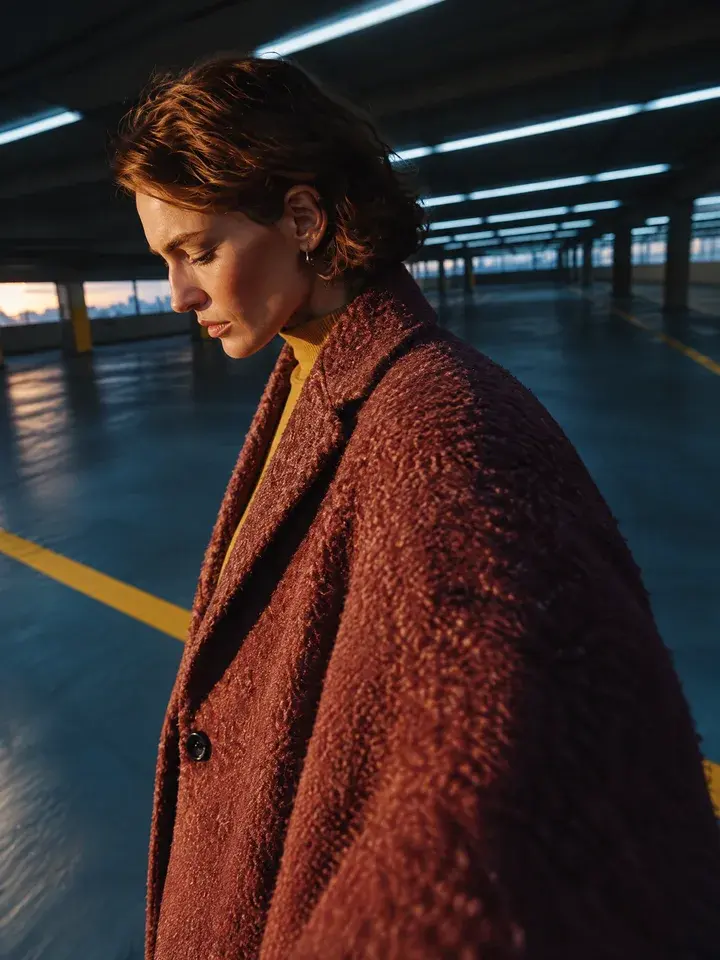
Edit the uploaded image itself rather than generating a new scene. Use it as the sole source for the person, pose, framing, clothing and environment. Preserve the exact number of people, recognizable facial identity, age, skin tone, hairstyle, body type, clothing, footwear, accessories, colors, prints, logos and fabric textures. Keep the original pose, gesture and amount of body shown: a portrait remains a portrait, waist-up remains waist-up, three-quarter remains three-quarter and full-body remains full-body. Change only the spatial projection and viewpoint. Analyze the complete visible silhouette and select an individual off-axis viewing direction based on its existing shoulder-to-torso line, body rotation and garment volume. Position the virtual viewpoint extremely close to a broad connected region of the visible figure, such as the shoulder with upper torso, side of the coat or torso with hip, and direct the entire silhouette diagonally through depth. Create one continuous perspective gradient across the whole visible person, with the broad nearest zone appearing approximately three times larger than the farthest zone and every intermediate area reducing gradually in scale. Keep the face, hands, knees and footwear proportional to their neighboring anatomy. Apply powerful near-field ultra-wide perspective to both the person and the existing environment through expanded foreground volume, rapid scale reduction, strong foreshortening, stretched edge space and converging background lines. Keep every originally visible body part inside the image with 8–12% surrounding space. Retain the same recognizable background elements, location, lighting, colors, weather and atmosphere, altering only their spatial perspective. Present the result as a standard rectangular edge-to-edge photograph with continuous environment reaching all four corners, coherent anatomy, preserved identity and detailed photorealism.