


Утрамбовка
Логотип, буква или силуэт собирается из множества копий выбранного объекта. Персонажи, цветы и предметы становятся объёмной скульптурой, сохраняя узнаваемые детали. Первое изображение задаёт форму, второе и последующие — то, из чего она будет собрана. Промпты управляют плотностью укладки, масштабом элементов, светом и фоном.


15 промптов
48 примеров
Nano Banana Pro / 2.1
Утрамбовка
Логотип, буква или силуэт собирается из множества копий выбранного объекта. Персонажи, цветы и предметы становятся объёмной скульптурой, сохраняя узнаваемые детали. Первое изображение задаёт форму, второе и последующие — то, из чего она будет собрана. Промпты управляют плотностью укладки, масштабом элементов, светом и фоном.
15 промптов
48 примеров
Nano Banana Pro / 2.1
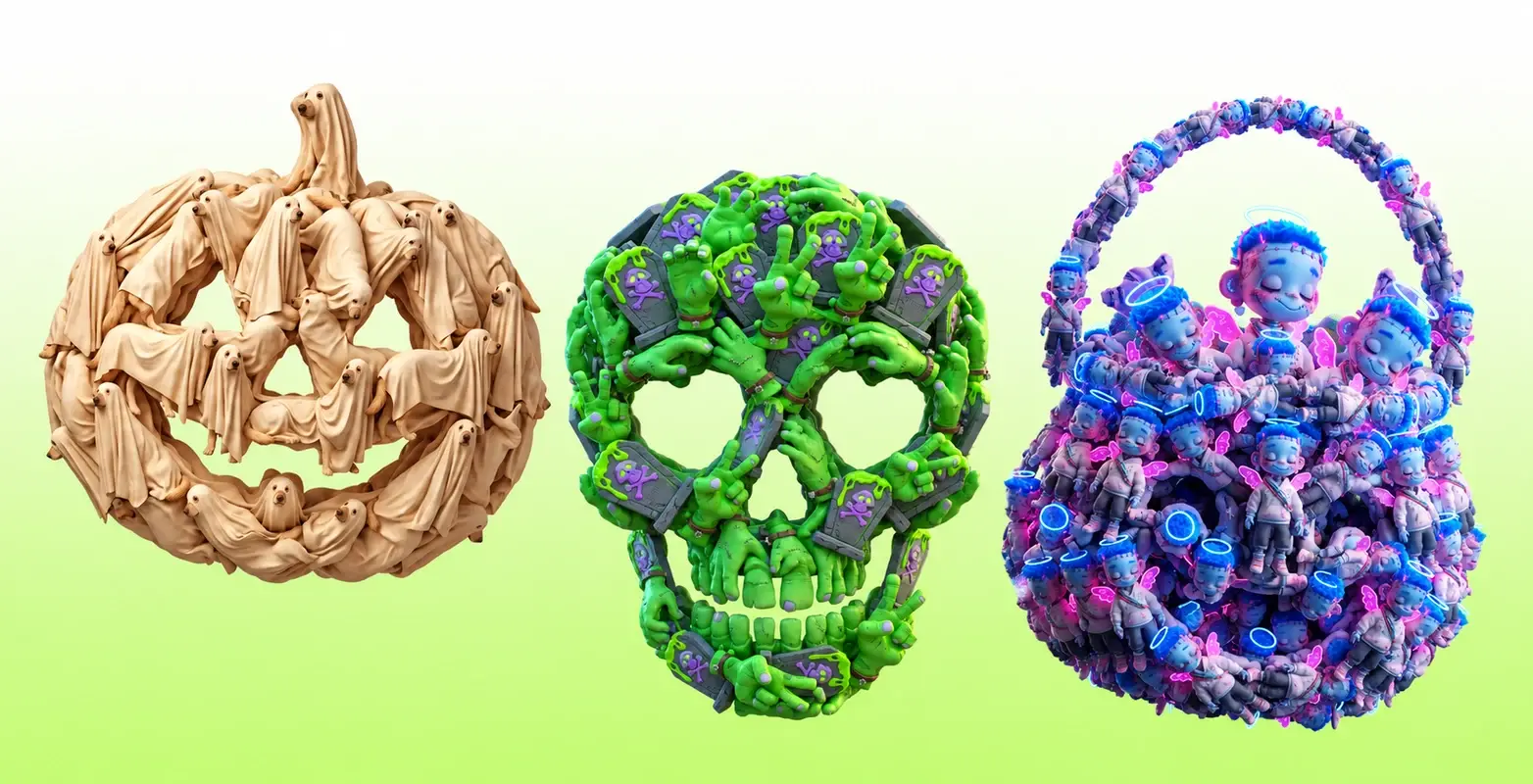
Halloween
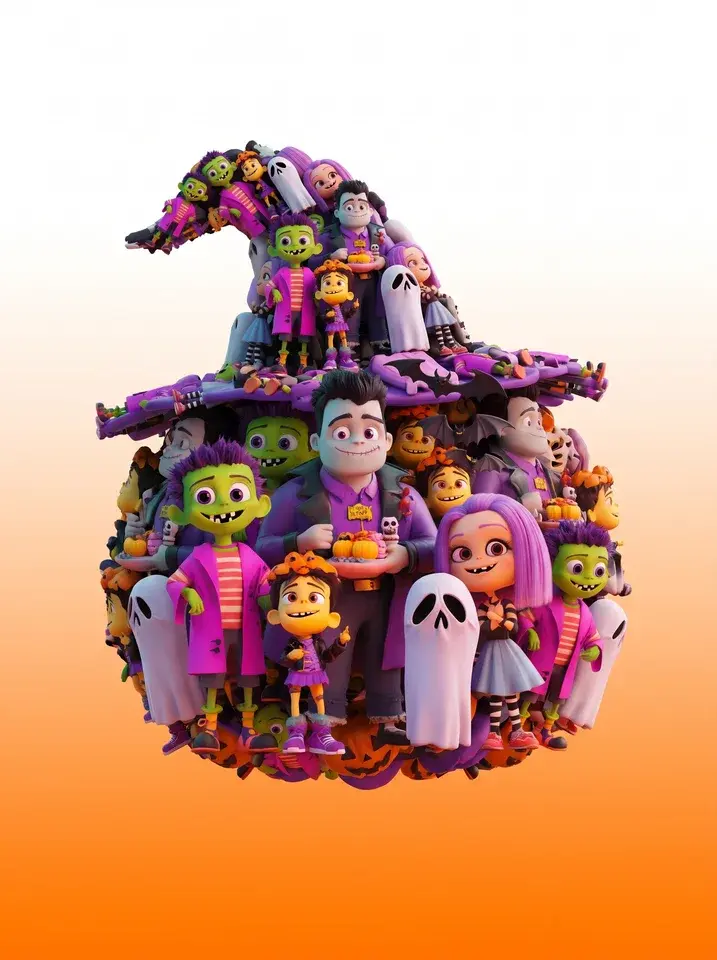
Тыквы, привидения, черепа, шляпы и конфеты, собранные из множества маленьких персонажей и объектов.
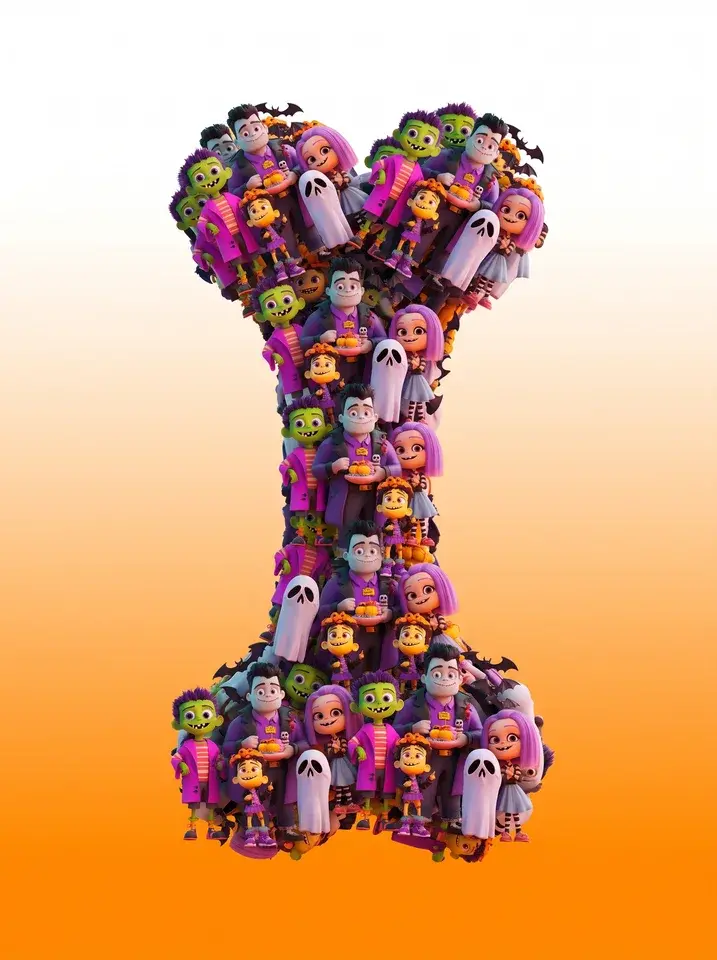
Nano Banana Pro

Copy

Create a premium photorealistic three-dimensional sculpture whose exact overall silhouette is taken from the first uploaded image and whose entire physical structure consists exclusively of complete replicas of the subjects shown in the second and subsequent reference images. Follow a strict two-stage construction process. First, reconstruct each referenced subject as one complete, anatomically and structurally coherent three-dimensional asset before assembling the final composition. When a reference shows only a portrait, face, head, bust, or cropped upper body, extrapolate the unseen anatomy to create a complete head-to-toe person with a naturally proportioned torso, shoulders, arms, hands, waist, hips, legs, and feet. Continue the visible clothing into a coherent complete outfit, including appropriate trousers, lower garments, and footwear matching the original styling, colors, and materials. Preserve the exact recognizable facial features, hairstyle, accessories, visible garments, and distinctive appearance of the reference. For animals and nonhuman subjects, reconstruct the complete recognizable object with its natural full structure and defining features. The resulting complete subject becomes the single indivisible building unit used throughout the sculpture. Every repeated instance must display a coherent full physical body or complete object, with a recognizable head-to-body relationship, intact proportions, and clearly articulated structural features. Only after establishing these complete assets, recreate the first image as a dense assembly of numerous replicas. Treat the first reference purely as the geometric definition of the final silhouette, including its exact outer contours, proportions, orientation, typography, internal openings, and negative spaces. Replace every solid region of that silhouette with tightly arranged complete referenced subjects, filling the entire visible area and three-dimensional thickness through carefully organized physical placement. The original graphic material disappears entirely. Arrange the replicas in an intricate, compact, three-dimensional composition using proportional scaling, varied rotations, naturally interlocking orientations, and controlled overlapping. Maintain a consistent relationship between subject size and silhouette thickness so each repeated figure remains clearly recognizable as a complete individual rather than an isolated face or unidentifiable fragment. Place subjects at varying depths while ensuring visible torso and lower-body structure across the composition. Preserve natural anatomical proportions, individual object boundaries, distinctive textures, and essential features. Smaller complete figures may occupy narrow details, while moderately sized complete figures form the
primary sculptural structure. The assembled objects themselves create the entire outer contour and all visible surfaces of the target shape, with accurately preserved internal openings remaining completely empty and revealing the background through the sculpture. The final image must read simultaneously as the precise original shape and as a dense construction of fully formed individual subjects. Present the complete sculpture levitating weightlessly in empty space, predominantly front-facing with subtle three-dimensional thickness, elegant framing, and generous negative space. The sculpture must appear fully suspended in the air with no floor, no ground plane, no surface, no pedestal, no platform, no support, and no environmental base of any kind. Render every subject with exceptional photorealistic geometry, faithful facial detail, realistic anatomy, intricate fabric and material textures, beautiful surface definition, and crisp edges. Use refined studio lighting with a broad directional key light and balanced fill illumination to reveal both the complete bodies and the dimensional depth of the assembly. Allow subtle contact shadows, inter-object cast shadows, and ambient occlusion only within the sculpture itself, where one replicated subject naturally shades another subject behind or beside it. Do not cast any shadow beneath the sculpture. Do not create a floor shadow, ground shadow, drop shadow, projected shadow, reflection shadow, or any diffuse darkening below the object. The background must remain perfectly clean and unaffected by the sculpture, with no shadow contamination, no grounding cue, and no indication of a surface below. Place the sculpture against a perfectly clean, seamless vertical digital gradient transitioning uniformly from pure white (#FFFFFF) at the top to the brightest vivid saturated color found on the main subject in the second uploaded reference at the bottom. Preserve the selected hue's brightness and saturation through a perfectly even, continuous linear color transition. The background remains a pristine, uninterrupted digital color field with no additional colors, darkening, radial lighting, atmospheric effects, texture, grain, vignetting, halos, floor, horizon, reflections, or projected shadows. The sculpture floats freely in pure open space. Exceptional high-end CGI, precise silhouette construction, faithful reference reproduction, complete full-body subject replication, natural anatomy, sophisticated dimensional arrangement, immaculate material quality, clean seamless gradient, and refined contemporary art direction.
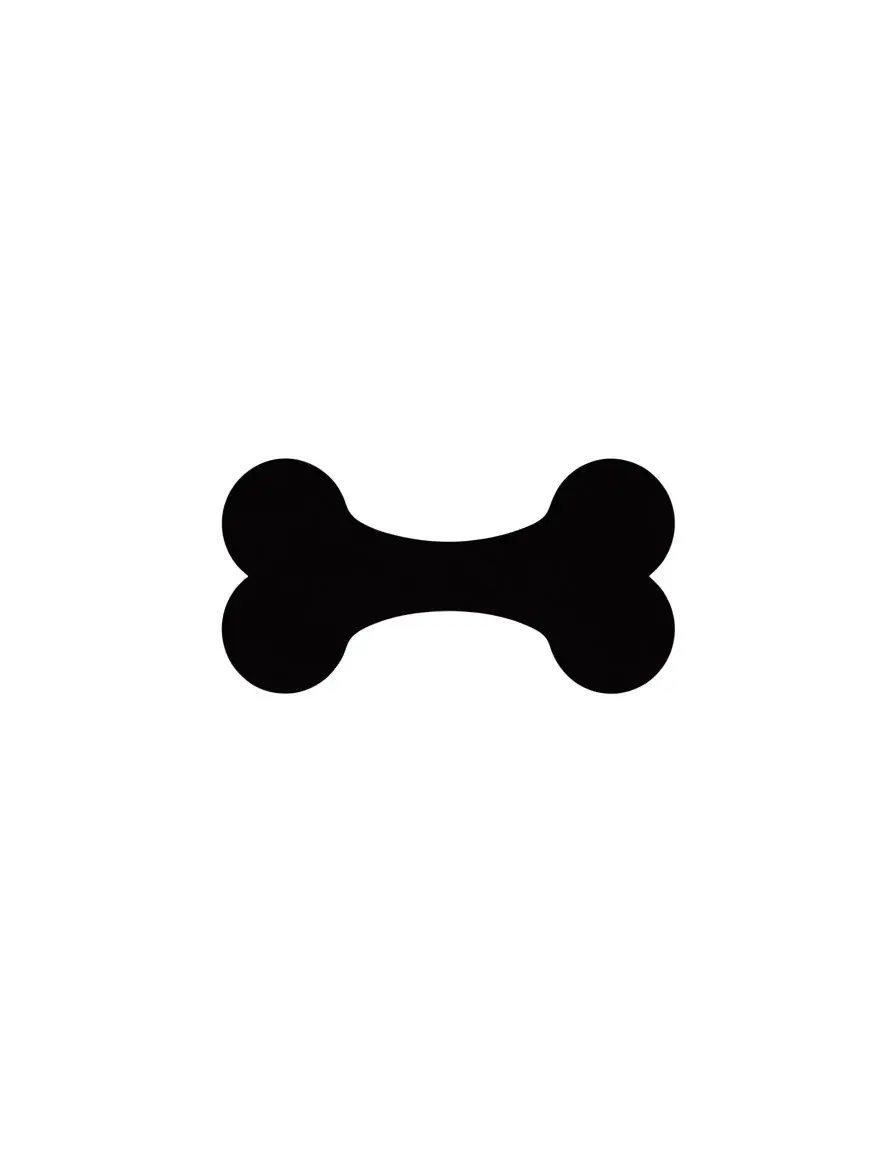
Референс 1

Референс 2

Nano Banana Pro
Copy
Create a premium high-end three-dimensional assemblage in which the exact overall shape from IMAGE 1 is formed entirely and exclusively by numerous separate, complete, faithfully reproduced copies of the subjects shown in IMAGE 2 and all subsequent object references. Treat IMAGE 1 only as a geometric blueprint for the final outer silhouette, proportions, curves, orientation, thickness, internal openings, and overall spatial attitude. IMAGE 1 must never appear as a visible material, wrapper, shell, core, filler, smooth surface, backing, membrane, skin, support, or structural base. The finished composition must contain only two things: the repeated subjects from IMAGE 2 and the clean background. No other visible material category is allowed. If all repeated subjects were removed, nothing of the shape from IMAGE 1 would remain. The entire shape must be physically built from the referenced subjects themselves, not decorated with them and not covered by them. Every solid region of the target form, including the center, outer contour, narrow tips, side edges, and full visible depth, must consist exclusively of the repeated subjects. Do not place the objects merely on the surface of a preexisting form. Do not embed them into a smooth body. Do not wrap them around a solid core. Do not create any visible candy body, wrapper, ribbon, skin, metallic foil, shell, smooth connecting layer, or continuous mass derived from IMAGE 1. The recognizable form from IMAGE 1 must emerge only from the collective arrangement, density, and outer boundaries of the repeated subjects. All visible surfaces belong to the repeated subjects themselves. Preserve each subject from IMAGE 2 and any additional references with maximum fidelity. Maintain exact recognizable identity, anatomy, proportions, colors, materials, textures, clothing, accessories, and defining structural features. If a subject is partially visible, reconstruct it into one complete coherent full object or full-body figure while naturally continuing the same original styling, outfit logic, and material language. Every repeated instance must remain a distinct, structurally intact, fully recognizable replica of that same subject. Do not invent new materials, stretched connecting shapes, abstract filler forms, melted masses, or simplified surrogate geometry. Arrange the repeated subjects as separate independent elements with correct anatomy or object geometry, complete limbs where applicable, intact clothing, and clear boundaries. Use varied but controlled natural poses, rotations, and orientations to make the assembly visually rich and more interesting to inspect up close, while preserving full recognizability and structural integrity. Allow subjects to stand, sit, lean, recline, bend, crouch, or gently twist only within
natural believable limits. Do not deform them to fit the silhouette. Do not fuse them together. Do not merge bodies, share limbs, duplicate heads, stretch torsos, create hybrid anatomy, or allow one subject to dissolve into another. Maintain clear independent silhouettes and clean separation between neighboring objects. Build a dense but readable composition with multiple spatial layers and controlled overlaps. Use mostly medium-sized high-fidelity replicas and smaller complete replicas only where necessary for narrow contours, pointed ends, or intricate sections. Preserve strong subject readability, clear material definition, and crisp individual silhouettes throughout the composition. Maintain consistent object density across both central areas and outer boundaries, ensuring that the whole target form is genuinely constructed from the subjects rather than simply outlined by them. Preserve all true internal openings and negative spaces from IMAGE 1 as fully empty open gaps with the background visible directly through them. Present the complete assemblage as a weightless levitating object in empty space. Use a refined three-quarter frontal camera angle with a subtle yet elegant spatial turn, preserving the legibility of the original silhouette while revealing convincing thickness, front-to-back layering, and dynamic levitation. Retain and reinforce the original tilt or dynamic attitude of IMAGE 1 where relevant. The sculpture should feel suspended, balanced, and alive in space rather than frontally pasted onto the background. Use sophisticated studio lighting to create dimensional depth inside the assemblage. Apply a directional key light from above and to one side, with balanced fill illumination, so that foreground subjects cast realistic shadows only onto neighboring and recessed subjects inside the assemblage. Allow contact shadows, inter-object cast shadows, and ambient occlusion only where the repeated subjects physically overlap or sit close together. Keep all shadows confined to the assemblage itself. Absolutely no shadow, reflection, dark patch, grounding cue, contact patch, ambient darkening, occlusion halo, or projected shape is allowed beneath the sculpture or anywhere on the background. There is no floor, no ground plane, no invisible surface, no pedestal, no support, and no surface receiving light or shadow. The background must remain completely untouched by the object. Render the image with exceptional high-end CGI quality, sharp geometry, crisp edges, accurate materials, fine textures, clean subject separation, and excellent readability. Avoid plastic-looking oversimplification, blur, mushy detail, artificial smoothing, or low-detail repetition. Place the levitating assemblage against a perfectly smooth, seamless vertical digital
gradient transitioning from pure white (#FFFFFF) at the top to the single dominant bright saturated color of the primary subject in IMAGE 2 at the bottom. Use exactly two color endpoints and one clean continuous linear transition. The gradient must remain uniform, textureless, and perfectly clean across the entire frame, with no additional colors, no dirty mixing, no vignette, no atmosphere, no haze, no radial glow, no uneven patches, no horizon cue, and no localized darkening beneath the object. The lower part of the frame must remain the same clean gradient field, not a floor-like area. The final result should read immediately as the exact shape from IMAGE 1 and, on closer inspection, as a fully volumetric levitating construction made entirely from distinct, complete, faithful replicas of the subjects from IMAGE 2.

Референс 1

Референс 2
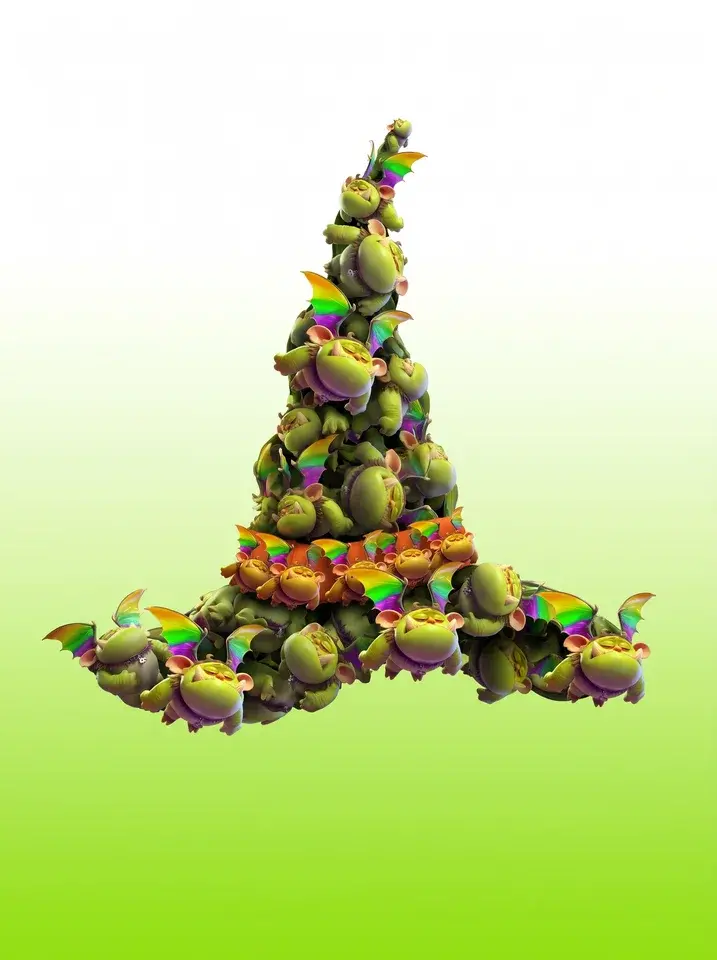
Nano Banana Pro
Copy
Create a premium photorealistic three-dimensional assemblage whose exact overall silhouette matches IMAGE 1, constructed exclusively from numerous separate, complete, faithfully reproduced copies of the subjects in IMAGE 2 and all subsequent references. IMAGE 1 defines only the precise geometry, proportions, curves, typography, spacing, stroke thickness, and internal openings. The shape emerges entirely from the physical arrangement of these objects, which form every solid region across its full width, height, and depth. The original graphic is completely absent as a physical surface, backing, shell, or filler. Every visible part of the sculpture consists exclusively of the referenced subjects. Preserve each subject's recognizable identity, anatomy, proportions, clothing, accessories, original colors, intricate textures, and material properties with maximum fidelity. For partially visible subjects, reconstruct complete coherent objects or full-body characters, naturally continuing their original outfit and styling. Every repeated instance remains a distinct, structurally intact object with correct geometry and anatomy, including complete limbs and footwear where applicable. Create a sophisticated arrangement of varied natural poses, rotations, and controlled proportional scales, allowing subjects to stand, sit, lean, recline, bend, or curl while preserving their anatomy, clothing, and individual recognizable features. Arrange them closely in multiple spatial layers with carefully controlled overlaps and convincing physical contact, maintaining separate bodies, correct limb connections, and realistic object boundaries. Achieve dense packing through intelligent positioning rather than deformation, fusion, or compression. Use smaller complete replicas where necessary for narrow contours, while keeping most subjects sufficiently large for clear individual readability. Preserve the exact outer silhouette and all internal openings of IMAGE 1, with genuine empty spaces revealing the background directly through the construction. Maintain consistent object density throughout the central regions and exterior edges, ensuring the entire shape is physically constructed from the referenced objects rather than merely outlined or decorated. Give the sculpture pronounced dimensional depth through sophisticated directional studio lighting and physically accurate inter-object shadow casting. Use a strong, broad directional key light positioned above and to one side, producing beautifully defined highlights on the foreground objects and distinct cast shadows falling naturally across the surfaces of neighboring objects positioned behind them. Every foreground element should cast spatially consistent shadows onto the underlying and recessed elements according to their
actual relative positions. Create rich contact shadows at points of physical interaction, deeper ambient occlusion inside tightly packed areas, and visible light-to-shadow transitions that reveal the layered arrangement. Maintain realistic shadow softness appropriate to the light source, with defined shadow edges near contact points and progressively softer shadows across more distant surfaces. Preserve readable textures, accurate colors, and recognizable details within the shadowed areas through controlled complementary fill illumination. Establish a clear hierarchy of illuminated foreground subjects, partially shadowed middle layers, and deeper recessed objects, creating dimensional separation without turning the interior into an indistinguishable dark mass. Allow the combined highlights, cast shadows, and subtle occlusion to emphasize the recognizable geometry of the overall silhouette. Preserve high-quality skin, fabric, hair, and material textures, natural roughness, fine details, sharp individual geometry, and realistic surface response. The result should resemble an expertly lit physical installation photographed in a professional studio, with exceptional material fidelity rather than a plastic or artificial appearance. Present the complete sculpture levitating freely in empty space, predominantly front-facing with subtle visible thickness, fully centered and surrounded by generous negative space. Place it against a perfectly smooth, seamless vertical digital gradient transitioning from pure white (#FFFFFF) at the top to the brightest dominant saturated color belonging to the main subject in IMAGE 2 at the bottom. Use a single uniform linear transition with clean, consistent color distribution, free of texture, uneven patches, atmospheric effects, halos, vignetting, and additional colors. Keep the background independent of the sculpture's lighting. All cast shadows occur exclusively between objects within the sculpture, never on the background or an imaginary floor. The sculpture floats without any visible support, pedestal, ground plane, horizon, or projected shadow. Exceptional high-end photorealistic CGI, exact silhouette reconstruction, separate anatomically correct objects, faithful reference materials, expressive natural posing, pronounced inter-object shadows, refined volumetric depth, and sophisticated contemporary art direction.
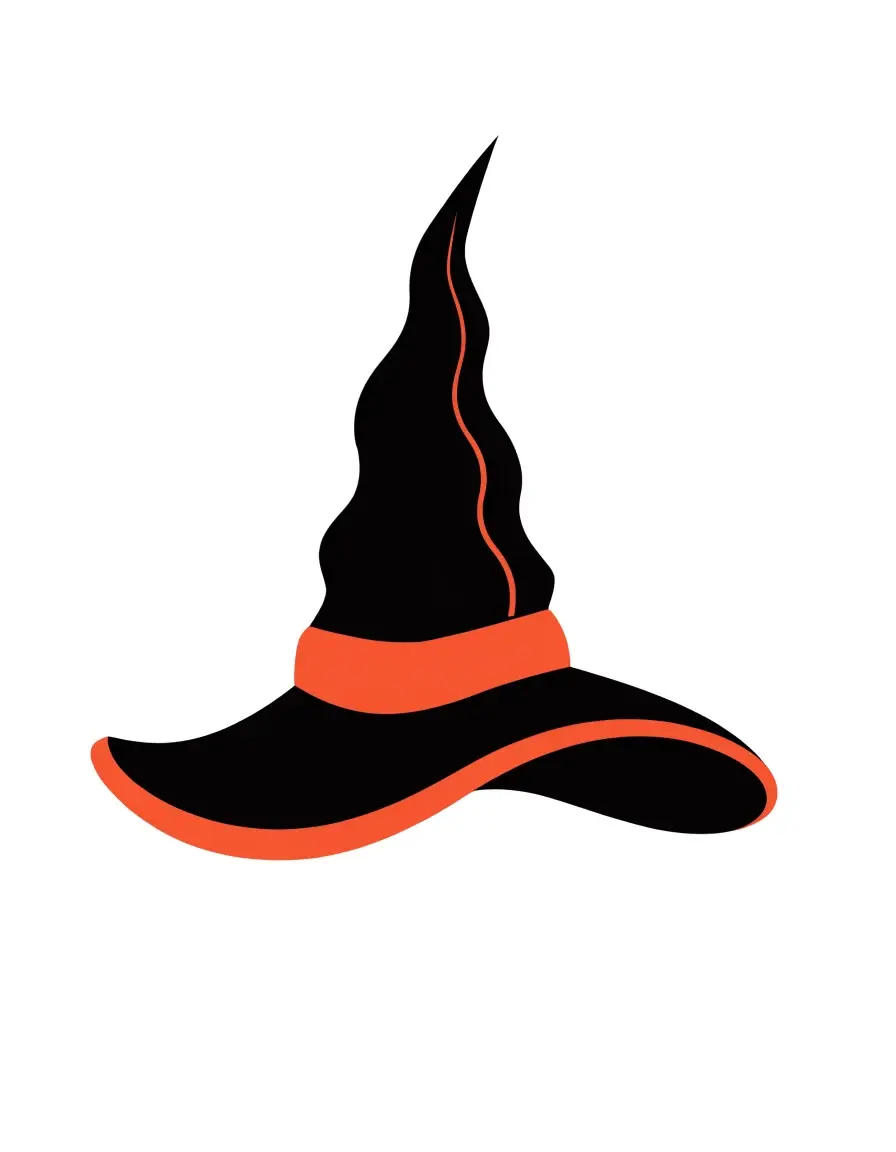
Референс 1

Референс 2
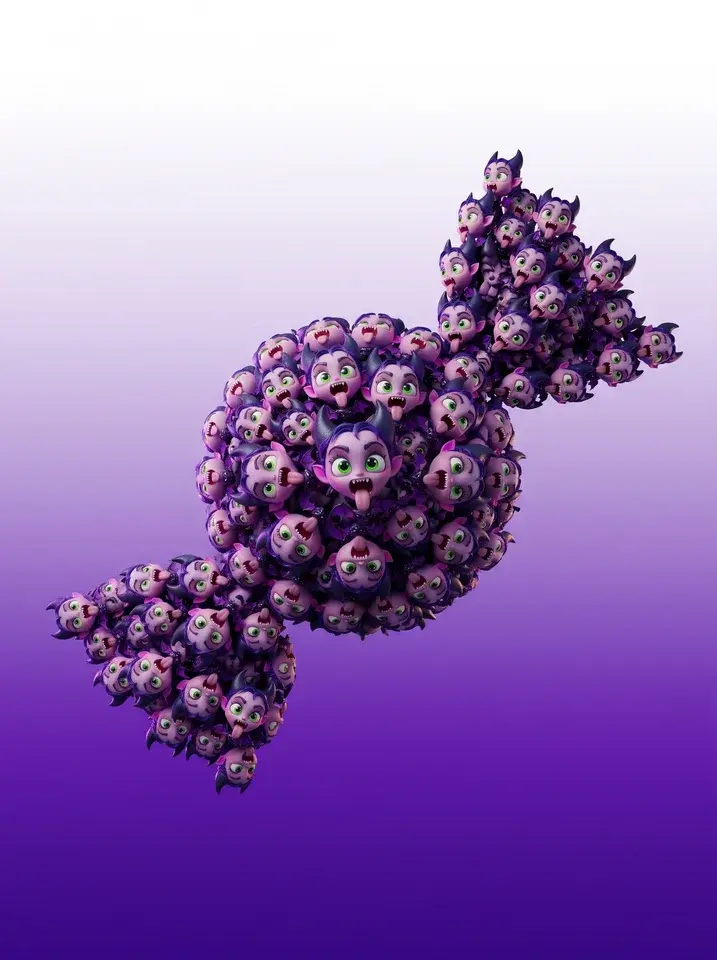
Nano Banana Pro
Copy
Create a premium high-end three-dimensional assemblage in which the exact overall shape from IMAGE 1 is formed entirely and exclusively by numerous separate, complete, faithfully reproduced copies of the subjects shown in IMAGE 2 and all subsequent object references. Treat IMAGE 1 only as a geometric blueprint for the final outer silhouette, proportions, curves, orientation, thickness, internal openings, and overall spatial attitude. IMAGE 1 must never appear as a visible material, wrapper, shell, core, filler, smooth surface, backing, membrane, skin, support, or structural base. The finished composition must contain only two things: the repeated subjects from IMAGE 2 and the clean background. No other visible material category is allowed. If all repeated subjects were removed, nothing of the shape from IMAGE 1 would remain. The entire shape must be physically built from the referenced subjects themselves, not decorated with them and not covered by them. Every solid region of the target form, including the center, outer contour, narrow tips, side edges, and full visible depth, must consist exclusively of the repeated subjects. Do not place the objects merely on the surface of a preexisting form. Do not embed them into a smooth body. Do not wrap them around a solid core. Do not create any visible candy body, wrapper, ribbon, skin, metallic foil, shell, smooth connecting layer, or continuous mass derived from IMAGE 1. The recognizable form from IMAGE 1 must emerge only from the collective arrangement, density, and outer boundaries of the repeated subjects. All visible surfaces belong to the repeated subjects themselves. Preserve each subject from IMAGE 2 and any additional references with maximum fidelity. Maintain exact recognizable identity, anatomy, proportions, colors, materials, textures, clothing, accessories, and defining structural features. If a subject is partially visible, reconstruct it into one complete coherent full object or full-body figure while naturally continuing the same original styling, outfit logic, and material language. Every repeated instance must remain a distinct, structurally intact, fully recognizable replica of that same subject. Do not invent new materials, stretched connecting shapes, abstract filler forms, melted masses, or simplified surrogate geometry. Arrange the repeated subjects as separate independent elements with correct anatomy or object geometry, complete limbs where applicable, intact clothing, and clear boundaries. Use varied but controlled natural poses, rotations, and orientations to make the assembly visually rich and more interesting to inspect up close, while preserving full recognizability and structural integrity. Allow subjects to stand, sit, lean, recline, bend, crouch, or gently twist only within
natural believable limits. Do not deform them to fit the silhouette. Do not fuse them together. Do not merge bodies, share limbs, duplicate heads, stretch torsos, create hybrid anatomy, or allow one subject to dissolve into another. Maintain clear independent silhouettes and clean separation between neighboring objects. Build a dense but readable composition with multiple spatial layers and controlled overlaps. Use mostly medium-sized high-fidelity replicas and smaller complete replicas only where necessary for narrow contours, pointed ends, or intricate sections. Preserve strong subject readability, clear material definition, and crisp individual silhouettes throughout the composition. Maintain consistent object density across both central areas and outer boundaries, ensuring that the whole target form is genuinely constructed from the subjects rather than simply outlined by them. Preserve all true internal openings and negative spaces from IMAGE 1 as fully empty open gaps with the background visible directly through them. Present the complete assemblage as a weightless levitating object in empty space. Use a refined three-quarter frontal camera angle with a subtle yet elegant spatial turn, preserving the legibility of the original silhouette while revealing convincing thickness, front-to-back layering, and dynamic levitation. Retain and reinforce the original tilt or dynamic attitude of IMAGE 1 where relevant. The sculpture should feel suspended, balanced, and alive in space rather than frontally pasted onto the background. Use sophisticated studio lighting to create dimensional depth inside the assemblage. Apply a directional key light from above and to one side, with balanced fill illumination, so that foreground subjects cast realistic shadows only onto neighboring and recessed subjects inside the assemblage. Allow contact shadows, inter-object cast shadows, and ambient occlusion only where the repeated subjects physically overlap or sit close together. Keep all shadows confined to the assemblage itself. Absolutely no shadow, reflection, dark patch, grounding cue, contact patch, ambient darkening, occlusion halo, or projected shape is allowed beneath the sculpture or anywhere on the background. There is no floor, no ground plane, no invisible surface, no pedestal, no support, and no surface receiving light or shadow. The background must remain completely untouched by the object. Render the image with exceptional high-end CGI quality, sharp geometry, crisp edges, accurate materials, fine textures, clean subject separation, and excellent readability. Avoid plastic-looking oversimplification, blur, mushy detail, artificial smoothing, or low-detail repetition. Place the levitating assemblage against a perfectly smooth, seamless vertical digital
gradient transitioning from pure white (#FFFFFF) at the top to the single dominant bright saturated color of the primary subject in IMAGE 2 at the bottom. Use exactly two color endpoints and one clean continuous linear transition. The gradient must remain uniform, textureless, and perfectly clean across the entire frame, with no additional colors, no dirty mixing, no vignette, no atmosphere, no haze, no radial glow, no uneven patches, no horizon cue, and no localized darkening beneath the object. The lower part of the frame must remain the same clean gradient field, not a floor-like area. The final result should read immediately as the exact shape from IMAGE 1 and, on closer inspection, as a fully volumetric levitating construction made entirely from distinct, complete, faithful replicas of the subjects from IMAGE 2.

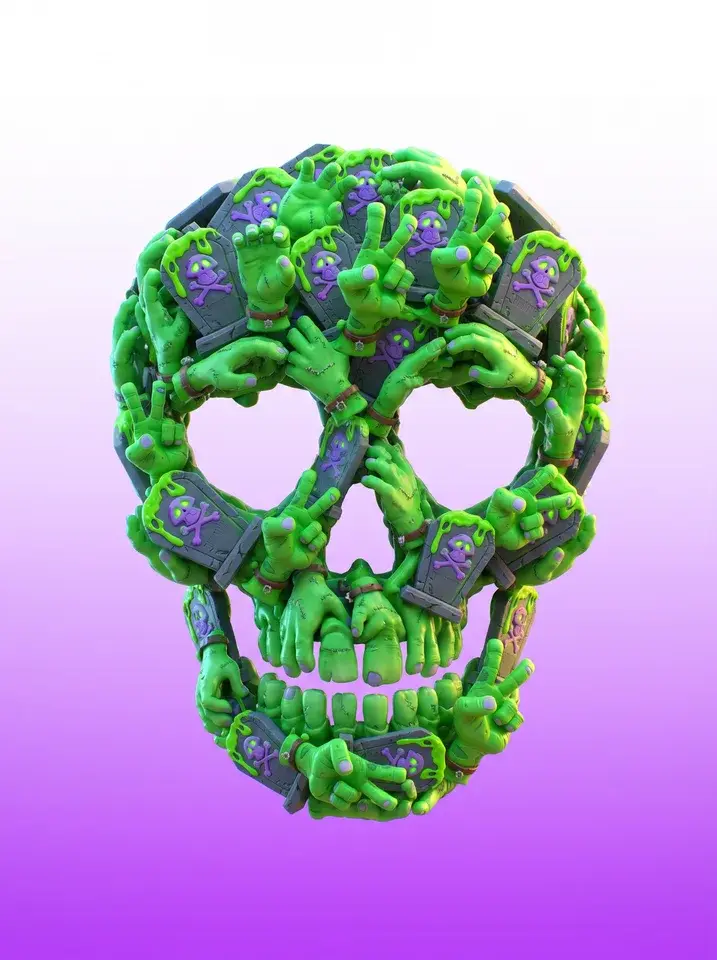
Референс 1

Референс 2
Nano Banana Pro
Copy
Create a premium high-end three-dimensional assemblage in which the exact overall shape from IMAGE 1 is formed entirely and exclusively by numerous separate, complete, faithfully reproduced copies of the subjects shown in IMAGE 2 and all subsequent object references. Treat IMAGE 1 only as a geometric blueprint for the final outer silhouette, proportions, curves, orientation, thickness, internal openings, and overall spatial attitude. IMAGE 1 must never appear as a visible material, wrapper, shell, core, filler, smooth surface, backing, membrane, skin, support, or structural base. The finished composition must contain only two things: the repeated subjects from IMAGE 2 and the clean background. No other visible material category is allowed. If all repeated subjects were removed, nothing of the shape from IMAGE 1 would remain. The entire shape must be physically built from the referenced subjects themselves, not decorated with them and not covered by them. Every solid region of the target form, including the center, outer contour, narrow tips, side edges, and full visible depth, must consist exclusively of the repeated subjects. Do not place the objects merely on the surface of a preexisting form. Do not embed them into a smooth body. Do not wrap them around a solid core. Do not create any visible candy body, wrapper, ribbon, skin, metallic foil, shell, smooth connecting layer, or continuous mass derived from IMAGE 1. The recognizable form from IMAGE 1 must emerge only from the collective arrangement, density, and outer boundaries of the repeated subjects. All visible surfaces belong to the repeated subjects themselves. Preserve each subject from IMAGE 2 and any additional references with maximum fidelity. Maintain exact recognizable identity, anatomy, proportions, colors, materials, textures, clothing, accessories, and defining structural features. If a subject is partially visible, reconstruct it into one complete coherent full object or full-body figure while naturally continuing the same original styling, outfit logic, and material language. Every repeated instance must remain a distinct, structurally intact, fully recognizable replica of that same subject. Do not invent new materials, stretched connecting shapes, abstract filler forms, melted masses, or simplified surrogate geometry. Arrange the repeated subjects as separate independent elements with correct anatomy or object geometry, complete limbs where applicable, intact clothing, and clear boundaries. Use varied but controlled natural poses, rotations, and orientations to make the assembly visually rich and more interesting to inspect up close, while preserving full recognizability and structural integrity. Allow subjects to stand, sit, lean, recline, bend, crouch, or gently twist only within
natural believable limits. Do not deform them to fit the silhouette. Do not fuse them together. Do not merge bodies, share limbs, duplicate heads, stretch torsos, create hybrid anatomy, or allow one subject to dissolve into another. Maintain clear independent silhouettes and clean separation between neighboring objects. Build a dense but readable composition with multiple spatial layers and controlled overlaps. Use mostly medium-sized high-fidelity replicas and smaller complete replicas only where necessary for narrow contours, pointed ends, or intricate sections. Preserve strong subject readability, clear material definition, and crisp individual silhouettes throughout the composition. Maintain consistent object density across both central areas and outer boundaries, ensuring that the whole target form is genuinely constructed from the subjects rather than simply outlined by them. Preserve all true internal openings and negative spaces from IMAGE 1 as fully empty open gaps with the background visible directly through them. Present the complete assemblage as a weightless levitating object in empty space. Use a refined three-quarter frontal camera angle with a subtle yet elegant spatial turn, preserving the legibility of the original silhouette while revealing convincing thickness, front-to-back layering, and dynamic levitation. Retain and reinforce the original tilt or dynamic attitude of IMAGE 1 where relevant. The sculpture should feel suspended, balanced, and alive in space rather than frontally pasted onto the background. Use sophisticated studio lighting to create dimensional depth inside the assemblage. Apply a directional key light from above and to one side, with balanced fill illumination, so that foreground subjects cast realistic shadows only onto neighboring and recessed subjects inside the assemblage. Allow contact shadows, inter-object cast shadows, and ambient occlusion only where the repeated subjects physically overlap or sit close together. Keep all shadows confined to the assemblage itself. Absolutely no shadow, reflection, dark patch, grounding cue, contact patch, ambient darkening, occlusion halo, or projected shape is allowed beneath the sculpture or anywhere on the background. There is no floor, no ground plane, no invisible surface, no pedestal, no support, and no surface receiving light or shadow. The background must remain completely untouched by the object. Render the image with exceptional high-end CGI quality, sharp geometry, crisp edges, accurate materials, fine textures, clean subject separation, and excellent readability. Avoid plastic-looking oversimplification, blur, mushy detail, artificial smoothing, or low-detail repetition. Place the levitating assemblage against a perfectly smooth, seamless vertical digital
gradient transitioning from pure white (#FFFFFF) at the top to the single dominant bright saturated color of the primary subject in IMAGE 2 at the bottom. Use exactly two color endpoints and one clean continuous linear transition. The gradient must remain uniform, textureless, and perfectly clean across the entire frame, with no additional colors, no dirty mixing, no vignette, no atmosphere, no haze, no radial glow, no uneven patches, no horizon cue, and no localized darkening beneath the object. The lower part of the frame must remain the same clean gradient field, not a floor-like area. The final result should read immediately as the exact shape from IMAGE 1 and, on closer inspection, as a fully volumetric levitating construction made entirely from distinct, complete, faithful replicas of the subjects from IMAGE 2.

Референс 1
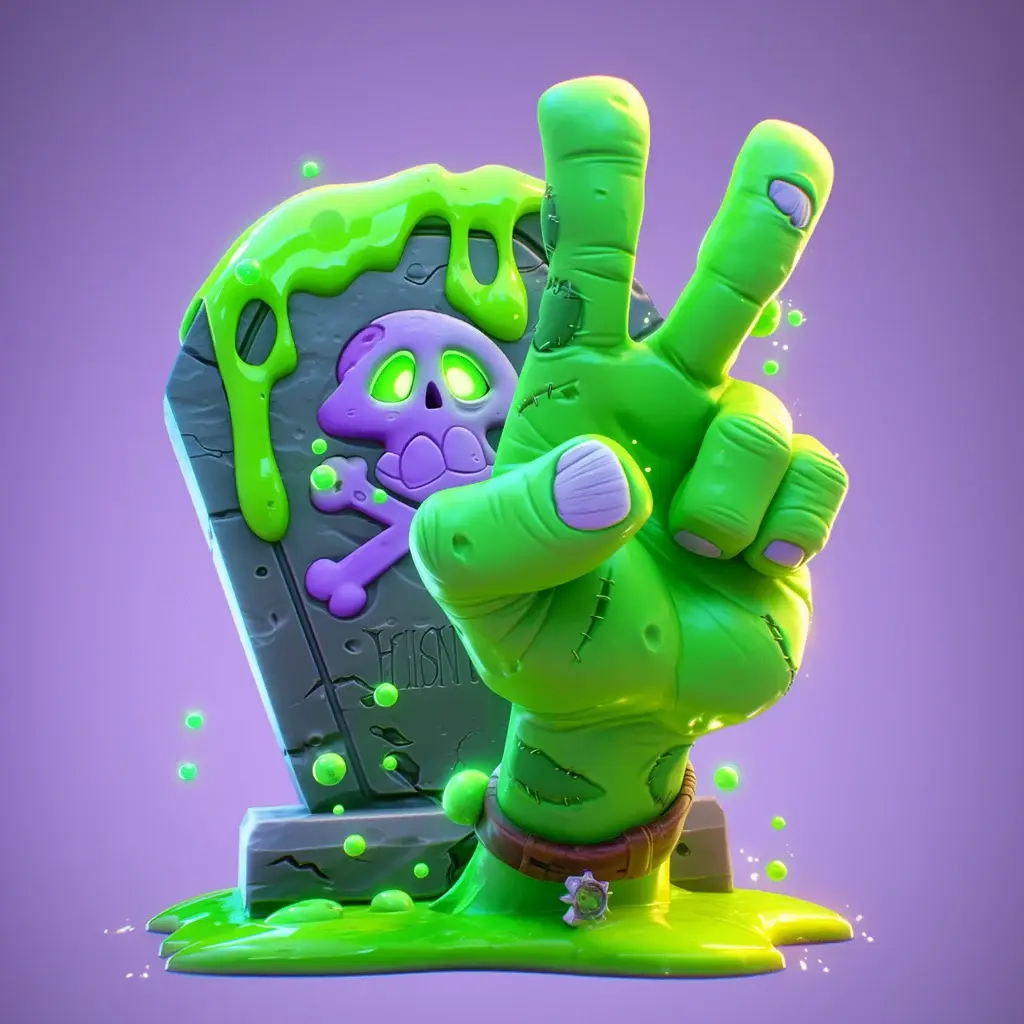
Референс 2
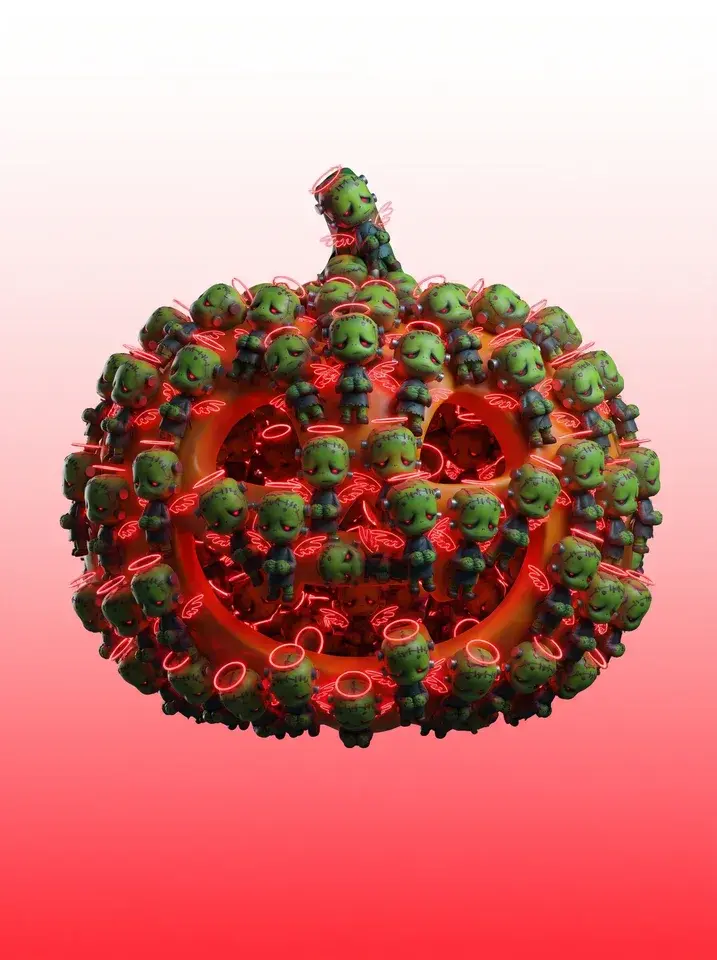
Nano Banana Pro
Copy
Create a premium high-end three-dimensional assemblage in which the exact overall shape from IMAGE 1 is formed entirely and exclusively by numerous separate, complete, faithfully reproduced copies of the subjects shown in IMAGE 2 and all subsequent object references. Treat IMAGE 1 only as a geometric blueprint for the final outer silhouette, proportions, curves, orientation, thickness, internal openings, and overall spatial attitude. IMAGE 1 must never appear as a visible material, wrapper, shell, core, filler, smooth surface, backing, membrane, skin, support, or structural base. The finished composition must contain only two things: the repeated subjects from IMAGE 2 and the clean background. No other visible material category is allowed. If all repeated subjects were removed, nothing of the shape from IMAGE 1 would remain. The entire shape must be physically built from the referenced subjects themselves, not decorated with them and not covered by them. Every solid region of the target form, including the center, outer contour, narrow tips, side edges, and full visible depth, must consist exclusively of the repeated subjects. Do not place the objects merely on the surface of a preexisting form. Do not embed them into a smooth body. Do not wrap them around a solid core. Do not create any visible candy body, wrapper, ribbon, skin, metallic foil, shell, smooth connecting layer, or continuous mass derived from IMAGE 1. The recognizable form from IMAGE 1 must emerge only from the collective arrangement, density, and outer boundaries of the repeated subjects. All visible surfaces belong to the repeated subjects themselves. Preserve each subject from IMAGE 2 and any additional references with maximum fidelity. Maintain exact recognizable identity, anatomy, proportions, colors, materials, textures, clothing, accessories, and defining structural features. If a subject is partially visible, reconstruct it into one complete coherent full object or full-body figure while naturally continuing the same original styling, outfit logic, and material language. Every repeated instance must remain a distinct, structurally intact, fully recognizable replica of that same subject. Do not invent new materials, stretched connecting shapes, abstract filler forms, melted masses, or simplified surrogate geometry. Arrange the repeated subjects as separate independent elements with correct anatomy or object geometry, complete limbs where applicable, intact clothing, and clear boundaries. Use varied but controlled natural poses, rotations, and orientations to make the assembly visually rich and more interesting to inspect up close, while preserving full recognizability and structural integrity. Allow subjects to stand, sit, lean, recline, bend, crouch, or gently twist only within
natural believable limits. Do not deform them to fit the silhouette. Do not fuse them together. Do not merge bodies, share limbs, duplicate heads, stretch torsos, create hybrid anatomy, or allow one subject to dissolve into another. Maintain clear independent silhouettes and clean separation between neighboring objects. Build a dense but readable composition with multiple spatial layers and controlled overlaps. Use mostly medium-sized high-fidelity replicas and smaller complete replicas only where necessary for narrow contours, pointed ends, or intricate sections. Preserve strong subject readability, clear material definition, and crisp individual silhouettes throughout the composition. Maintain consistent object density across both central areas and outer boundaries, ensuring that the whole target form is genuinely constructed from the subjects rather than simply outlined by them. Preserve all true internal openings and negative spaces from IMAGE 1 as fully empty open gaps with the background visible directly through them. Present the complete assemblage as a weightless levitating object in empty space. Use a refined three-quarter frontal camera angle with a subtle yet elegant spatial turn, preserving the legibility of the original silhouette while revealing convincing thickness, front-to-back layering, and dynamic levitation. Retain and reinforce the original tilt or dynamic attitude of IMAGE 1 where relevant. The sculpture should feel suspended, balanced, and alive in space rather than frontally pasted onto the background. Use sophisticated studio lighting to create dimensional depth inside the assemblage. Apply a directional key light from above and to one side, with balanced fill illumination, so that foreground subjects cast realistic shadows only onto neighboring and recessed subjects inside the assemblage. Allow contact shadows, inter-object cast shadows, and ambient occlusion only where the repeated subjects physically overlap or sit close together. Keep all shadows confined to the assemblage itself. Absolutely no shadow, reflection, dark patch, grounding cue, contact patch, ambient darkening, occlusion halo, or projected shape is allowed beneath the sculpture or anywhere on the background. There is no floor, no ground plane, no invisible surface, no pedestal, no support, and no surface receiving light or shadow. The background must remain completely untouched by the object. Render the image with exceptional high-end CGI quality, sharp geometry, crisp edges, accurate materials, fine textures, clean subject separation, and excellent readability. Avoid plastic-looking oversimplification, blur, mushy detail, artificial smoothing, or low-detail repetition. Place the levitating assemblage against a perfectly smooth, seamless vertical digital
gradient transitioning from pure white (#FFFFFF) at the top to the single dominant bright saturated color of the primary subject in IMAGE 2 at the bottom. Use exactly two color endpoints and one clean continuous linear transition. The gradient must remain uniform, textureless, and perfectly clean across the entire frame, with no additional colors, no dirty mixing, no vignette, no atmosphere, no haze, no radial glow, no uneven patches, no horizon cue, and no localized darkening beneath the object. The lower part of the frame must remain the same clean gradient field, not a floor-like area. The final result should read immediately as the exact shape from IMAGE 1 and, on closer inspection, as a fully volumetric levitating construction made entirely from distinct, complete, faithful replicas of the subjects from IMAGE 2.
Референс 1

Референс 2
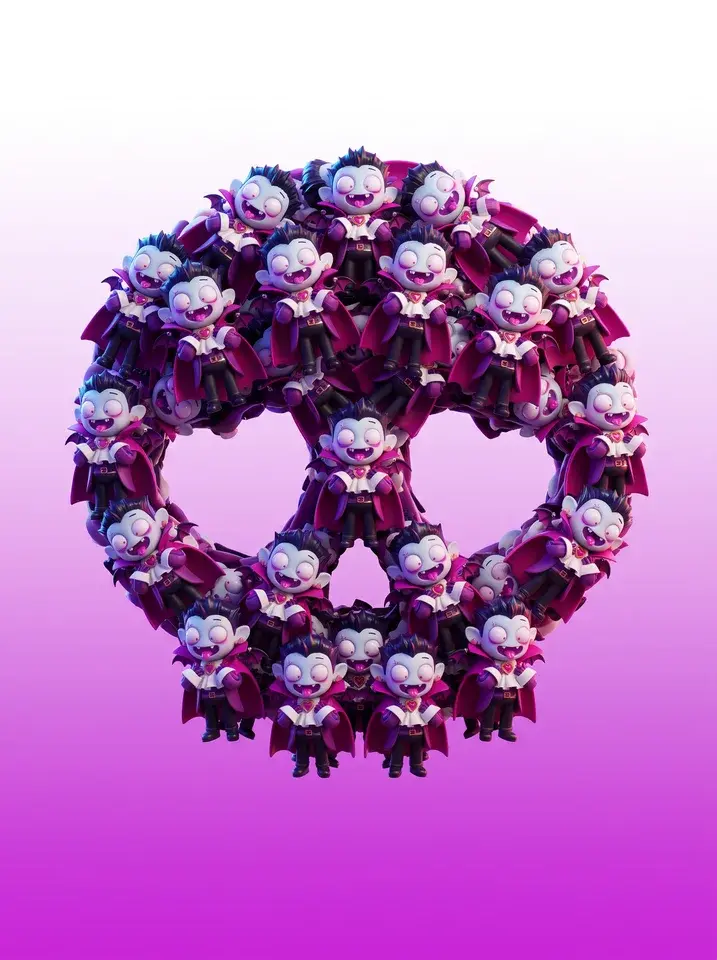
Nano Banana Pro
Copy
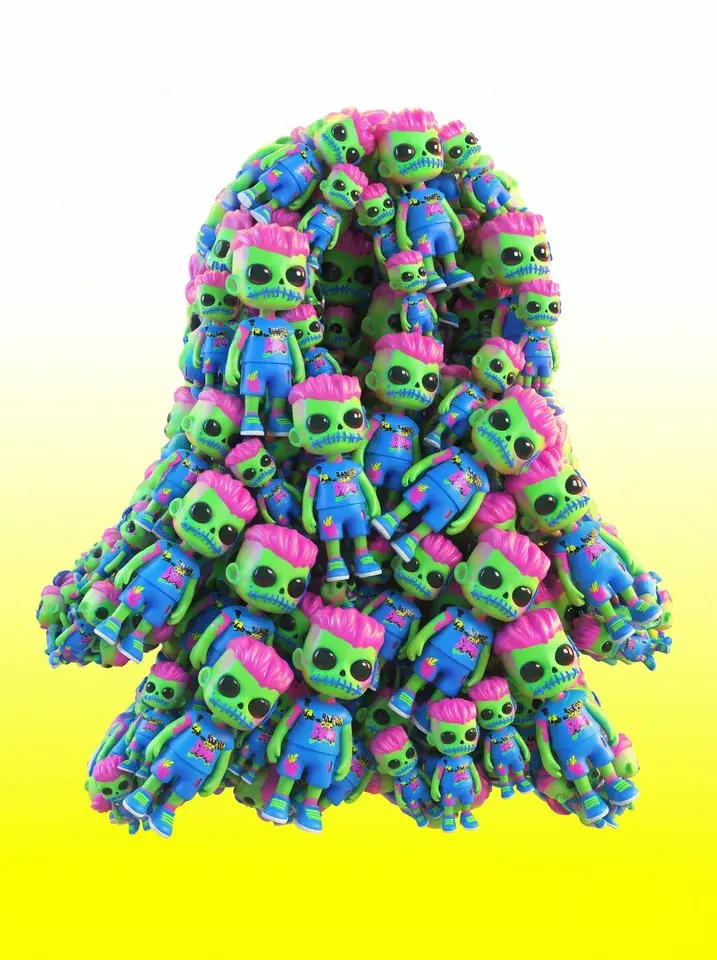
Create a premium photorealistic three-dimensional sculpture whose exact overall silhouette is taken from the first uploaded image and whose entire physical structure consists exclusively of complete replicas of the subjects shown in the second and subsequent reference images. Follow a strict two-stage construction process. First, reconstruct each referenced subject as one complete, anatomically and structurally coherent three-dimensional asset before assembling the final composition. When a reference shows only a portrait, face, head, bust, or cropped upper body, extrapolate the unseen anatomy to create a complete head-to-toe person with a naturally proportioned torso, shoulders, arms, hands, waist, hips, legs, and feet. Continue the visible clothing into a coherent complete outfit, including appropriate trousers, lower garments, and footwear matching the original styling, colors, and materials. Preserve the exact recognizable facial features, hairstyle, accessories, visible garments, and distinctive appearance of the reference. For animals and nonhuman subjects, reconstruct the complete recognizable object with its natural full structure and defining features. The resulting complete subject becomes the single indivisible building unit used throughout the sculpture. Every repeated instance must display a coherent full physical body or complete object, with a recognizable head-to-body relationship, intact proportions, and clearly articulated structural features. Only after establishing these complete assets, recreate the first image as a dense assembly of numerous replicas. Treat the first reference purely as the geometric definition of the final silhouette, including its exact outer contours, proportions, orientation, typography, internal openings, and negative spaces. Replace every solid region of that silhouette with tightly arranged complete referenced subjects, filling the entire visible area and three-dimensional thickness through carefully organized physical placement. The original graphic material disappears entirely. Arrange the replicas in an intricate, compact, three-dimensional composition using proportional scaling, varied rotations, naturally interlocking orientations, and controlled overlapping. Maintain a consistent relationship between subject size and silhouette thickness so each repeated figure remains clearly recognizable as a complete individual rather than an isolated face or unidentifiable fragment. Place subjects at varying depths while ensuring visible torso and lower-body structure across the composition. Preserve natural anatomical proportions, individual object boundaries, distinctive textures, and essential features. Smaller complete figures may occupy narrow details, while moderately sized complete figures form the
primary sculptural structure. The assembled objects themselves create the entire outer contour and all visible surfaces of the target shape, with accurately preserved internal openings remaining completely empty and revealing the background through the sculpture. The final image must read simultaneously as the precise original shape and as a dense construction of fully formed individual subjects. Present the complete sculpture levitating weightlessly in empty space, predominantly front-facing with subtle three-dimensional thickness, elegant framing, and generous negative space. The sculpture must appear fully suspended in the air with no floor, no ground plane, no surface, no pedestal, no platform, no support, and no environmental base of any kind. Render every subject with exceptional photorealistic geometry, faithful facial detail, realistic anatomy, intricate fabric and material textures, beautiful surface definition, and crisp edges. Use refined studio lighting with a broad directional key light and balanced fill illumination to reveal both the complete bodies and the dimensional depth of the assembly. Allow subtle contact shadows, inter-object cast shadows, and ambient occlusion only within the sculpture itself, where one replicated subject naturally shades another subject behind or beside it. Do not cast any shadow beneath the sculpture. Do not create a floor shadow, ground shadow, drop shadow, projected shadow, reflection shadow, or any diffuse darkening below the object. The background must remain perfectly clean and unaffected by the sculpture, with no shadow contamination, no grounding cue, and no indication of a surface below. Place the sculpture against a perfectly clean, seamless vertical digital gradient transitioning uniformly from pure white (#FFFFFF) at the top to the brightest vivid saturated color found on the main subject in the second uploaded reference at the bottom. Preserve the selected hue's brightness and saturation through a perfectly even, continuous linear color transition. The background remains a pristine, uninterrupted digital color field with no additional colors, darkening, radial lighting, atmospheric effects, texture, grain, vignetting, halos, floor, horizon, reflections, or projected shadows. The sculpture floats freely in pure open space. Exceptional high-end CGI, precise silhouette construction, faithful reference reproduction, complete full-body subject replication, natural anatomy, sophisticated dimensional arrangement, immaculate material quality, clean seamless gradient, and refined contemporary art direction.
Референс 1

Референс 2
Nano Banana Pro
Copy
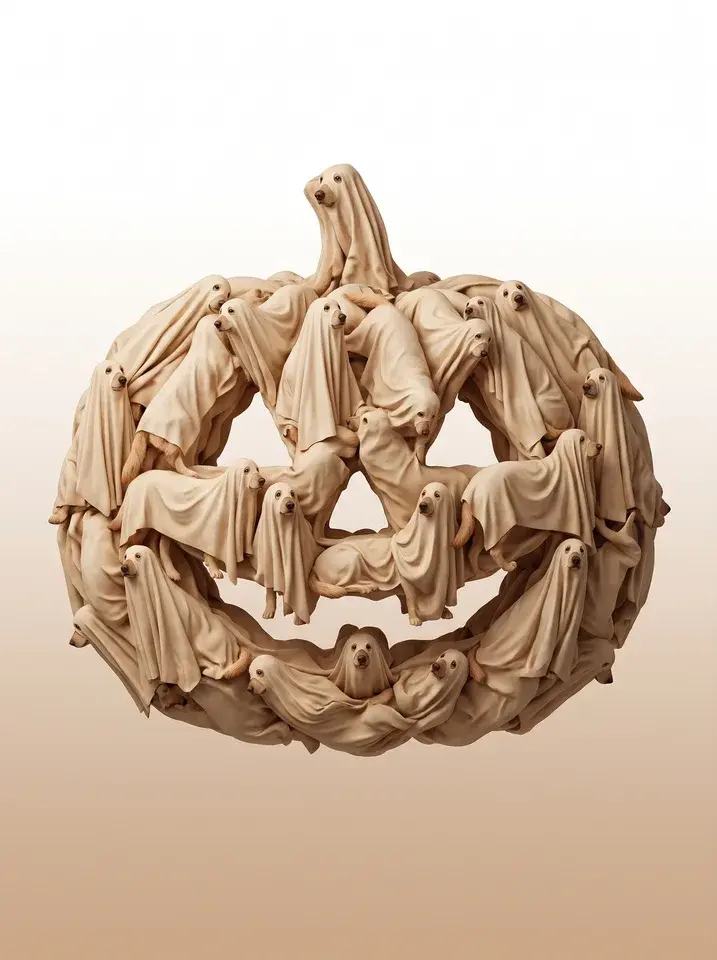
Create a premium photorealistic three-dimensional sculpture whose exact overall silhouette is taken from the first uploaded image and whose entire physical structure consists exclusively of complete replicas of the subjects shown in the second and subsequent reference images. Follow a strict two-stage construction process. First, reconstruct each referenced subject as one complete, anatomically and structurally coherent three-dimensional asset before assembling the final composition. When a reference shows only a portrait, face, head, bust, or cropped upper body, extrapolate the unseen anatomy to create a complete head-to-toe person with a naturally proportioned torso, shoulders, arms, hands, waist, hips, legs, and feet. Continue the visible clothing into a coherent complete outfit, including appropriate trousers, lower garments, and footwear matching the original styling, colors, and materials. Preserve the exact recognizable facial features, hairstyle, accessories, visible garments, and distinctive appearance of the reference. For animals and nonhuman subjects, reconstruct the complete recognizable object with its natural full structure and defining features. The resulting complete subject becomes the single indivisible building unit used throughout the sculpture. Every repeated instance must display a coherent full physical body or complete object, with a recognizable head-to-body relationship, intact proportions, and clearly articulated structural features. Only after establishing these complete assets, recreate the first image as a dense assembly of numerous replicas. Treat the first reference purely as the geometric definition of the final silhouette, including its exact outer contours, proportions, orientation, typography, internal openings, and negative spaces. Replace every solid region of that silhouette with tightly arranged complete referenced subjects, filling the entire visible area and three-dimensional thickness through carefully organized physical placement. The original graphic material disappears entirely. Arrange the replicas in an intricate, compact, three-dimensional composition using proportional scaling, varied rotations, naturally interlocking orientations, and controlled overlapping. Maintain a consistent relationship between subject size and silhouette thickness so each repeated figure remains clearly recognizable as a complete individual rather than an isolated face or unidentifiable fragment. Place subjects at varying depths while ensuring visible torso and lower-body structure across the composition. Preserve natural anatomical proportions, individual object boundaries, distinctive textures, and essential features. Smaller complete figures may occupy narrow details, while moderately sized complete figures form the
primary sculptural structure. The assembled objects themselves create the entire outer contour and all visible surfaces of the target shape, with accurately preserved internal openings remaining completely empty and revealing the background through the sculpture. The final image must read simultaneously as the precise original shape and as a dense construction of fully formed individual subjects. Present the complete sculpture levitating weightlessly in empty space, predominantly front-facing with subtle three-dimensional thickness, elegant framing, and generous negative space. The sculpture must appear fully suspended in the air with no floor, no ground plane, no surface, no pedestal, no platform, no support, and no environmental base of any kind. Render every subject with exceptional photorealistic geometry, faithful facial detail, realistic anatomy, intricate fabric and material textures, beautiful surface definition, and crisp edges. Use refined studio lighting with a broad directional key light and balanced fill illumination to reveal both the complete bodies and the dimensional depth of the assembly. Allow subtle contact shadows, inter-object cast shadows, and ambient occlusion only within the sculpture itself, where one replicated subject naturally shades another subject behind or beside it. Do not cast any shadow beneath the sculpture. Do not create a floor shadow, ground shadow, drop shadow, projected shadow, reflection shadow, or any diffuse darkening below the object. The background must remain perfectly clean and unaffected by the sculpture, with no shadow contamination, no grounding cue, and no indication of a surface below. Place the sculpture against a perfectly clean, seamless vertical digital gradient transitioning uniformly from pure white (#FFFFFF) at the top to the brightest vivid saturated color found on the main subject in the second uploaded reference at the bottom. Preserve the selected hue's brightness and saturation through a perfectly even, continuous linear color transition. The background remains a pristine, uninterrupted digital color field with no additional colors, darkening, radial lighting, atmospheric effects, texture, grain, vignetting, halos, floor, horizon, reflections, or projected shadows. The sculpture floats freely in pure open space. Exceptional high-end CGI, precise silhouette construction, faithful reference reproduction, complete full-body subject replication, natural anatomy, sophisticated dimensional arrangement, immaculate material quality, clean seamless gradient, and refined contemporary art direction.

Референс 1

Референс 2
Nano Banana Pro
Copy
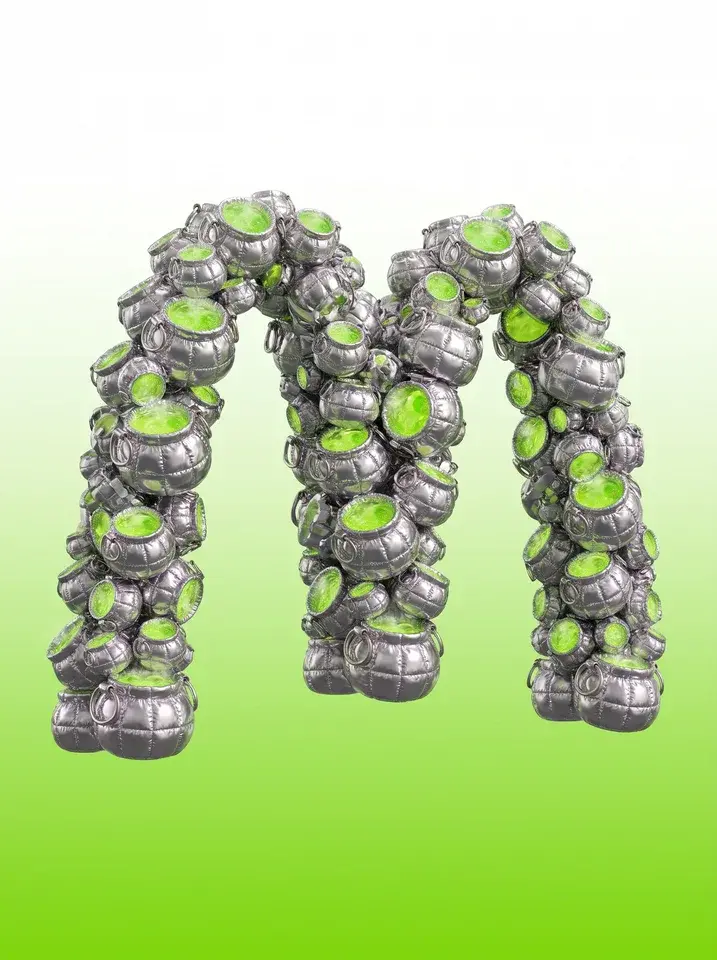
Create a premium photorealistic three-dimensional assemblage whose exact overall silhouette matches IMAGE 1, constructed exclusively from numerous separate, complete, faithfully reproduced copies of the subjects in IMAGE 2 and all subsequent references. IMAGE 1 defines only the precise geometry, proportions, curves, typography, spacing, stroke thickness, and internal openings. The shape emerges entirely from the physical arrangement of these objects, which form every solid region across its full width, height, and depth. The original graphic is completely absent as a physical surface, backing, shell, or filler. Every visible part of the sculpture consists exclusively of the referenced subjects. Preserve each subject's recognizable identity, anatomy, proportions, clothing, accessories, original colors, intricate textures, and material properties with maximum fidelity. For partially visible subjects, reconstruct complete coherent objects or full-body characters, naturally continuing their original outfit and styling. Every repeated instance remains a distinct, structurally intact object with correct geometry and anatomy, including complete limbs and footwear where applicable. Create a sophisticated arrangement of varied natural poses, rotations, and controlled proportional scales, allowing subjects to stand, sit, lean, recline, bend, or curl while preserving their anatomy, clothing, and individual recognizable features. Arrange them closely in multiple spatial layers with carefully controlled overlaps and convincing physical contact, maintaining separate bodies, correct limb connections, and realistic object boundaries. Achieve dense packing through intelligent positioning rather than deformation, fusion, or compression. Use smaller complete replicas where necessary for narrow contours, while keeping most subjects sufficiently large for clear individual readability. Preserve the exact outer silhouette and all internal openings of IMAGE 1, with genuine empty spaces revealing the background directly through the construction. Maintain consistent object density throughout the central regions and exterior edges, ensuring the entire shape is physically constructed from the referenced objects rather than merely outlined or decorated. Give the sculpture pronounced dimensional depth through sophisticated directional studio lighting and physically accurate inter-object shadow casting. Use a strong, broad directional key light positioned above and to one side, producing beautifully defined highlights on the foreground objects and distinct cast shadows falling naturally across the surfaces of neighboring objects positioned behind them. Every foreground element should cast spatially consistent shadows onto the underlying and recessed elements according to their
actual relative positions. Create rich contact shadows at points of physical interaction, deeper ambient occlusion inside tightly packed areas, and visible light-to-shadow transitions that reveal the layered arrangement. Maintain realistic shadow softness appropriate to the light source, with defined shadow edges near contact points and progressively softer shadows across more distant surfaces. Preserve readable textures, accurate colors, and recognizable details within the shadowed areas through controlled complementary fill illumination. Establish a clear hierarchy of illuminated foreground subjects, partially shadowed middle layers, and deeper recessed objects, creating dimensional separation without turning the interior into an indistinguishable dark mass. Allow the combined highlights, cast shadows, and subtle occlusion to emphasize the recognizable geometry of the overall silhouette. Preserve high-quality skin, fabric, hair, and material textures, natural roughness, fine details, sharp individual geometry, and realistic surface response. The result should resemble an expertly lit physical installation photographed in a professional studio, with exceptional material fidelity rather than a plastic or artificial appearance. Present the complete sculpture levitating freely in empty space, predominantly front-facing with subtle visible thickness, fully centered and surrounded by generous negative space. Place it against a perfectly smooth, seamless vertical digital gradient transitioning from pure white (#FFFFFF) at the top to the brightest dominant saturated color belonging to the main subject in IMAGE 2 at the bottom. Use a single uniform linear transition with clean, consistent color distribution, free of texture, uneven patches, atmospheric effects, halos, vignetting, and additional colors. Keep the background independent of the sculpture's lighting. All cast shadows occur exclusively between objects within the sculpture, never on the background or an imaginary floor. The sculpture floats without any visible support, pedestal, ground plane, horizon, or projected shadow. Exceptional high-end photorealistic CGI, exact silhouette reconstruction, separate anatomically correct objects, faithful reference materials, expressive natural posing, pronounced inter-object shadows, refined volumetric depth, and sophisticated contemporary art direction.

Референс 1

Референс 2
Nano Banana Pro
Copy
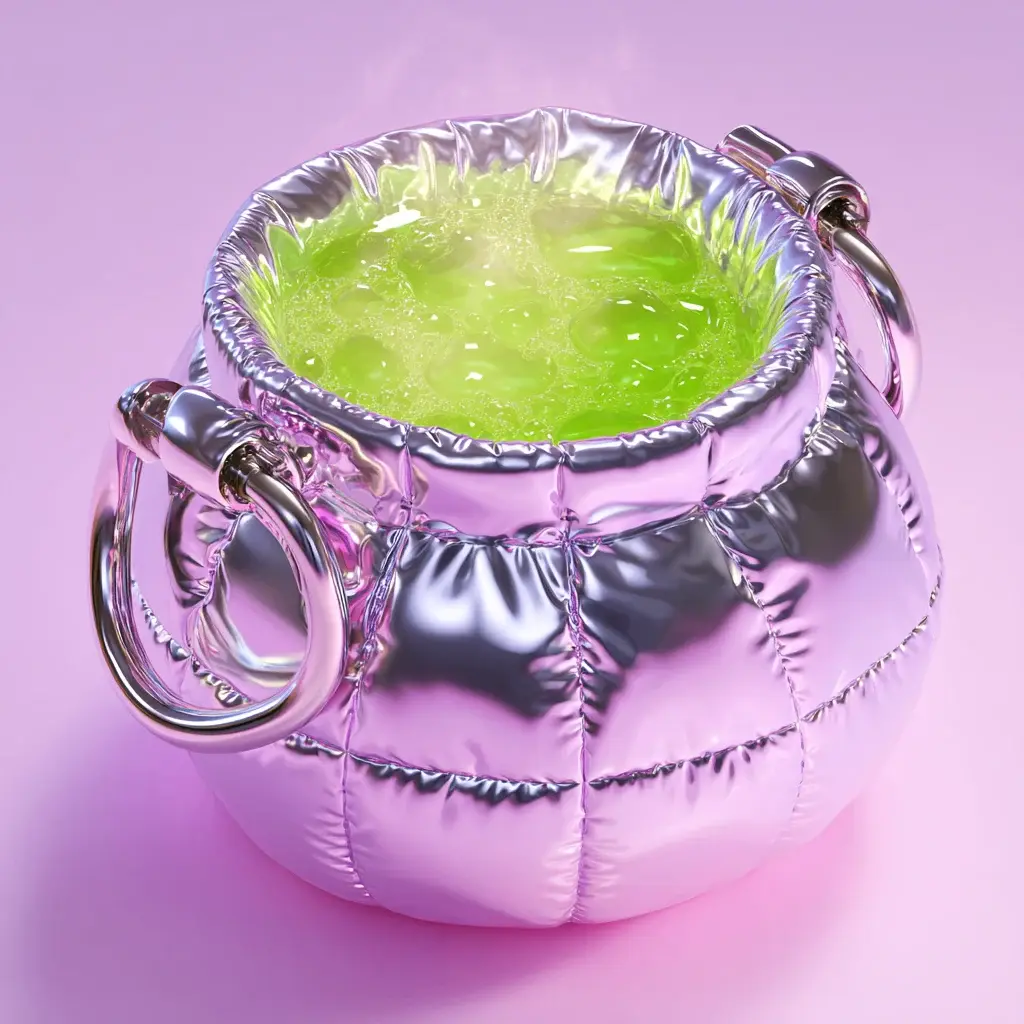
Create a premium photorealistic 3D sculpture that precisely reproduces the shape of the first uploaded image, constructed entirely from densely packed replicas of the subjects shown in the second and all subsequent reference images. The first image defines only the exact silhouette, proportions, curves, typography, spacing, and internal openings. Every solid region of this shape must be physically replaced by the referenced subjects themselves, completely filling its width, height, and three-dimensional thickness. The original graphic surface and its colors disappear entirely. Identify the primary subject in each additional reference and reconstruct it as one complete, coherent three-dimensional object. If the reference shows a person only as a portrait, headshot, or partial body, intelligently extend the person into a complete head-to-toe figure, generating anatomically correct arms, hands, torso, legs, feet, and appropriate footwear. Faithfully preserve the visible face, identity, hairstyle, clothing, colors, accessories, and distinctive design features, while extending any unseen clothing and body parts naturally in the same visual style. If the reference contains an animal or another partially visible subject, reconstruct its complete natural form with all essential parts. Every replica used in the final sculpture must be a complete, intact, recognizable subject, with realistic anatomy, consistent proportions, and accurate material textures. Use multiple uniformly scaled copies of these complete subjects, varying their size, orientation, and depth to arrange them into a dense, carefully balanced three-dimensional assembly. Fit the replicas closely together using intelligent rotations, natural overlapping, and organic spatial layering, preserving the individual geometry and recognizable features of each subject. Smaller complete replicas fill narrower sections and intricate contours. Maintain consistent visual density throughout every solid region, including the interior and perimeter. The referenced subjects themselves must create the entire silhouette, with no separate graphic surface, backing, solid core, decorative border, or underlying logo. Preserve every internal opening and negative space as a genuine unobstructed hole through which the background remains visible. The overall shape must remain precisely recognizable, with clean contours, accurate proportions, and faithful spacing. Present the completed construction as a substantial three-dimensional sculpture levitating freely in empty space, viewed predominantly from the front with subtle visible sculptural depth. The entire shape is centered and fully visible, surrounded by generous negative space. Render every individual subject with crisp geometry, recognizable details, high-resolution
photorealistic textures, accurate materials, and beautiful dimensional lighting. Use a controlled directional studio key light and balanced fill illumination to reveal the natural shape and surface detail of each replica, with realistic contact shadows confined to the assembly. Place the floating sculpture against a perfectly smooth, seamless digital linear gradient transitioning vertically from pure white (#FFFFFF) at the top to the brightest vivid saturated color found on the primary subject in the second reference at the bottom. Maintain a clean, uniform transition with consistent color distribution across the frame, preserving the selected color's brightness and saturation. The background remains a pure uninterrupted digital gradient, free of atmospheric effects, spotlights, halos, vignetting, texture, color patches, floors, horizons, and projected shadows. The sculpture floats weightlessly without any support or grounding surface. Exceptional high-end CGI, accurate geometric reconstruction, faithful reference subjects, complete full-body replicas where applicable, intricate volumetric construction, immaculate surface detail, sophisticated lighting, and premium contemporary art direction.

Референс 1
Референс 2
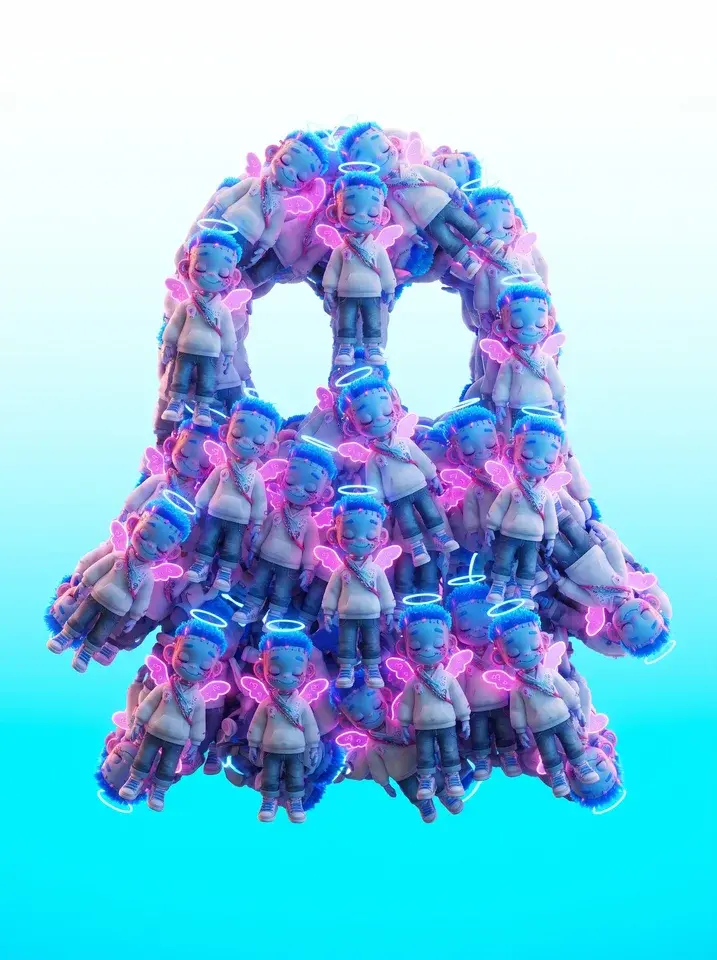
Nano Banana Pro
Copy
Create a premium photorealistic three-dimensional sculpture whose exact overall silhouette is taken from the first uploaded image and whose entire physical structure consists exclusively of complete replicas of the subjects shown in the second and subsequent reference images. Follow a strict two-stage construction process. First, reconstruct each referenced subject as one complete, anatomically and structurally coherent three-dimensional asset before assembling the final composition. When a reference shows only a portrait, face, head, bust, or cropped upper body, extrapolate the unseen anatomy to create a complete head-to-toe person with a naturally proportioned torso, shoulders, arms, hands, waist, hips, legs, and feet. Continue the visible clothing into a coherent complete outfit, including appropriate trousers, lower garments, and footwear matching the original styling, colors, and materials. Preserve the exact recognizable facial features, hairstyle, accessories, visible garments, and distinctive appearance of the reference. For animals and nonhuman subjects, reconstruct the complete recognizable object with its natural full structure and defining features. The resulting complete subject becomes the single indivisible building unit used throughout the sculpture. Every repeated instance must display a coherent full physical body or complete object, with a recognizable head-to-body relationship, intact proportions, and clearly articulated structural features. Only after establishing these complete assets, recreate the first image as a dense assembly of numerous replicas. Treat the first reference purely as the geometric definition of the final silhouette, including its exact outer contours, proportions, orientation, typography, internal openings, and negative spaces. Replace every solid region of that silhouette with tightly arranged complete referenced subjects, filling the entire visible area and three-dimensional thickness through carefully organized physical placement. The original graphic material disappears entirely. Arrange the replicas in an intricate, compact, three-dimensional composition using proportional scaling, varied rotations, naturally interlocking orientations, and controlled overlapping. Maintain a consistent relationship between subject size and silhouette thickness so each repeated figure remains clearly recognizable as a complete individual rather than an isolated face or unidentifiable fragment. Place subjects at varying depths while ensuring visible torso and lower-body structure across the composition. Preserve natural anatomical proportions, individual object boundaries, distinctive textures, and essential features. Smaller complete figures may occupy narrow details, while moderately sized complete figures form the
primary sculptural structure. The assembled objects themselves create the entire outer contour and all visible surfaces of the target shape, with accurately preserved internal openings remaining completely empty and revealing the background through the sculpture. The final image must read simultaneously as the precise original shape and as a dense construction of fully formed individual subjects. Present the complete sculpture levitating weightlessly in empty space, predominantly front-facing with subtle three-dimensional thickness, elegant framing, and generous negative space. The sculpture must appear fully suspended in the air with no floor, no ground plane, no surface, no pedestal, no platform, no support, and no environmental base of any kind. Render every subject with exceptional photorealistic geometry, faithful facial detail, realistic anatomy, intricate fabric and material textures, beautiful surface definition, and crisp edges. Use refined studio lighting with a broad directional key light and balanced fill illumination to reveal both the complete bodies and the dimensional depth of the assembly. Allow subtle contact shadows, inter-object cast shadows, and ambient occlusion only within the sculpture itself, where one replicated subject naturally shades another subject behind or beside it. Do not cast any shadow beneath the sculpture. Do not create a floor shadow, ground shadow, drop shadow, projected shadow, reflection shadow, or any diffuse darkening below the object. The background must remain perfectly clean and unaffected by the sculpture, with no shadow contamination, no grounding cue, and no indication of a surface below. Place the sculpture against a perfectly clean, seamless vertical digital gradient transitioning uniformly from pure white (#FFFFFF) at the top to the brightest vivid saturated color found on the main subject in the second uploaded reference at the bottom. Preserve the selected hue's brightness and saturation through a perfectly even, continuous linear color transition. The background remains a pristine, uninterrupted digital color field with no additional colors, darkening, radial lighting, atmospheric effects, texture, grain, vignetting, halos, floor, horizon, reflections, or projected shadows. The sculpture floats freely in pure open space. Exceptional high-end CGI, precise silhouette construction, faithful reference reproduction, complete full-body subject replication, natural anatomy, sophisticated dimensional arrangement, immaculate material quality, clean seamless gradient, and refined contemporary art direction.
Референс 1

Референс 2
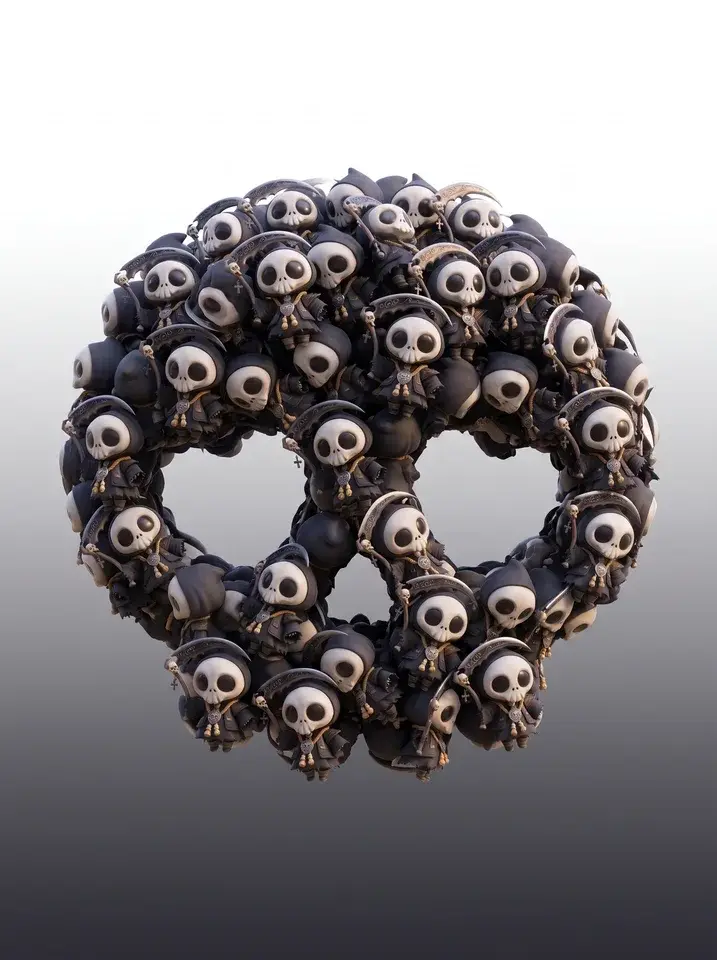
Nano Banana Pro
Copy
Create a premium, meticulously art-directed three-dimensional composition made exclusively from faithful, individually recognizable replicas of the subjects in IMAGE 2 and all subsequent object references. Arrange these independent subjects so that their combined physical volume recreates the precise shape shown in IMAGE 1. Preserve IMAGE 1 as the definitive geometric reference for the overall silhouette, proportions, orientation, contour, curves, pointed ends, openings, and three-dimensional structure. Retain its original dynamic tilt and spatial orientation where visible. The original shape serves only as a geometric guide; the final sculpture consists entirely of the referenced subjects themselves, with every solid area filled by their physical forms and absolutely no separate backing, smooth connecting material, graphic overlay, or underlying shell. Treat the primary subjects from IMAGE 2 onward as fixed, high-fidelity visual assets. Their original appearance is immutable: preserve exact character design, facial identity, head shape, body proportions, anatomy, clothing, accessories, footwear, colors, material distribution, surface textures, and distinctive structural details. Each repeated subject must look like a faithful copy of the uploaded reference rather than a newly invented variation. Preserve the original rendering style, whether photographic, illustrated, stylized 3D, or realistic CGI. Reproduce individual materials exactly where they belong on the original subject, retaining their characteristic texture, roughness, color, and finish. Keep all garments and accessories attached in their correct original positions. Introduce no additional fabric masses, elongated connecting shapes, stretched clothing, invented decorative elements, or unrelated materials. Arrange the replicas as separate, fully formed physical elements with clearly distinguishable silhouettes and consistent anatomical integrity. Use moderate variations in pose and orientation while preserving natural joint movement, correct limb proportions, complete bodies, and recognizable individual identities. Create pose diversity through controlled changes in stance, seated positions, gentle body turns, arm placement, and leg positioning, rather than extreme bending or twisting. Maintain a coherent range of object scales, with smaller complete replicas only where needed to resolve narrow portions of the silhouette. Organize the individual elements into a dense but visually clean composition, allowing carefully controlled overlaps and natural physical contact while retaining visible boundaries between neighboring subjects. Objects remain structurally independent, with no shared anatomy, merged limbs, duplicated heads, stretched torsos, or distorted geometric connections. Fill the
entire solid silhouette of IMAGE 1 with these complete subjects, from its center to its exterior edges and throughout its visible three-dimensional thickness. The combined arrangement itself creates the recognizable shape, with all original openings and negative spaces preserved as genuinely empty areas through which the background is visible. Maintain accurate contour definition and clear shape readability from the final viewing angle. The finished sculpture must contain only the referenced subjects, assembled into the original geometric form. Suspend the complete sculpture weightlessly in open space with a refined, visually engaging three-dimensional orientation. Use a carefully controlled three-quarter perspective with a modest spatial tilt that complements the original shape, reveals its thickness, and maintains immediate silhouette recognition. Rotate the assembled structure as one coherent object, preserving the integrity and relative placement of its individual components. Keep the entire sculpture fully visible, elegantly framed, and surrounded by generous negative space. Illuminate the sculpture with a controlled directional key light positioned above and to one side, creating beautifully defined highlights and realistic shadows cast by foreground subjects onto neighboring subjects behind them. Use balanced fill illumination to preserve clear facial features, accurate material colors, and detailed textures within recessed areas. Maintain rich but controlled contact shadows, natural depth separation, and convincing light-to-shadow transitions throughout the assembly. All shadows remain confined to the physical subjects themselves. Render the subjects with exceptional visual fidelity, crisp geometry, accurately preserved original materials, high-resolution textures, fine surface detail, realistic light response, and clean subject separation. Maintain the authentic visual character of the uploaded references without introducing plastic-like simplification, artificial smoothing, or stylized reinterpretation. Place the floating sculpture against a perfectly smooth, seamless vertical digital gradient transitioning from pure white (#FFFFFF) at the top to the dominant vivid color of the primary subject in IMAGE 2 at the bottom. The gradient uses exactly two color endpoints and one continuous, uniform linear interpolation, with a perfectly clean, textureless appearance across the entire frame. The background remains independent of the sculpture's illumination, with consistent color across every horizontal level and no localized brightness variations, additional color patches, atmosphere, vignette, or projected shadows. The entire composition floats in infinite empty space without any floor, pedestal, support, ground plane, horizon, or shadow beneath
it. Premium high-resolution CGI, precise reference preservation, distinct complete objects, elegant volumetric construction, natural pose variation, controlled dynamic levitation, realistic inter-object shadows, sophisticated materials, and clean contemporary art direction.
Референс 1

Референс 2
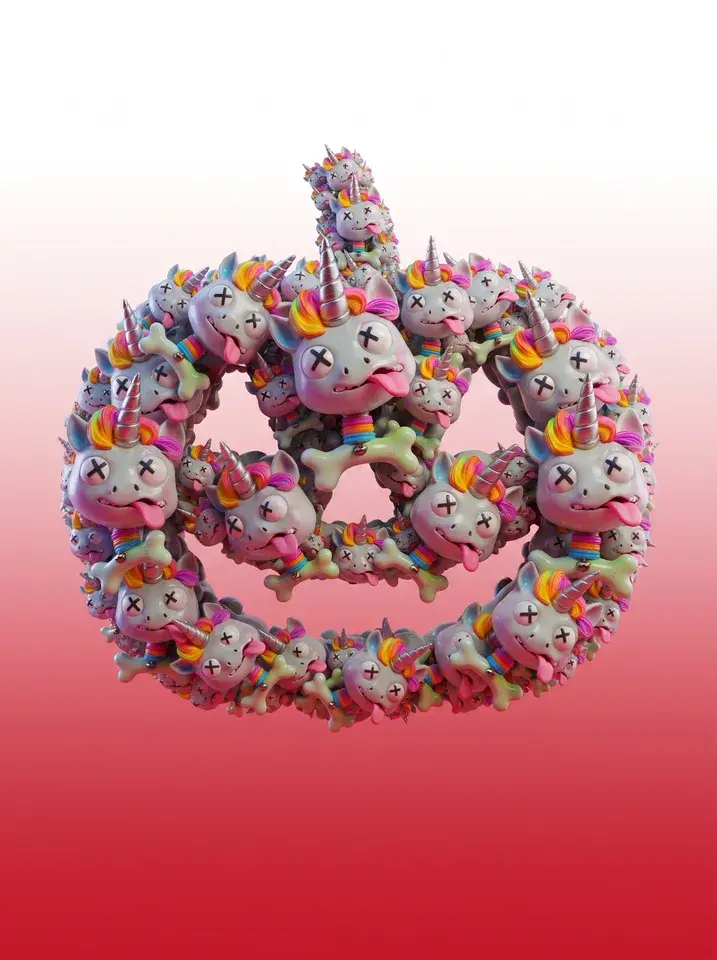
Nano Banana Pro
Copy
Create a premium photorealistic three-dimensional sculpture whose exact overall silhouette is taken from the first uploaded image and whose entire physical structure consists exclusively of complete replicas of the subjects shown in the second and subsequent reference images. Follow a strict two-stage construction process. First, reconstruct each referenced subject as one complete, anatomically and structurally coherent three-dimensional asset before assembling the final composition. When a reference shows only a portrait, face, head, bust, or cropped upper body, extrapolate the unseen anatomy to create a complete head-to-toe person with a naturally proportioned torso, shoulders, arms, hands, waist, hips, legs, and feet. Continue the visible clothing into a coherent complete outfit, including appropriate trousers, lower garments, and footwear matching the original styling, colors, and materials. Preserve the exact recognizable facial features, hairstyle, accessories, visible garments, and distinctive appearance of the reference. For animals and nonhuman subjects, reconstruct the complete recognizable object with its natural full structure and defining features. The resulting complete subject becomes the single indivisible building unit used throughout the sculpture. Every repeated instance must display a coherent full physical body or complete object, with a recognizable head-to-body relationship, intact proportions, and clearly articulated structural features. Only after establishing these complete assets, recreate the first image as a dense assembly of numerous replicas. Treat the first reference purely as the geometric definition of the final silhouette, including its exact outer contours, proportions, orientation, typography, internal openings, and negative spaces. Replace every solid region of that silhouette with tightly arranged complete referenced subjects, filling the entire visible area and three-dimensional thickness through carefully organized physical placement. The original graphic material disappears entirely. Arrange the replicas in an intricate, compact, three-dimensional composition using proportional scaling, varied rotations, naturally interlocking orientations, and controlled overlapping. Maintain a consistent relationship between subject size and silhouette thickness so each repeated figure remains clearly recognizable as a complete individual rather than an isolated face or unidentifiable fragment. Place subjects at varying depths while ensuring visible torso and lower-body structure across the composition. Preserve natural anatomical proportions, individual object boundaries, distinctive textures, and essential features. Smaller complete figures may occupy narrow details, while moderately sized complete figures form the
primary sculptural structure. The assembled objects themselves create the entire outer contour and all visible surfaces of the target shape, with accurately preserved internal openings remaining completely empty and revealing the background through the sculpture. The final image must read simultaneously as the precise original shape and as a dense construction of fully formed individual subjects. Present the complete sculpture levitating weightlessly in empty space, predominantly front-facing with subtle three-dimensional thickness, elegant framing, and generous negative space. The sculpture must appear fully suspended in the air with no floor, no ground plane, no surface, no pedestal, no platform, no support, and no environmental base of any kind. Render every subject with exceptional photorealistic geometry, faithful facial detail, realistic anatomy, intricate fabric and material textures, beautiful surface definition, and crisp edges. Use refined studio lighting with a broad directional key light and balanced fill illumination to reveal both the complete bodies and the dimensional depth of the assembly. Allow subtle contact shadows, inter-object cast shadows, and ambient occlusion only within the sculpture itself, where one replicated subject naturally shades another subject behind or beside it. Do not cast any shadow beneath the sculpture. Do not create a floor shadow, ground shadow, drop shadow, projected shadow, reflection shadow, or any diffuse darkening below the object. The background must remain perfectly clean and unaffected by the sculpture, with no shadow contamination, no grounding cue, and no indication of a surface below. Place the sculpture against a perfectly clean, seamless vertical digital gradient transitioning uniformly from pure white (#FFFFFF) at the top to the brightest vivid saturated color found on the main subject in the second uploaded reference at the bottom. Preserve the selected hue's brightness and saturation through a perfectly even, continuous linear color transition. The background remains a pristine, uninterrupted digital color field with no additional colors, darkening, radial lighting, atmospheric effects, texture, grain, vignetting, halos, floor, horizon, reflections, or projected shadows. The sculpture floats freely in pure open space. Exceptional high-end CGI, precise silhouette construction, faithful reference reproduction, complete full-body subject replication, natural anatomy, sophisticated dimensional arrangement, immaculate material quality, clean seamless gradient, and refined contemporary art direction.
Референс 1
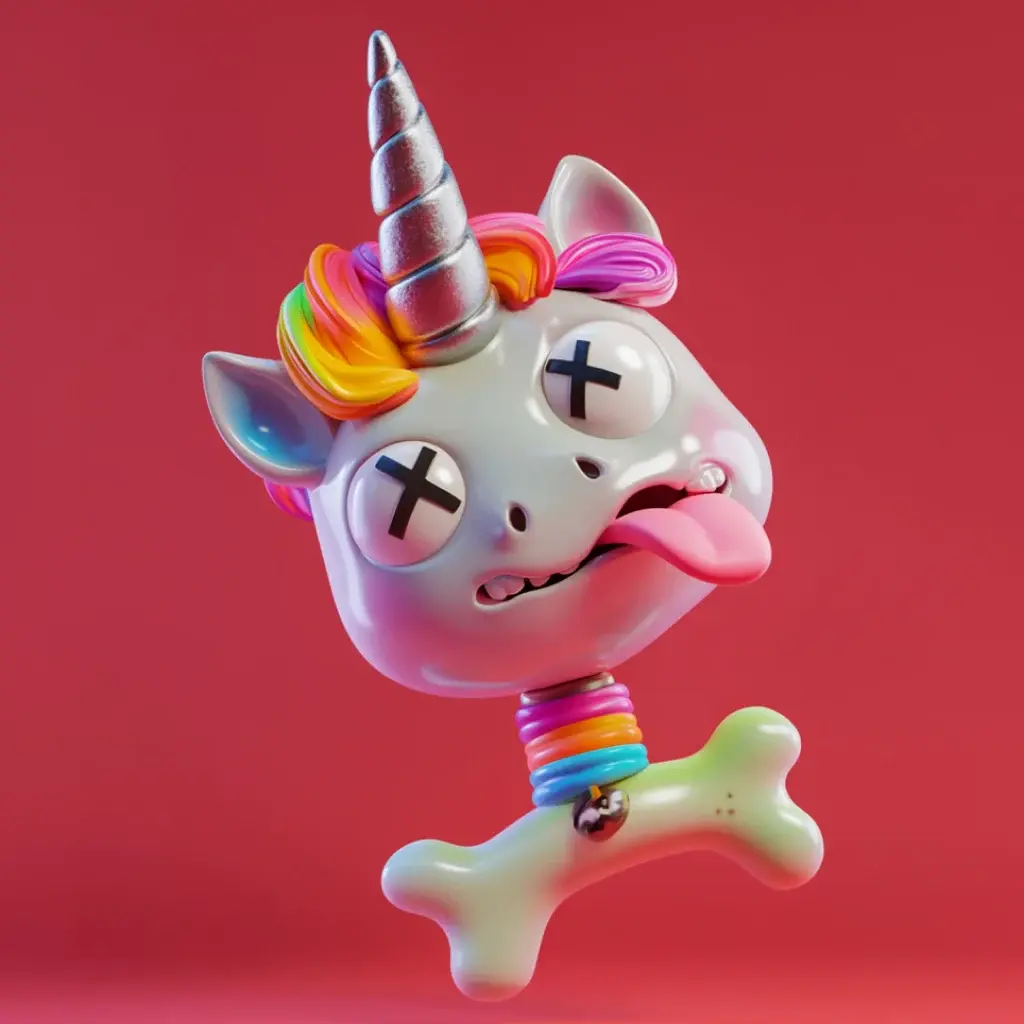
Референс 2
Nano Banana Pro
Copy
Create a premium photorealistic three-dimensional sculpture whose exact overall silhouette is taken from the first uploaded image and whose entire physical structure consists exclusively of complete replicas of the subjects shown in the second and subsequent reference images. Follow a strict two-stage construction process. First, reconstruct each referenced subject as one complete, anatomically and structurally coherent three-dimensional asset before assembling the final composition. When a reference shows only a portrait, face, head, bust, or cropped upper body, extrapolate the unseen anatomy to create a complete head-to-toe person with a naturally proportioned torso, shoulders, arms, hands, waist, hips, legs, and feet. Continue the visible clothing into a coherent complete outfit, including appropriate trousers, lower garments, and footwear matching the original styling, colors, and materials. Preserve the exact recognizable facial features, hairstyle, accessories, visible garments, and distinctive appearance of the reference. For animals and nonhuman subjects, reconstruct the complete recognizable object with its natural full structure and defining features. The resulting complete subject becomes the single indivisible building unit used throughout the sculpture. Every repeated instance must display a coherent full physical body or complete object, with a recognizable head-to-body relationship, intact proportions, and clearly articulated structural features. Only after establishing these complete assets, recreate the first image as a dense assembly of numerous replicas. Treat the first reference purely as the geometric definition of the final silhouette, including its exact outer contours, proportions, orientation, typography, internal openings, and negative spaces. Replace every solid region of that silhouette with tightly arranged complete referenced subjects, filling the entire visible area and three-dimensional thickness through carefully organized physical placement. The original graphic material disappears entirely. Arrange the replicas in an intricate, compact, three-dimensional composition using proportional scaling, varied rotations, naturally interlocking orientations, and controlled overlapping. Maintain a consistent relationship between subject size and silhouette thickness so each repeated figure remains clearly recognizable as a complete individual rather than an isolated face or unidentifiable fragment. Place subjects at varying depths while ensuring visible torso and lower-body structure across the composition. Preserve natural anatomical proportions, individual object boundaries, distinctive textures, and essential features. Smaller complete figures may occupy narrow details, while moderately sized complete figures form the
primary sculptural structure. The assembled objects themselves create the entire outer contour and all visible surfaces of the target shape, with accurately preserved internal openings remaining completely empty and revealing the background through the sculpture. The final image must read simultaneously as the precise original shape and as a dense construction of fully formed individual subjects. Present the complete sculpture levitating weightlessly in empty space, predominantly front-facing with subtle three-dimensional thickness, elegant framing, and generous negative space. The sculpture must appear fully suspended in the air with no floor, no ground plane, no surface, no pedestal, no platform, no support, and no environmental base of any kind. Render every subject with exceptional photorealistic geometry, faithful facial detail, realistic anatomy, intricate fabric and material textures, beautiful surface definition, and crisp edges. Use refined studio lighting with a broad directional key light and balanced fill illumination to reveal both the complete bodies and the dimensional depth of the assembly. Allow subtle contact shadows, inter-object cast shadows, and ambient occlusion only within the sculpture itself, where one replicated subject naturally shades another subject behind or beside it. Do not cast any shadow beneath the sculpture. Do not create a floor shadow, ground shadow, drop shadow, projected shadow, reflection shadow, or any diffuse darkening below the object. The background must remain perfectly clean and unaffected by the sculpture, with no shadow contamination, no grounding cue, and no indication of a surface below. Place the sculpture against a perfectly clean, seamless vertical digital gradient transitioning uniformly from pure white (#FFFFFF) at the top to the brightest vivid saturated color found on the main subject in the second uploaded reference at the bottom. Preserve the selected hue's brightness and saturation through a perfectly even, continuous linear color transition. The background remains a pristine, uninterrupted digital color field with no additional colors, darkening, radial lighting, atmospheric effects, texture, grain, vignetting, halos, floor, horizon, reflections, or projected shadows. The sculpture floats freely in pure open space. Exceptional high-end CGI, precise silhouette construction, faithful reference reproduction, complete full-body subject replication, natural anatomy, sophisticated dimensional arrangement, immaculate material quality, clean seamless gradient, and refined contemporary art direction.

Референс 1
Референс 2
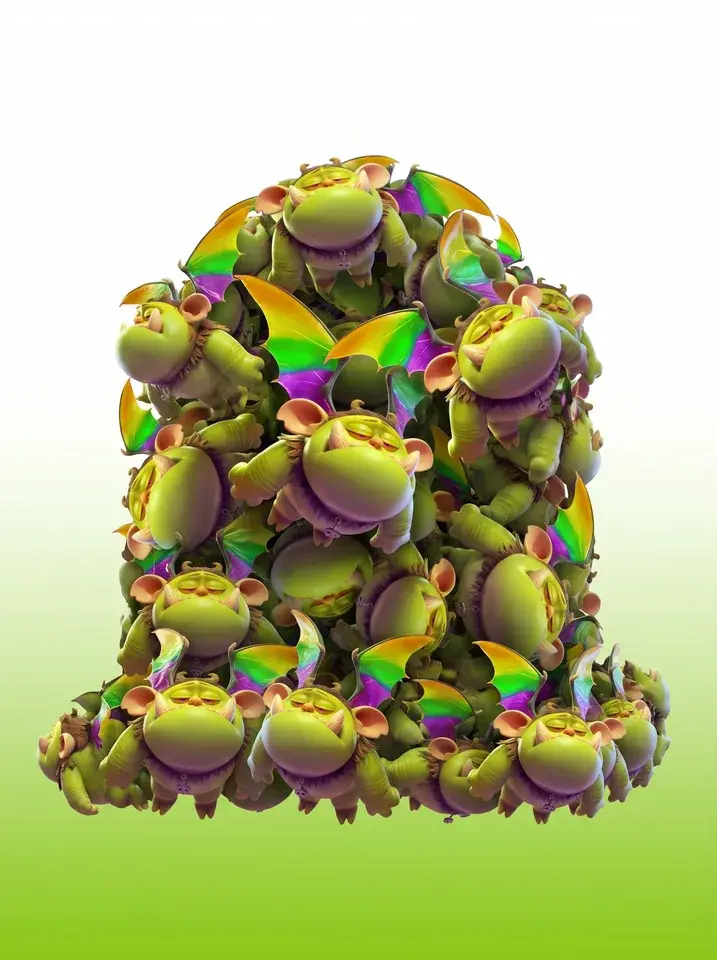
Nano Banana Pro
Copy
Create a premium photorealistic three-dimensional sculpture whose exact overall silhouette is taken from the first uploaded image and whose entire physical structure consists exclusively of complete replicas of the subjects shown in the second and subsequent reference images. Follow a strict two-stage construction process. First, reconstruct each referenced subject as one complete, anatomically and structurally coherent three-dimensional asset before assembling the final composition. When a reference shows only a portrait, face, head, bust, or cropped upper body, extrapolate the unseen anatomy to create a complete head-to-toe person with a naturally proportioned torso, shoulders, arms, hands, waist, hips, legs, and feet. Continue the visible clothing into a coherent complete outfit, including appropriate trousers, lower garments, and footwear matching the original styling, colors, and materials. Preserve the exact recognizable facial features, hairstyle, accessories, visible garments, and distinctive appearance of the reference. For animals and nonhuman subjects, reconstruct the complete recognizable object with its natural full structure and defining features. The resulting complete subject becomes the single indivisible building unit used throughout the sculpture. Every repeated instance must display a coherent full physical body or complete object, with a recognizable head-to-body relationship, intact proportions, and clearly articulated structural features. Only after establishing these complete assets, recreate the first image as a dense assembly of numerous replicas. Treat the first reference purely as the geometric definition of the final silhouette, including its exact outer contours, proportions, orientation, typography, internal openings, and negative spaces. Replace every solid region of that silhouette with tightly arranged complete referenced subjects, filling the entire visible area and three-dimensional thickness through carefully organized physical placement. The original graphic material disappears entirely. Arrange the replicas in an intricate, compact, three-dimensional composition using proportional scaling, varied rotations, naturally interlocking orientations, and controlled overlapping. Maintain a consistent relationship between subject size and silhouette thickness so each repeated figure remains clearly recognizable as a complete individual rather than an isolated face or unidentifiable fragment. Place subjects at varying depths while ensuring visible torso and lower-body structure across the composition. Preserve natural anatomical proportions, individual object boundaries, distinctive textures, and essential features. Smaller complete figures may occupy narrow details, while moderately sized complete figures form the
primary sculptural structure. The assembled objects themselves create the entire outer contour and all visible surfaces of the target shape, with accurately preserved internal openings remaining completely empty and revealing the background through the sculpture. The final image must read simultaneously as the precise original shape and as a dense construction of fully formed individual subjects. Present the complete sculpture levitating weightlessly in empty space, predominantly front-facing with subtle three-dimensional thickness, elegant framing, and generous negative space. The sculpture must appear fully suspended in the air with no floor, no ground plane, no surface, no pedestal, no platform, no support, and no environmental base of any kind. Render every subject with exceptional photorealistic geometry, faithful facial detail, realistic anatomy, intricate fabric and material textures, beautiful surface definition, and crisp edges. Use refined studio lighting with a broad directional key light and balanced fill illumination to reveal both the complete bodies and the dimensional depth of the assembly. Allow subtle contact shadows, inter-object cast shadows, and ambient occlusion only within the sculpture itself, where one replicated subject naturally shades another subject behind or beside it. Do not cast any shadow beneath the sculpture. Do not create a floor shadow, ground shadow, drop shadow, projected shadow, reflection shadow, or any diffuse darkening below the object. The background must remain perfectly clean and unaffected by the sculpture, with no shadow contamination, no grounding cue, and no indication of a surface below. Place the sculpture against a perfectly clean, seamless vertical digital gradient transitioning uniformly from pure white (#FFFFFF) at the top to the brightest vivid saturated color found on the main subject in the second uploaded reference at the bottom. Preserve the selected hue's brightness and saturation through a perfectly even, continuous linear color transition. The background remains a pristine, uninterrupted digital color field with no additional colors, darkening, radial lighting, atmospheric effects, texture, grain, vignetting, halos, floor, horizon, reflections, or projected shadows. The sculpture floats freely in pure open space. Exceptional high-end CGI, precise silhouette construction, faithful reference reproduction, complete full-body subject replication, natural anatomy, sophisticated dimensional arrangement, immaculate material quality, clean seamless gradient, and refined contemporary art direction.

Референс 1
Референс 2
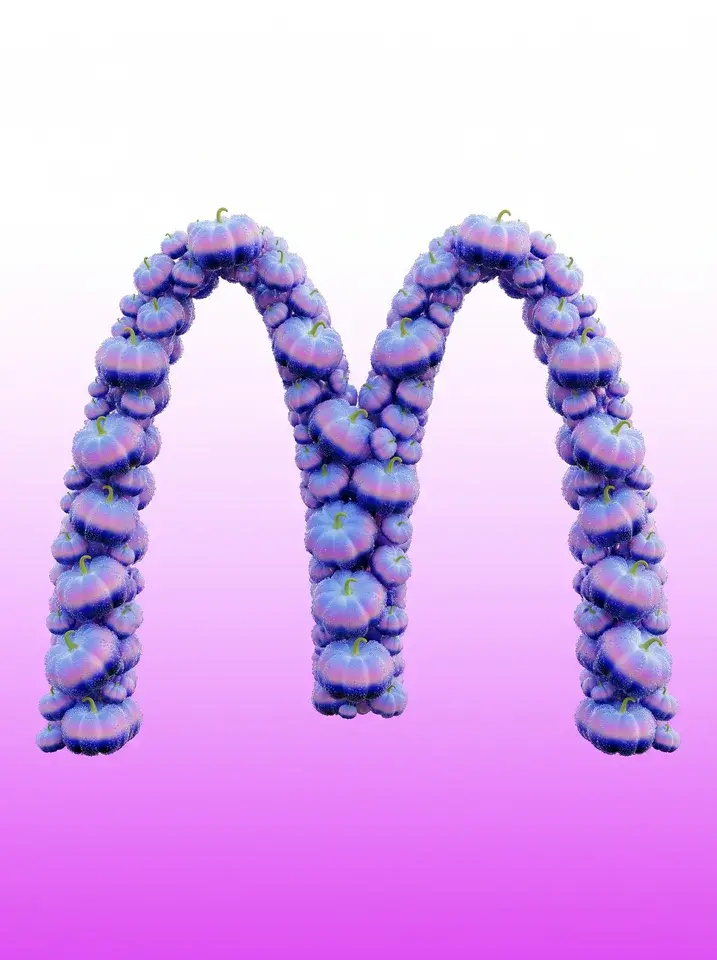
Nano Banana Pro
Copy
Create a high-end photorealistic 3D sculpture that exactly reproduces the complete shape of the first uploaded image, constructed entirely from tightly arranged copies of the subjects in the second and subsequent reference images. The first image is a geometry-only guide: preserve its precise silhouette, proportions, layout, letterforms, spacing, and all open negative spaces. Replace every solid visible area of that shape with a dense arrangement of the actual referenced subjects. Only the subjects from the additional reference images may appear as physical building elements. Preserve each subject's complete recognizable appearance, natural proportions, defining features, colors, clothing, accessories, and detailed surface textures. Reproduce each subject as an intact miniature three-dimensional replica, uniformly scaled and positioned at different natural orientations. Arrange these replicas in a compact, visually balanced, organic three-dimensional structure that fills the entire width and thickness of every part of the target shape, including its central areas and outer edges. Allow natural overlaps while keeping the individual subjects clearly identifiable and their essential parts intact. Vary scale within a controlled range, using smaller complete replicas for narrow sections and intricate details. The subjects themselves form every visible surface and boundary of the final sculpture. The original solid graphic is completely replaced by these objects, with its color and surface entirely absent. Preserve every internal opening as a genuine empty space through which the background is clearly visible. Maintain a precise, unmistakable outer silhouette and clean, accurately shaped negative spaces. Present the completed sculpture floating weightlessly in open space, viewed almost directly from the front with subtle visible dimensional thickness. Keep the full composition centered and surrounded by generous empty space. Render with crisp, faithful geometry, exceptional individual subject detail, realistic material textures, refined directional studio lighting, balanced fill illumination, and subtle contact shadows between neighboring objects. Use a perfectly smooth, clean, vertical digital gradient background transitioning uniformly from pure white (#FFFFFF) at the top to the brightest saturated color found on the main subject in the second reference at the bottom. Maintain the exact vivid hue of that color, with a continuous, even transition and no additional colors, lighting effects, textures, hotspots, vignetting, or uneven patches. The sculpture remains suspended in empty space without a floor, support, horizon, or projected shadow. Premium CGI, precise silhouette reconstruction, complete recognizable objects, carefully controlled density,
sophisticated material rendering, and immaculate contemporary art direction.
Референс 1
Референс 2

Nano Banana Pro
Copy
Create a premium high-end three-dimensional assemblage in which the exact overall shape from IMAGE 1 is formed entirely and exclusively by numerous separate, complete, faithfully reproduced copies of the subjects shown in IMAGE 2 and all subsequent object references. Treat IMAGE 1 only as a geometric blueprint for the final outer silhouette, proportions, curves, orientation, thickness, internal openings, and overall spatial attitude. IMAGE 1 must never appear as a visible material, wrapper, shell, core, filler, smooth surface, backing, membrane, skin, support, or structural base. The finished composition must contain only two things: the repeated subjects from IMAGE 2 and the clean background. No other visible material category is allowed. If all repeated subjects were removed, nothing of the shape from IMAGE 1 would remain. The entire shape must be physically built from the referenced subjects themselves, not decorated with them and not covered by them. Every solid region of the target form, including the center, outer contour, narrow tips, side edges, and full visible depth, must consist exclusively of the repeated subjects. Do not place the objects merely on the surface of a preexisting form. Do not embed them into a smooth body. Do not wrap them around a solid core. Do not create any visible candy body, wrapper, ribbon, skin, metallic foil, shell, smooth connecting layer, or continuous mass derived from IMAGE 1. The recognizable form from IMAGE 1 must emerge only from the collective arrangement, density, and outer boundaries of the repeated subjects. All visible surfaces belong to the repeated subjects themselves. Preserve each subject from IMAGE 2 and any additional references with maximum fidelity. Maintain exact recognizable identity, anatomy, proportions, colors, materials, textures, clothing, accessories, and defining structural features. If a subject is partially visible, reconstruct it into one complete coherent full object or full-body figure while naturally continuing the same original styling, outfit logic, and material language. Every repeated instance must remain a distinct, structurally intact, fully recognizable replica of that same subject. Do not invent new materials, stretched connecting shapes, abstract filler forms, melted masses, or simplified surrogate geometry. Arrange the repeated subjects as separate independent elements with correct anatomy or object geometry, complete limbs where applicable, intact clothing, and clear boundaries. Use varied but controlled natural poses, rotations, and orientations to make the assembly visually rich and more interesting to inspect up close, while preserving full recognizability and structural integrity. Allow subjects to stand, sit, lean, recline, bend, crouch, or gently twist only within
natural believable limits. Do not deform them to fit the silhouette. Do not fuse them together. Do not merge bodies, share limbs, duplicate heads, stretch torsos, create hybrid anatomy, or allow one subject to dissolve into another. Maintain clear independent silhouettes and clean separation between neighboring objects. Build a dense but readable composition with multiple spatial layers and controlled overlaps. Use mostly medium-sized high-fidelity replicas and smaller complete replicas only where necessary for narrow contours, pointed ends, or intricate sections. Preserve strong subject readability, clear material definition, and crisp individual silhouettes throughout the composition. Maintain consistent object density across both central areas and outer boundaries, ensuring that the whole target form is genuinely constructed from the subjects rather than simply outlined by them. Preserve all true internal openings and negative spaces from IMAGE 1 as fully empty open gaps with the background visible directly through them. Present the complete assemblage as a weightless levitating object in empty space. Use a refined three-quarter frontal camera angle with a subtle yet elegant spatial turn, preserving the legibility of the original silhouette while revealing convincing thickness, front-to-back layering, and dynamic levitation. Retain and reinforce the original tilt or dynamic attitude of IMAGE 1 where relevant. The sculpture should feel suspended, balanced, and alive in space rather than frontally pasted onto the background. Use sophisticated studio lighting to create dimensional depth inside the assemblage. Apply a directional key light from above and to one side, with balanced fill illumination, so that foreground subjects cast realistic shadows only onto neighboring and recessed subjects inside the assemblage. Allow contact shadows, inter-object cast shadows, and ambient occlusion only where the repeated subjects physically overlap or sit close together. Keep all shadows confined to the assemblage itself. Absolutely no shadow, reflection, dark patch, grounding cue, contact patch, ambient darkening, occlusion halo, or projected shape is allowed beneath the sculpture or anywhere on the background. There is no floor, no ground plane, no invisible surface, no pedestal, no support, and no surface receiving light or shadow. The background must remain completely untouched by the object. Render the image with exceptional high-end CGI quality, sharp geometry, crisp edges, accurate materials, fine textures, clean subject separation, and excellent readability. Avoid plastic-looking oversimplification, blur, mushy detail, artificial smoothing, or low-detail repetition. Place the levitating assemblage against a perfectly smooth, seamless vertical digital
gradient transitioning from pure white (#FFFFFF) at the top to the single dominant bright saturated color of the primary subject in IMAGE 2 at the bottom. Use exactly two color endpoints and one clean continuous linear transition. The gradient must remain uniform, textureless, and perfectly clean across the entire frame, with no additional colors, no dirty mixing, no vignette, no atmosphere, no haze, no radial glow, no uneven patches, no horizon cue, and no localized darkening beneath the object. The lower part of the frame must remain the same clean gradient field, not a floor-like area. The final result should read immediately as the exact shape from IMAGE 1 and, on closer inspection, as a fully volumetric levitating construction made entirely from distinct, complete, faithful replicas of the subjects from IMAGE 2.
Референс 1

Референс 2
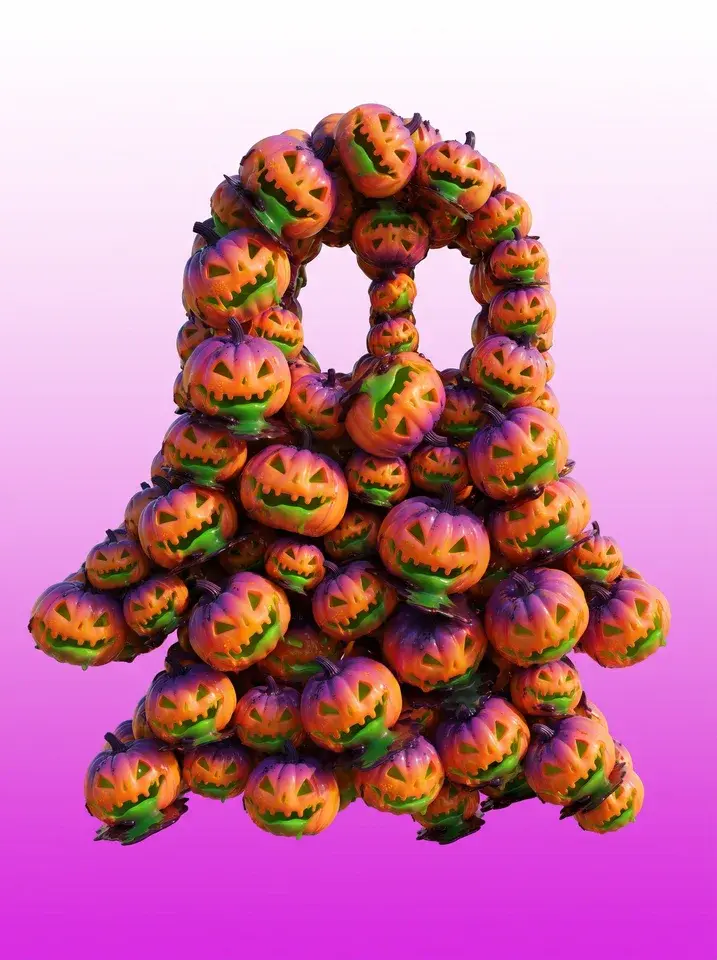
Nano Banana Pro
Copy
Create a premium photorealistic three-dimensional assemblage whose exact overall silhouette matches IMAGE 1, constructed exclusively from numerous separate, complete, faithfully reproduced copies of the subjects in IMAGE 2 and all subsequent references. IMAGE 1 defines only the precise geometry, proportions, curves, typography, spacing, stroke thickness, and internal openings. The shape emerges entirely from the physical arrangement of these objects, which form every solid region across its full width, height, and depth. The original graphic is completely absent as a physical surface, backing, shell, or filler. Every visible part of the sculpture consists exclusively of the referenced subjects. Preserve each subject's recognizable identity, anatomy, proportions, clothing, accessories, original colors, intricate textures, and material properties with maximum fidelity. For partially visible subjects, reconstruct complete coherent objects or full-body characters, naturally continuing their original outfit and styling. Every repeated instance remains a distinct, structurally intact object with correct geometry and anatomy, including complete limbs and footwear where applicable. Create a sophisticated arrangement of varied natural poses, rotations, and controlled proportional scales, allowing subjects to stand, sit, lean, recline, bend, or curl while preserving their anatomy, clothing, and individual recognizable features. Arrange them closely in multiple spatial layers with carefully controlled overlaps and convincing physical contact, maintaining separate bodies, correct limb connections, and realistic object boundaries. Achieve dense packing through intelligent positioning rather than deformation, fusion, or compression. Use smaller complete replicas where necessary for narrow contours, while keeping most subjects sufficiently large for clear individual readability. Preserve the exact outer silhouette and all internal openings of IMAGE 1, with genuine empty spaces revealing the background directly through the construction. Maintain consistent object density throughout the central regions and exterior edges, ensuring the entire shape is physically constructed from the referenced objects rather than merely outlined or decorated. Give the sculpture pronounced dimensional depth through sophisticated directional studio lighting and physically accurate inter-object shadow casting. Use a strong, broad directional key light positioned above and to one side, producing beautifully defined highlights on the foreground objects and distinct cast shadows falling naturally across the surfaces of neighboring objects positioned behind them. Every foreground element should cast spatially consistent shadows onto the underlying and recessed elements according to their
actual relative positions. Create rich contact shadows at points of physical interaction, deeper ambient occlusion inside tightly packed areas, and visible light-to-shadow transitions that reveal the layered arrangement. Maintain realistic shadow softness appropriate to the light source, with defined shadow edges near contact points and progressively softer shadows across more distant surfaces. Preserve readable textures, accurate colors, and recognizable details within the shadowed areas through controlled complementary fill illumination. Establish a clear hierarchy of illuminated foreground subjects, partially shadowed middle layers, and deeper recessed objects, creating dimensional separation without turning the interior into an indistinguishable dark mass. Allow the combined highlights, cast shadows, and subtle occlusion to emphasize the recognizable geometry of the overall silhouette. Preserve high-quality skin, fabric, hair, and material textures, natural roughness, fine details, sharp individual geometry, and realistic surface response. The result should resemble an expertly lit physical installation photographed in a professional studio, with exceptional material fidelity rather than a plastic or artificial appearance. Present the complete sculpture levitating freely in empty space, predominantly front-facing with subtle visible thickness, fully centered and surrounded by generous negative space. Place it against a perfectly smooth, seamless vertical digital gradient transitioning from pure white (#FFFFFF) at the top to the brightest dominant saturated color belonging to the main subject in IMAGE 2 at the bottom. Use a single uniform linear transition with clean, consistent color distribution, free of texture, uneven patches, atmospheric effects, halos, vignetting, and additional colors. Keep the background independent of the sculpture's lighting. All cast shadows occur exclusively between objects within the sculpture, never on the background or an imaginary floor. The sculpture floats without any visible support, pedestal, ground plane, horizon, or projected shadow. Exceptional high-end photorealistic CGI, exact silhouette reconstruction, separate anatomically correct objects, faithful reference materials, expressive natural posing, pronounced inter-object shadows, refined volumetric depth, and sophisticated contemporary art direction.
Референс 1

Референс 2
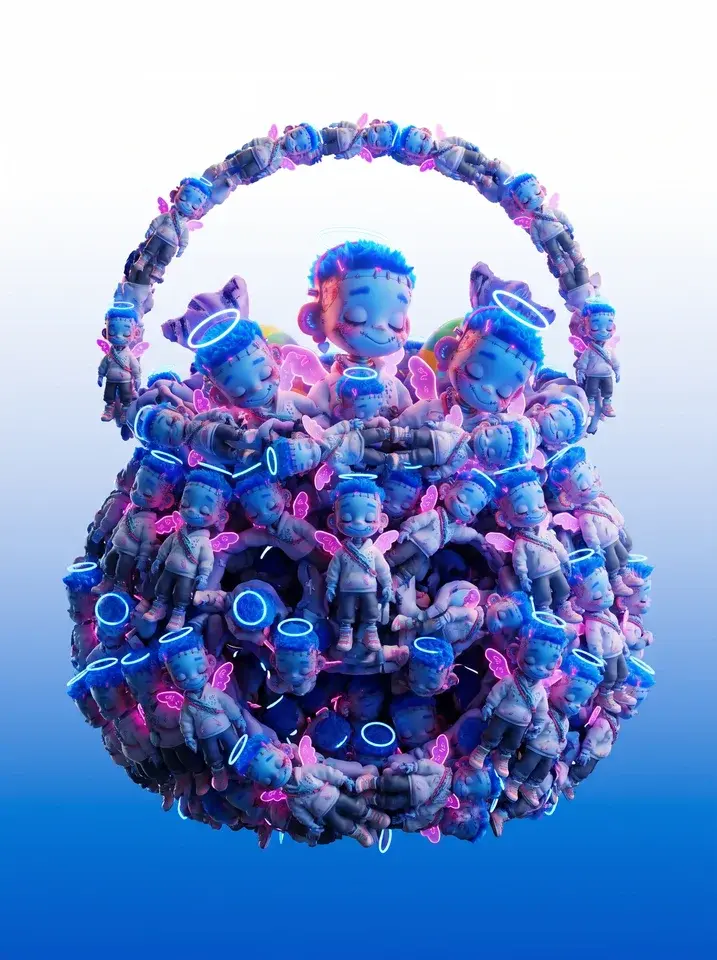
Nano Banana Pro
Copy
Create a premium high-end three-dimensional assemblage in which the exact overall shape from IMAGE 1 is formed entirely and exclusively by numerous separate, complete, faithfully reproduced copies of the subjects shown in IMAGE 2 and all subsequent object references. Treat IMAGE 1 only as a geometric blueprint for the final outer silhouette, proportions, curves, orientation, thickness, internal openings, and overall spatial attitude. IMAGE 1 must never appear as a visible material, wrapper, shell, core, filler, smooth surface, backing, membrane, skin, support, or structural base. The finished composition must contain only two things: the repeated subjects from IMAGE 2 and the clean background. No other visible material category is allowed. If all repeated subjects were removed, nothing of the shape from IMAGE 1 would remain. The entire shape must be physically built from the referenced subjects themselves, not decorated with them and not covered by them. Every solid region of the target form, including the center, outer contour, narrow tips, side edges, and full visible depth, must consist exclusively of the repeated subjects. Do not place the objects merely on the surface of a preexisting form. Do not embed them into a smooth body. Do not wrap them around a solid core. Do not create any visible candy body, wrapper, ribbon, skin, metallic foil, shell, smooth connecting layer, or continuous mass derived from IMAGE 1. The recognizable form from IMAGE 1 must emerge only from the collective arrangement, density, and outer boundaries of the repeated subjects. All visible surfaces belong to the repeated subjects themselves. Preserve each subject from IMAGE 2 and any additional references with maximum fidelity. Maintain exact recognizable identity, anatomy, proportions, colors, materials, textures, clothing, accessories, and defining structural features. If a subject is partially visible, reconstruct it into one complete coherent full object or full-body figure while naturally continuing the same original styling, outfit logic, and material language. Every repeated instance must remain a distinct, structurally intact, fully recognizable replica of that same subject. Do not invent new materials, stretched connecting shapes, abstract filler forms, melted masses, or simplified surrogate geometry. Arrange the repeated subjects as separate independent elements with correct anatomy or object geometry, complete limbs where applicable, intact clothing, and clear boundaries. Use varied but controlled natural poses, rotations, and orientations to make the assembly visually rich and more interesting to inspect up close, while preserving full recognizability and structural integrity. Allow subjects to stand, sit, lean, recline, bend, crouch, or gently twist only within
natural believable limits. Do not deform them to fit the silhouette. Do not fuse them together. Do not merge bodies, share limbs, duplicate heads, stretch torsos, create hybrid anatomy, or allow one subject to dissolve into another. Maintain clear independent silhouettes and clean separation between neighboring objects. Build a dense but readable composition with multiple spatial layers and controlled overlaps. Use mostly medium-sized high-fidelity replicas and smaller complete replicas only where necessary for narrow contours, pointed ends, or intricate sections. Preserve strong subject readability, clear material definition, and crisp individual silhouettes throughout the composition. Maintain consistent object density across both central areas and outer boundaries, ensuring that the whole target form is genuinely constructed from the subjects rather than simply outlined by them. Preserve all true internal openings and negative spaces from IMAGE 1 as fully empty open gaps with the background visible directly through them. Present the complete assemblage as a weightless levitating object in empty space. Use a refined three-quarter frontal camera angle with a subtle yet elegant spatial turn, preserving the legibility of the original silhouette while revealing convincing thickness, front-to-back layering, and dynamic levitation. Retain and reinforce the original tilt or dynamic attitude of IMAGE 1 where relevant. The sculpture should feel suspended, balanced, and alive in space rather than frontally pasted onto the background. Use sophisticated studio lighting to create dimensional depth inside the assemblage. Apply a directional key light from above and to one side, with balanced fill illumination, so that foreground subjects cast realistic shadows only onto neighboring and recessed subjects inside the assemblage. Allow contact shadows, inter-object cast shadows, and ambient occlusion only where the repeated subjects physically overlap or sit close together. Keep all shadows confined to the assemblage itself. Absolutely no shadow, reflection, dark patch, grounding cue, contact patch, ambient darkening, occlusion halo, or projected shape is allowed beneath the sculpture or anywhere on the background. There is no floor, no ground plane, no invisible surface, no pedestal, no support, and no surface receiving light or shadow. The background must remain completely untouched by the object. Render the image with exceptional high-end CGI quality, sharp geometry, crisp edges, accurate materials, fine textures, clean subject separation, and excellent readability. Avoid plastic-looking oversimplification, blur, mushy detail, artificial smoothing, or low-detail repetition. Place the levitating assemblage against a perfectly smooth, seamless vertical digital
gradient transitioning from pure white (#FFFFFF) at the top to the single dominant bright saturated color of the primary subject in IMAGE 2 at the bottom. Use exactly two color endpoints and one clean continuous linear transition. The gradient must remain uniform, textureless, and perfectly clean across the entire frame, with no additional colors, no dirty mixing, no vignette, no atmosphere, no haze, no radial glow, no uneven patches, no horizon cue, and no localized darkening beneath the object. The lower part of the frame must remain the same clean gradient field, not a floor-like area. The final result should read immediately as the exact shape from IMAGE 1 and, on closer inspection, as a fully volumetric levitating construction made entirely from distinct, complete, faithful replicas of the subjects from IMAGE 2.

Референс 1
Референс 2

Nano Banana Pro
Copy
Create a premium, meticulously art-directed three-dimensional composition made exclusively from faithful, individually recognizable replicas of the subjects in IMAGE 2 and all subsequent object references. Arrange these independent subjects so that their combined physical volume recreates the precise shape shown in IMAGE 1. Preserve IMAGE 1 as the definitive geometric reference for the overall silhouette, proportions, orientation, contour, curves, pointed ends, openings, and three-dimensional structure. Retain its original dynamic tilt and spatial orientation where visible. The original shape serves only as a geometric guide; the final sculpture consists entirely of the referenced subjects themselves, with every solid area filled by their physical forms and absolutely no separate backing, smooth connecting material, graphic overlay, or underlying shell. Treat the primary subjects from IMAGE 2 onward as fixed, high-fidelity visual assets. Their original appearance is immutable: preserve exact character design, facial identity, head shape, body proportions, anatomy, clothing, accessories, footwear, colors, material distribution, surface textures, and distinctive structural details. Each repeated subject must look like a faithful copy of the uploaded reference rather than a newly invented variation. Preserve the original rendering style, whether photographic, illustrated, stylized 3D, or realistic CGI. Reproduce individual materials exactly where they belong on the original subject, retaining their characteristic texture, roughness, color, and finish. Keep all garments and accessories attached in their correct original positions. Introduce no additional fabric masses, elongated connecting shapes, stretched clothing, invented decorative elements, or unrelated materials. Arrange the replicas as separate, fully formed physical elements with clearly distinguishable silhouettes and consistent anatomical integrity. Use moderate variations in pose and orientation while preserving natural joint movement, correct limb proportions, complete bodies, and recognizable individual identities. Create pose diversity through controlled changes in stance, seated positions, gentle body turns, arm placement, and leg positioning, rather than extreme bending or twisting. Maintain a coherent range of object scales, with smaller complete replicas only where needed to resolve narrow portions of the silhouette. Organize the individual elements into a dense but visually clean composition, allowing carefully controlled overlaps and natural physical contact while retaining visible boundaries between neighboring subjects. Objects remain structurally independent, with no shared anatomy, merged limbs, duplicated heads, stretched torsos, or distorted geometric connections. Fill the
entire solid silhouette of IMAGE 1 with these complete subjects, from its center to its exterior edges and throughout its visible three-dimensional thickness. The combined arrangement itself creates the recognizable shape, with all original openings and negative spaces preserved as genuinely empty areas through which the background is visible. Maintain accurate contour definition and clear shape readability from the final viewing angle. The finished sculpture must contain only the referenced subjects, assembled into the original geometric form. Suspend the complete sculpture weightlessly in open space with a refined, visually engaging three-dimensional orientation. Use a carefully controlled three-quarter perspective with a modest spatial tilt that complements the original shape, reveals its thickness, and maintains immediate silhouette recognition. Rotate the assembled structure as one coherent object, preserving the integrity and relative placement of its individual components. Keep the entire sculpture fully visible, elegantly framed, and surrounded by generous negative space. Illuminate the sculpture with a controlled directional key light positioned above and to one side, creating beautifully defined highlights and realistic shadows cast by foreground subjects onto neighboring subjects behind them. Use balanced fill illumination to preserve clear facial features, accurate material colors, and detailed textures within recessed areas. Maintain rich but controlled contact shadows, natural depth separation, and convincing light-to-shadow transitions throughout the assembly. All shadows remain confined to the physical subjects themselves. Render the subjects with exceptional visual fidelity, crisp geometry, accurately preserved original materials, high-resolution textures, fine surface detail, realistic light response, and clean subject separation. Maintain the authentic visual character of the uploaded references without introducing plastic-like simplification, artificial smoothing, or stylized reinterpretation. Place the floating sculpture against a perfectly smooth, seamless vertical digital gradient transitioning from pure white (#FFFFFF) at the top to the dominant vivid color of the primary subject in IMAGE 2 at the bottom. The gradient uses exactly two color endpoints and one continuous, uniform linear interpolation, with a perfectly clean, textureless appearance across the entire frame. The background remains independent of the sculpture's illumination, with consistent color across every horizontal level and no localized brightness variations, additional color patches, atmosphere, vignette, or projected shadows. The entire composition floats in infinite empty space without any floor, pedestal, support, ground plane, horizon, or shadow beneath
it. Premium high-resolution CGI, precise reference preservation, distinct complete objects, elegant volumetric construction, natural pose variation, controlled dynamic levitation, realistic inter-object shadows, sophisticated materials, and clean contemporary art direction.
Референс 1
Референс 2
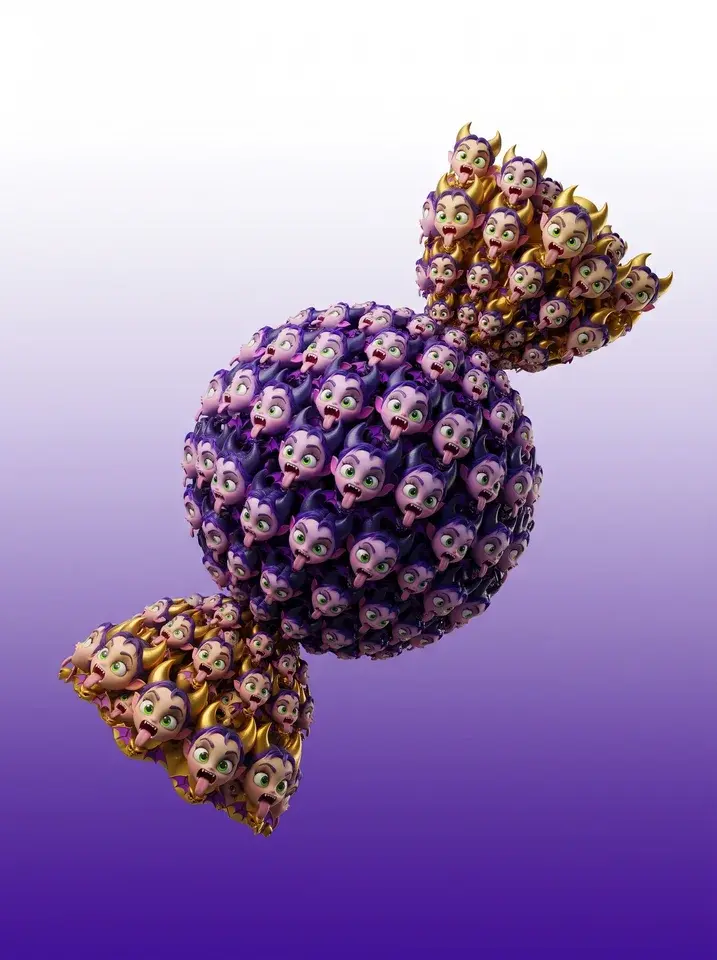
Nano Banana Pro
Copy
Create a premium, meticulously art-directed three-dimensional composition made exclusively from faithful, individually recognizable replicas of the subjects in IMAGE 2 and all subsequent object references. Arrange these independent subjects so that their combined physical volume recreates the precise shape shown in IMAGE 1. Preserve IMAGE 1 as the definitive geometric reference for the overall silhouette, proportions, orientation, contour, curves, pointed ends, openings, and three-dimensional structure. Retain its original dynamic tilt and spatial orientation where visible. The original shape serves only as a geometric guide; the final sculpture consists entirely of the referenced subjects themselves, with every solid area filled by their physical forms and absolutely no separate backing, smooth connecting material, graphic overlay, or underlying shell. Treat the primary subjects from IMAGE 2 onward as fixed, high-fidelity visual assets. Their original appearance is immutable: preserve exact character design, facial identity, head shape, body proportions, anatomy, clothing, accessories, footwear, colors, material distribution, surface textures, and distinctive structural details. Each repeated subject must look like a faithful copy of the uploaded reference rather than a newly invented variation. Preserve the original rendering style, whether photographic, illustrated, stylized 3D, or realistic CGI. Reproduce individual materials exactly where they belong on the original subject, retaining their characteristic texture, roughness, color, and finish. Keep all garments and accessories attached in their correct original positions. Introduce no additional fabric masses, elongated connecting shapes, stretched clothing, invented decorative elements, or unrelated materials. Arrange the replicas as separate, fully formed physical elements with clearly distinguishable silhouettes and consistent anatomical integrity. Use moderate variations in pose and orientation while preserving natural joint movement, correct limb proportions, complete bodies, and recognizable individual identities. Create pose diversity through controlled changes in stance, seated positions, gentle body turns, arm placement, and leg positioning, rather than extreme bending or twisting. Maintain a coherent range of object scales, with smaller complete replicas only where needed to resolve narrow portions of the silhouette. Organize the individual elements into a dense but visually clean composition, allowing carefully controlled overlaps and natural physical contact while retaining visible boundaries between neighboring subjects. Objects remain structurally independent, with no shared anatomy, merged limbs, duplicated heads, stretched torsos, or distorted geometric connections. Fill the
entire solid silhouette of IMAGE 1 with these complete subjects, from its center to its exterior edges and throughout its visible three-dimensional thickness. The combined arrangement itself creates the recognizable shape, with all original openings and negative spaces preserved as genuinely empty areas through which the background is visible. Maintain accurate contour definition and clear shape readability from the final viewing angle. The finished sculpture must contain only the referenced subjects, assembled into the original geometric form. Suspend the complete sculpture weightlessly in open space with a refined, visually engaging three-dimensional orientation. Use a carefully controlled three-quarter perspective with a modest spatial tilt that complements the original shape, reveals its thickness, and maintains immediate silhouette recognition. Rotate the assembled structure as one coherent object, preserving the integrity and relative placement of its individual components. Keep the entire sculpture fully visible, elegantly framed, and surrounded by generous negative space. Illuminate the sculpture with a controlled directional key light positioned above and to one side, creating beautifully defined highlights and realistic shadows cast by foreground subjects onto neighboring subjects behind them. Use balanced fill illumination to preserve clear facial features, accurate material colors, and detailed textures within recessed areas. Maintain rich but controlled contact shadows, natural depth separation, and convincing light-to-shadow transitions throughout the assembly. All shadows remain confined to the physical subjects themselves. Render the subjects with exceptional visual fidelity, crisp geometry, accurately preserved original materials, high-resolution textures, fine surface detail, realistic light response, and clean subject separation. Maintain the authentic visual character of the uploaded references without introducing plastic-like simplification, artificial smoothing, or stylized reinterpretation. Place the floating sculpture against a perfectly smooth, seamless vertical digital gradient transitioning from pure white (#FFFFFF) at the top to the dominant vivid color of the primary subject in IMAGE 2 at the bottom. The gradient uses exactly two color endpoints and one continuous, uniform linear interpolation, with a perfectly clean, textureless appearance across the entire frame. The background remains independent of the sculpture's illumination, with consistent color across every horizontal level and no localized brightness variations, additional color patches, atmosphere, vignette, or projected shadows. The entire composition floats in infinite empty space without any floor, pedestal, support, ground plane, horizon, or shadow beneath
it. Premium high-resolution CGI, precise reference preservation, distinct complete objects, elegant volumetric construction, natural pose variation, controlled dynamic levitation, realistic inter-object shadows, sophisticated materials, and clean contemporary art direction.
Референс 1
Референс 2

Nano Banana Pro
Copy
Use IMAGE 1 as the absolute geometric master for the final composition. Reproduce its exact silhouette, proportions, orientation, contour, stroke thickness, curves, pointed ends, spacing, and internal openings with maximum precision. Use IMAGE 2 and all subsequent images as strict visual sources for the physical subjects that will entirely constitute this shape. The finished sculpture must consist exclusively of numerous faithful replicas of these exact subjects, densely arranged throughout every solid area of the original silhouette. The shape is created solely by the collective volume and placement of the subjects themselves, with the entire interior filled from front to back. The original graphic has no physical existence in the final image: every visible part is a recognizable referenced subject. Preserve the exact identity, facial structure, hairstyle, skin tone, body proportions, outfit, garment construction, colors, accessories, footwear, textures, and original visual style of each reference. All repeated instances represent the same identifiable subject, with consistent facial identity and identical clothing across different poses. When a reference is cropped, complete the missing body with anatomically accurate proportions and a natural continuation of the original outfit, preserving all visible details. Arrange complete individual subjects in varied natural poses and orientations to follow the target geometry, using predominantly consistent scales with smaller intact replicas for narrow areas. Create dense, carefully organized layers through close positioning and natural overlaps while retaining independent anatomy, complete limbs, correct joints, distinct bodies, and recognizable faces. Each figure remains a separate physical individual with realistic proportions, fully preserved clothing, and precise high-resolution material textures. Maintain clean outer contours and completely open internal negative spaces, including every gap between separate elements. The combined arrangement must match IMAGE 1 immediately at first glance. Present the construction as a substantial three-dimensional sculpture floating freely in space, viewed directly from the front with dimensional thickness revealed by layered objects and directional lighting. Illuminate with a defined upper-side key light producing realistic cast shadows from foreground objects onto the subjects behind them, rich contact shadows, detailed recessed areas, and balanced fill preserving facial and material clarity. Render people as lifelike photographic subjects when the reference is photographic, preserving natural skin, hair, textile structure, and authentic imperfections; retain the exact original rendering style for illustrated or CGI references. Set the sculpture against a perfectly
uniform vertical digital gradient from pure white (#FFFFFF) at the top to the single dominant vivid saturated color of the main subject in IMAGE 2 at the bottom. Use a clean, seamless, continuous two-color transition with uniform color across each horizontal level. The complete sculpture levitates with generous surrounding space, no floor, horizon, support, or projected shadow. Premium editorial art direction, uncompromising subject fidelity, geometrically faithful silhouette, distinct intact subjects, varied expressive poses, crisp microtextures, realistic inter-object shadows, and exceptionally clean high-resolution rendering.
Референс 1

Референс 2

Nano Banana Pro
Copy
Create a premium photorealistic three-dimensional assemblage whose exact overall silhouette matches IMAGE 1, constructed exclusively from numerous separate, complete, faithfully reproduced copies of the subjects in IMAGE 2 and all subsequent references. IMAGE 1 defines only the precise geometry, proportions, curves, typography, spacing, stroke thickness, and internal openings. The shape emerges entirely from the physical arrangement of these objects, which form every solid region across its full width, height, and depth. The original graphic is completely absent as a physical surface, backing, shell, or filler. Every visible part of the sculpture consists exclusively of the referenced subjects. Preserve each subject's recognizable identity, anatomy, proportions, clothing, accessories, original colors, intricate textures, and material properties with maximum fidelity. For partially visible subjects, reconstruct complete coherent objects or full-body characters, naturally continuing their original outfit and styling. Every repeated instance remains a distinct, structurally intact object with correct geometry and anatomy, including complete limbs and footwear where applicable. Create a sophisticated arrangement of varied natural poses, rotations, and controlled proportional scales, allowing subjects to stand, sit, lean, recline, bend, or curl while preserving their anatomy, clothing, and individual recognizable features. Arrange them closely in multiple spatial layers with carefully controlled overlaps and convincing physical contact, maintaining separate bodies, correct limb connections, and realistic object boundaries. Achieve dense packing through intelligent positioning rather than deformation, fusion, or compression. Use smaller complete replicas where necessary for narrow contours, while keeping most subjects sufficiently large for clear individual readability. Preserve the exact outer silhouette and all internal openings of IMAGE 1, with genuine empty spaces revealing the background directly through the construction. Maintain consistent object density throughout the central regions and exterior edges, ensuring the entire shape is physically constructed from the referenced objects rather than merely outlined or decorated. Give the sculpture pronounced dimensional depth through sophisticated directional studio lighting and physically accurate inter-object shadow casting. Use a strong, broad directional key light positioned above and to one side, producing beautifully defined highlights on the foreground objects and distinct cast shadows falling naturally across the surfaces of neighboring objects positioned behind them. Every foreground element should cast spatially consistent shadows onto the underlying and recessed elements according to their
actual relative positions. Create rich contact shadows at points of physical interaction, deeper ambient occlusion inside tightly packed areas, and visible light-to-shadow transitions that reveal the layered arrangement. Maintain realistic shadow softness appropriate to the light source, with defined shadow edges near contact points and progressively softer shadows across more distant surfaces. Preserve readable textures, accurate colors, and recognizable details within the shadowed areas through controlled complementary fill illumination. Establish a clear hierarchy of illuminated foreground subjects, partially shadowed middle layers, and deeper recessed objects, creating dimensional separation without turning the interior into an indistinguishable dark mass. Allow the combined highlights, cast shadows, and subtle occlusion to emphasize the recognizable geometry of the overall silhouette. Preserve high-quality skin, fabric, hair, and material textures, natural roughness, fine details, sharp individual geometry, and realistic surface response. The result should resemble an expertly lit physical installation photographed in a professional studio, with exceptional material fidelity rather than a plastic or artificial appearance. Present the complete sculpture levitating freely in empty space, predominantly front-facing with subtle visible thickness, fully centered and surrounded by generous negative space. Place it against a perfectly smooth, seamless vertical digital gradient transitioning from pure white (#FFFFFF) at the top to the brightest dominant saturated color belonging to the main subject in IMAGE 2 at the bottom. Use a single uniform linear transition with clean, consistent color distribution, free of texture, uneven patches, atmospheric effects, halos, vignetting, and additional colors. Keep the background independent of the sculpture's lighting. All cast shadows occur exclusively between objects within the sculpture, never on the background or an imaginary floor. The sculpture floats without any visible support, pedestal, ground plane, horizon, or projected shadow. Exceptional high-end photorealistic CGI, exact silhouette reconstruction, separate anatomically correct objects, faithful reference materials, expressive natural posing, pronounced inter-object shadows, refined volumetric depth, and sophisticated contemporary art direction.
Референс 1

Референс 2
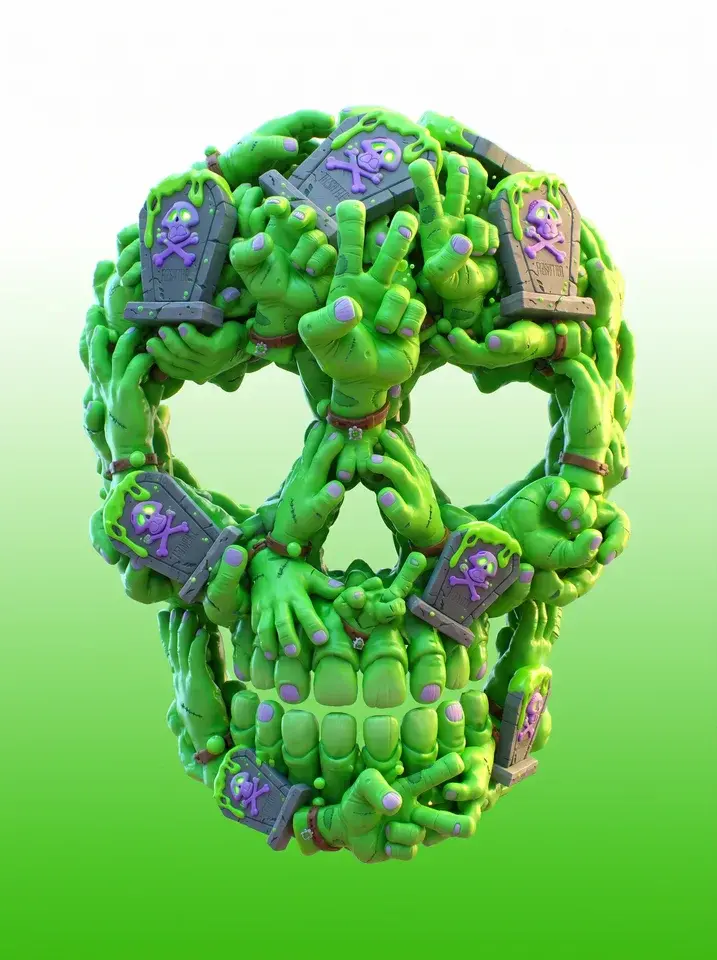
Nano Banana Pro
Copy
Create a premium, meticulously art-directed three-dimensional composition made exclusively from faithful, individually recognizable replicas of the subjects in IMAGE 2 and all subsequent object references. Arrange these independent subjects so that their combined physical volume recreates the precise shape shown in IMAGE 1. Preserve IMAGE 1 as the definitive geometric reference for the overall silhouette, proportions, orientation, contour, curves, pointed ends, openings, and three-dimensional structure. Retain its original dynamic tilt and spatial orientation where visible. The original shape serves only as a geometric guide; the final sculpture consists entirely of the referenced subjects themselves, with every solid area filled by their physical forms and absolutely no separate backing, smooth connecting material, graphic overlay, or underlying shell. Treat the primary subjects from IMAGE 2 onward as fixed, high-fidelity visual assets. Their original appearance is immutable: preserve exact character design, facial identity, head shape, body proportions, anatomy, clothing, accessories, footwear, colors, material distribution, surface textures, and distinctive structural details. Each repeated subject must look like a faithful copy of the uploaded reference rather than a newly invented variation. Preserve the original rendering style, whether photographic, illustrated, stylized 3D, or realistic CGI. Reproduce individual materials exactly where they belong on the original subject, retaining their characteristic texture, roughness, color, and finish. Keep all garments and accessories attached in their correct original positions. Introduce no additional fabric masses, elongated connecting shapes, stretched clothing, invented decorative elements, or unrelated materials. Arrange the replicas as separate, fully formed physical elements with clearly distinguishable silhouettes and consistent anatomical integrity. Use moderate variations in pose and orientation while preserving natural joint movement, correct limb proportions, complete bodies, and recognizable individual identities. Create pose diversity through controlled changes in stance, seated positions, gentle body turns, arm placement, and leg positioning, rather than extreme bending or twisting. Maintain a coherent range of object scales, with smaller complete replicas only where needed to resolve narrow portions of the silhouette. Organize the individual elements into a dense but visually clean composition, allowing carefully controlled overlaps and natural physical contact while retaining visible boundaries between neighboring subjects. Objects remain structurally independent, with no shared anatomy, merged limbs, duplicated heads, stretched torsos, or distorted geometric connections. Fill the
entire solid silhouette of IMAGE 1 with these complete subjects, from its center to its exterior edges and throughout its visible three-dimensional thickness. The combined arrangement itself creates the recognizable shape, with all original openings and negative spaces preserved as genuinely empty areas through which the background is visible. Maintain accurate contour definition and clear shape readability from the final viewing angle. The finished sculpture must contain only the referenced subjects, assembled into the original geometric form. Suspend the complete sculpture weightlessly in open space with a refined, visually engaging three-dimensional orientation. Use a carefully controlled three-quarter perspective with a modest spatial tilt that complements the original shape, reveals its thickness, and maintains immediate silhouette recognition. Rotate the assembled structure as one coherent object, preserving the integrity and relative placement of its individual components. Keep the entire sculpture fully visible, elegantly framed, and surrounded by generous negative space. Illuminate the sculpture with a controlled directional key light positioned above and to one side, creating beautifully defined highlights and realistic shadows cast by foreground subjects onto neighboring subjects behind them. Use balanced fill illumination to preserve clear facial features, accurate material colors, and detailed textures within recessed areas. Maintain rich but controlled contact shadows, natural depth separation, and convincing light-to-shadow transitions throughout the assembly. All shadows remain confined to the physical subjects themselves. Render the subjects with exceptional visual fidelity, crisp geometry, accurately preserved original materials, high-resolution textures, fine surface detail, realistic light response, and clean subject separation. Maintain the authentic visual character of the uploaded references without introducing plastic-like simplification, artificial smoothing, or stylized reinterpretation. Place the floating sculpture against a perfectly smooth, seamless vertical digital gradient transitioning from pure white (#FFFFFF) at the top to the dominant vivid color of the primary subject in IMAGE 2 at the bottom. The gradient uses exactly two color endpoints and one continuous, uniform linear interpolation, with a perfectly clean, textureless appearance across the entire frame. The background remains independent of the sculpture's illumination, with consistent color across every horizontal level and no localized brightness variations, additional color patches, atmosphere, vignette, or projected shadows. The entire composition floats in infinite empty space without any floor, pedestal, support, ground plane, horizon, or shadow beneath
it. Premium high-resolution CGI, precise reference preservation, distinct complete objects, elegant volumetric construction, natural pose variation, controlled dynamic levitation, realistic inter-object shadows, sophisticated materials, and clean contemporary art direction.
Референс 1
Референс 2
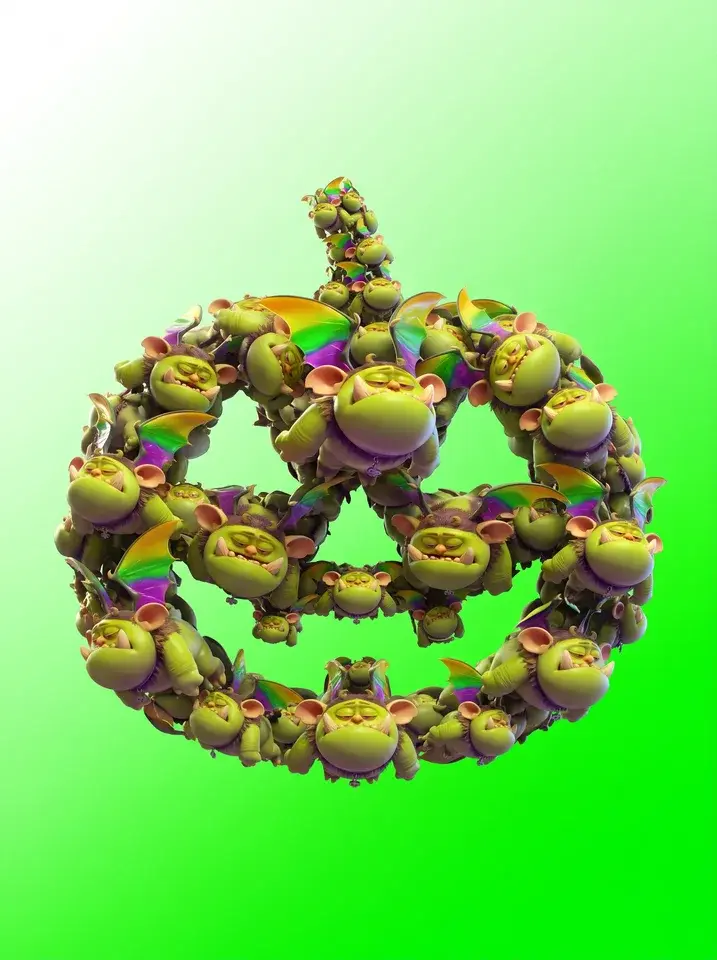
Nano Banana Pro
Copy
Create a premium photorealistic three-dimensional assemblage whose exact overall silhouette matches IMAGE 1, constructed exclusively from numerous separate, complete, faithfully reproduced copies of the subjects in IMAGE 2 and all subsequent references. IMAGE 1 defines only the precise geometry, proportions, curves, typography, spacing, stroke thickness, and internal openings. The shape emerges entirely from the physical arrangement of these objects, which form every solid region across its full width, height, and depth. The original graphic is completely absent as a physical surface, backing, shell, or filler. Every visible part of the sculpture consists exclusively of the referenced subjects. Preserve each subject's recognizable identity, anatomy, proportions, clothing, accessories, original colors, intricate textures, and material properties with maximum fidelity. For partially visible subjects, reconstruct complete coherent objects or full-body characters, naturally continuing their original outfit and styling. Every repeated instance remains a distinct, structurally intact object with correct geometry and anatomy, including complete limbs and footwear where applicable. Create a sophisticated arrangement of varied natural poses, rotations, and controlled proportional scales, allowing subjects to stand, sit, lean, recline, bend, or curl while preserving their anatomy, clothing, and individual recognizable features. Arrange them closely in multiple spatial layers with carefully controlled overlaps and convincing physical contact, maintaining separate bodies, correct limb connections, and realistic object boundaries. Achieve dense packing through intelligent positioning rather than deformation, fusion, or compression. Use smaller complete replicas where necessary for narrow contours, while keeping most subjects sufficiently large for clear individual readability. Preserve the exact outer silhouette and all internal openings of IMAGE 1, with genuine empty spaces revealing the background directly through the construction. Maintain consistent object density throughout the central regions and exterior edges, ensuring the entire shape is physically constructed from the referenced objects rather than merely outlined or decorated. Give the sculpture pronounced dimensional depth through sophisticated directional studio lighting and physically accurate inter-object shadow casting. Use a strong, broad directional key light positioned above and to one side, producing beautifully defined highlights on the foreground objects and distinct cast shadows falling naturally across the surfaces of neighboring objects positioned behind them. Every foreground element should cast spatially consistent shadows onto the underlying and recessed elements according to their
actual relative positions. Create rich contact shadows at points of physical interaction, deeper ambient occlusion inside tightly packed areas, and visible light-to-shadow transitions that reveal the layered arrangement. Maintain realistic shadow softness appropriate to the light source, with defined shadow edges near contact points and progressively softer shadows across more distant surfaces. Preserve readable textures, accurate colors, and recognizable details within the shadowed areas through controlled complementary fill illumination. Establish a clear hierarchy of illuminated foreground subjects, partially shadowed middle layers, and deeper recessed objects, creating dimensional separation without turning the interior into an indistinguishable dark mass. Allow the combined highlights, cast shadows, and subtle occlusion to emphasize the recognizable geometry of the overall silhouette. Preserve high-quality skin, fabric, hair, and material textures, natural roughness, fine details, sharp individual geometry, and realistic surface response. The result should resemble an expertly lit physical installation photographed in a professional studio, with exceptional material fidelity rather than a plastic or artificial appearance. Present the complete sculpture levitating freely in empty space, predominantly front-facing with subtle visible thickness, fully centered and surrounded by generous negative space. Place it against a perfectly smooth, seamless vertical digital gradient transitioning from pure white (#FFFFFF) at the top to the brightest dominant saturated color belonging to the main subject in IMAGE 2 at the bottom. Use a single uniform linear transition with clean, consistent color distribution, free of texture, uneven patches, atmospheric effects, halos, vignetting, and additional colors. Keep the background independent of the sculpture's lighting. All cast shadows occur exclusively between objects within the sculpture, never on the background or an imaginary floor. The sculpture floats without any visible support, pedestal, ground plane, horizon, or projected shadow. Exceptional high-end photorealistic CGI, exact silhouette reconstruction, separate anatomically correct objects, faithful reference materials, expressive natural posing, pronounced inter-object shadows, refined volumetric depth, and sophisticated contemporary art direction.
Референс 1
Референс 2

Nano Banana Pro
Copy
Create a premium photorealistic three-dimensional sculpture whose exact overall silhouette is taken from the first uploaded image and whose entire physical structure consists exclusively of complete replicas of the subjects shown in the second and subsequent reference images. Follow a strict two-stage construction process. First, reconstruct each referenced subject as one complete, anatomically and structurally coherent three-dimensional asset before assembling the final composition. When a reference shows only a portrait, face, head, bust, or cropped upper body, extrapolate the unseen anatomy to create a complete head-to-toe person with a naturally proportioned torso, shoulders, arms, hands, waist, hips, legs, and feet. Continue the visible clothing into a coherent complete outfit, including appropriate trousers, lower garments, and footwear matching the original styling, colors, and materials. Preserve the exact recognizable facial features, hairstyle, accessories, visible garments, and distinctive appearance of the reference. For animals and nonhuman subjects, reconstruct the complete recognizable object with its natural full structure and defining features. The resulting complete subject becomes the single indivisible building unit used throughout the sculpture. Every repeated instance must display a coherent full physical body or complete object, with a recognizable head-to-body relationship, intact proportions, and clearly articulated structural features. Only after establishing these complete assets, recreate the first image as a dense assembly of numerous replicas. Treat the first reference purely as the geometric definition of the final silhouette, including its exact outer contours, proportions, orientation, typography, internal openings, and negative spaces. Replace every solid region of that silhouette with tightly arranged complete referenced subjects, filling the entire visible area and three-dimensional thickness through carefully organized physical placement. The original graphic material disappears entirely. Arrange the replicas in an intricate, compact, three-dimensional composition using proportional scaling, varied rotations, naturally interlocking orientations, and controlled overlapping. Maintain a consistent relationship between subject size and silhouette thickness so each repeated figure remains clearly recognizable as a complete individual rather than an isolated face or unidentifiable fragment. Place subjects at varying depths while ensuring visible torso and lower-body structure across the composition. Preserve natural anatomical proportions, individual object boundaries, distinctive textures, and essential features. Smaller complete figures may occupy narrow details, while moderately sized complete figures form the
primary sculptural structure. The assembled objects themselves create the entire outer contour and all visible surfaces of the target shape, with accurately preserved internal openings remaining completely empty and revealing the background through the sculpture. The final image must read simultaneously as the precise original shape and as a dense construction of fully formed individual subjects. Present the complete sculpture levitating weightlessly in empty space, predominantly front-facing with subtle three-dimensional thickness, elegant framing, and generous negative space. The sculpture must appear fully suspended in the air with no floor, no ground plane, no surface, no pedestal, no platform, no support, and no environmental base of any kind. Render every subject with exceptional photorealistic geometry, faithful facial detail, realistic anatomy, intricate fabric and material textures, beautiful surface definition, and crisp edges. Use refined studio lighting with a broad directional key light and balanced fill illumination to reveal both the complete bodies and the dimensional depth of the assembly. Allow subtle contact shadows, inter-object cast shadows, and ambient occlusion only within the sculpture itself, where one replicated subject naturally shades another subject behind or beside it. Do not cast any shadow beneath the sculpture. Do not create a floor shadow, ground shadow, drop shadow, projected shadow, reflection shadow, or any diffuse darkening below the object. The background must remain perfectly clean and unaffected by the sculpture, with no shadow contamination, no grounding cue, and no indication of a surface below. Place the sculpture against a perfectly clean, seamless vertical digital gradient transitioning uniformly from pure white (#FFFFFF) at the top to the brightest vivid saturated color found on the main subject in the second uploaded reference at the bottom. Preserve the selected hue's brightness and saturation through a perfectly even, continuous linear color transition. The background remains a pristine, uninterrupted digital color field with no additional colors, darkening, radial lighting, atmospheric effects, texture, grain, vignetting, halos, floor, horizon, reflections, or projected shadows. The sculpture floats freely in pure open space. Exceptional high-end CGI, precise silhouette construction, faithful reference reproduction, complete full-body subject replication, natural anatomy, sophisticated dimensional arrangement, immaculate material quality, clean seamless gradient, and refined contemporary art direction.

Референс 1
Референс 2
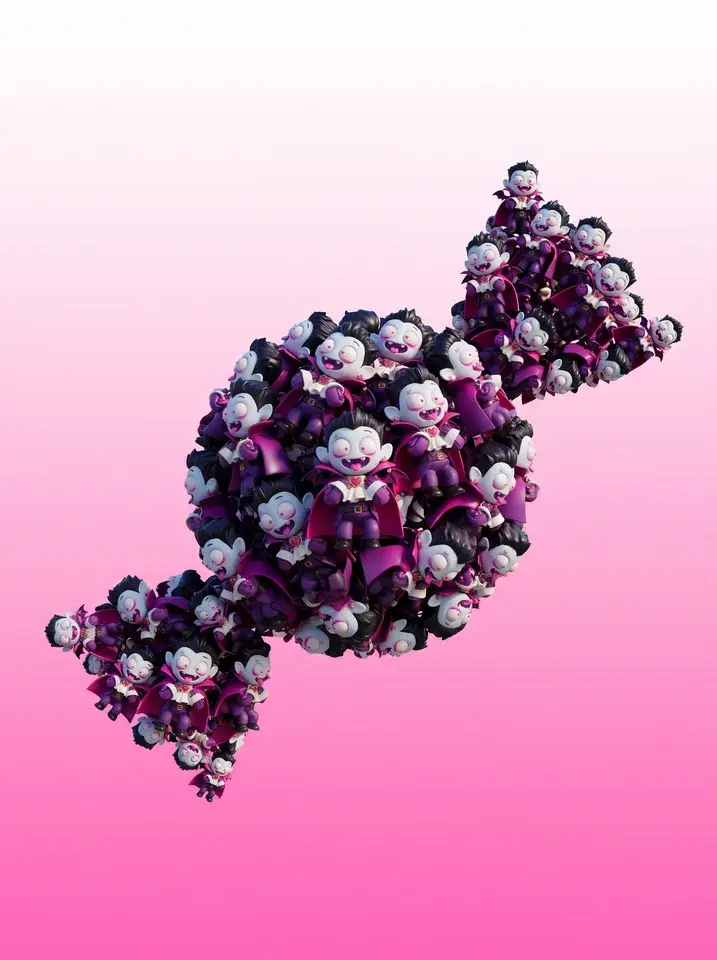
Nano Banana Pro
Copy
Create a premium high-end three-dimensional assemblage in which the exact overall shape from IMAGE 1 is formed entirely and exclusively by numerous separate, complete, faithfully reproduced copies of the subjects shown in IMAGE 2 and all subsequent object references. Treat IMAGE 1 only as a geometric blueprint for the final outer silhouette, proportions, curves, orientation, thickness, internal openings, and overall spatial attitude. IMAGE 1 must never appear as a visible material, wrapper, shell, core, filler, smooth surface, backing, membrane, skin, support, or structural base. The finished composition must contain only two things: the repeated subjects from IMAGE 2 and the clean background. No other visible material category is allowed. If all repeated subjects were removed, nothing of the shape from IMAGE 1 would remain. The entire shape must be physically built from the referenced subjects themselves, not decorated with them and not covered by them. Every solid region of the target form, including the center, outer contour, narrow tips, side edges, and full visible depth, must consist exclusively of the repeated subjects. Do not place the objects merely on the surface of a preexisting form. Do not embed them into a smooth body. Do not wrap them around a solid core. Do not create any visible candy body, wrapper, ribbon, skin, metallic foil, shell, smooth connecting layer, or continuous mass derived from IMAGE 1. The recognizable form from IMAGE 1 must emerge only from the collective arrangement, density, and outer boundaries of the repeated subjects. All visible surfaces belong to the repeated subjects themselves. Preserve each subject from IMAGE 2 and any additional references with maximum fidelity. Maintain exact recognizable identity, anatomy, proportions, colors, materials, textures, clothing, accessories, and defining structural features. If a subject is partially visible, reconstruct it into one complete coherent full object or full-body figure while naturally continuing the same original styling, outfit logic, and material language. Every repeated instance must remain a distinct, structurally intact, fully recognizable replica of that same subject. Do not invent new materials, stretched connecting shapes, abstract filler forms, melted masses, or simplified surrogate geometry. Arrange the repeated subjects as separate independent elements with correct anatomy or object geometry, complete limbs where applicable, intact clothing, and clear boundaries. Use varied but controlled natural poses, rotations, and orientations to make the assembly visually rich and more interesting to inspect up close, while preserving full recognizability and structural integrity. Allow subjects to stand, sit, lean, recline, bend, crouch, or gently twist only within
natural believable limits. Do not deform them to fit the silhouette. Do not fuse them together. Do not merge bodies, share limbs, duplicate heads, stretch torsos, create hybrid anatomy, or allow one subject to dissolve into another. Maintain clear independent silhouettes and clean separation between neighboring objects. Build a dense but readable composition with multiple spatial layers and controlled overlaps. Use mostly medium-sized high-fidelity replicas and smaller complete replicas only where necessary for narrow contours, pointed ends, or intricate sections. Preserve strong subject readability, clear material definition, and crisp individual silhouettes throughout the composition. Maintain consistent object density across both central areas and outer boundaries, ensuring that the whole target form is genuinely constructed from the subjects rather than simply outlined by them. Preserve all true internal openings and negative spaces from IMAGE 1 as fully empty open gaps with the background visible directly through them. Present the complete assemblage as a weightless levitating object in empty space. Use a refined three-quarter frontal camera angle with a subtle yet elegant spatial turn, preserving the legibility of the original silhouette while revealing convincing thickness, front-to-back layering, and dynamic levitation. Retain and reinforce the original tilt or dynamic attitude of IMAGE 1 where relevant. The sculpture should feel suspended, balanced, and alive in space rather than frontally pasted onto the background. Use sophisticated studio lighting to create dimensional depth inside the assemblage. Apply a directional key light from above and to one side, with balanced fill illumination, so that foreground subjects cast realistic shadows only onto neighboring and recessed subjects inside the assemblage. Allow contact shadows, inter-object cast shadows, and ambient occlusion only where the repeated subjects physically overlap or sit close together. Keep all shadows confined to the assemblage itself. Absolutely no shadow, reflection, dark patch, grounding cue, contact patch, ambient darkening, occlusion halo, or projected shape is allowed beneath the sculpture or anywhere on the background. There is no floor, no ground plane, no invisible surface, no pedestal, no support, and no surface receiving light or shadow. The background must remain completely untouched by the object. Render the image with exceptional high-end CGI quality, sharp geometry, crisp edges, accurate materials, fine textures, clean subject separation, and excellent readability. Avoid plastic-looking oversimplification, blur, mushy detail, artificial smoothing, or low-detail repetition. Place the levitating assemblage against a perfectly smooth, seamless vertical digital
gradient transitioning from pure white (#FFFFFF) at the top to the single dominant bright saturated color of the primary subject in IMAGE 2 at the bottom. Use exactly two color endpoints and one clean continuous linear transition. The gradient must remain uniform, textureless, and perfectly clean across the entire frame, with no additional colors, no dirty mixing, no vignette, no atmosphere, no haze, no radial glow, no uneven patches, no horizon cue, and no localized darkening beneath the object. The lower part of the frame must remain the same clean gradient field, not a floor-like area. The final result should read immediately as the exact shape from IMAGE 1 and, on closer inspection, as a fully volumetric levitating construction made entirely from distinct, complete, faithful replicas of the subjects from IMAGE 2.
Референс 1

Референс 2
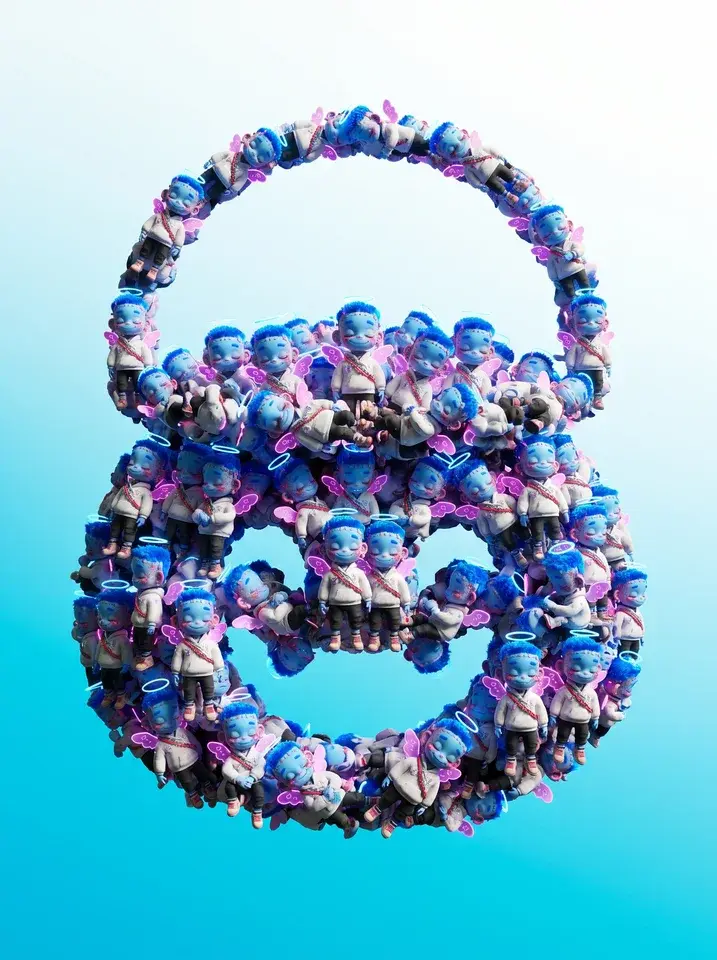
Nano Banana Pro
Copy
Create a premium photorealistic three-dimensional assemblage whose exact overall silhouette matches IMAGE 1, constructed exclusively from numerous separate, complete, faithfully reproduced copies of the subjects in IMAGE 2 and all subsequent references. IMAGE 1 defines only the precise geometry, proportions, curves, typography, spacing, stroke thickness, and internal openings. The shape emerges entirely from the physical arrangement of these objects, which form every solid region across its full width, height, and depth. The original graphic is completely absent as a physical surface, backing, shell, or filler. Every visible part of the sculpture consists exclusively of the referenced subjects. Preserve each subject's recognizable identity, anatomy, proportions, clothing, accessories, original colors, intricate textures, and material properties with maximum fidelity. For partially visible subjects, reconstruct complete coherent objects or full-body characters, naturally continuing their original outfit and styling. Every repeated instance remains a distinct, structurally intact object with correct geometry and anatomy, including complete limbs and footwear where applicable. Create a sophisticated arrangement of varied natural poses, rotations, and controlled proportional scales, allowing subjects to stand, sit, lean, recline, bend, or curl while preserving their anatomy, clothing, and individual recognizable features. Arrange them closely in multiple spatial layers with carefully controlled overlaps and convincing physical contact, maintaining separate bodies, correct limb connections, and realistic object boundaries. Achieve dense packing through intelligent positioning rather than deformation, fusion, or compression. Use smaller complete replicas where necessary for narrow contours, while keeping most subjects sufficiently large for clear individual readability. Preserve the exact outer silhouette and all internal openings of IMAGE 1, with genuine empty spaces revealing the background directly through the construction. Maintain consistent object density throughout the central regions and exterior edges, ensuring the entire shape is physically constructed from the referenced objects rather than merely outlined or decorated. Give the sculpture pronounced dimensional depth through sophisticated directional studio lighting and physically accurate inter-object shadow casting. Use a strong, broad directional key light positioned above and to one side, producing beautifully defined highlights on the foreground objects and distinct cast shadows falling naturally across the surfaces of neighboring objects positioned behind them. Every foreground element should cast spatially consistent shadows onto the underlying and recessed elements according to their
actual relative positions. Create rich contact shadows at points of physical interaction, deeper ambient occlusion inside tightly packed areas, and visible light-to-shadow transitions that reveal the layered arrangement. Maintain realistic shadow softness appropriate to the light source, with defined shadow edges near contact points and progressively softer shadows across more distant surfaces. Preserve readable textures, accurate colors, and recognizable details within the shadowed areas through controlled complementary fill illumination. Establish a clear hierarchy of illuminated foreground subjects, partially shadowed middle layers, and deeper recessed objects, creating dimensional separation without turning the interior into an indistinguishable dark mass. Allow the combined highlights, cast shadows, and subtle occlusion to emphasize the recognizable geometry of the overall silhouette. Preserve high-quality skin, fabric, hair, and material textures, natural roughness, fine details, sharp individual geometry, and realistic surface response. The result should resemble an expertly lit physical installation photographed in a professional studio, with exceptional material fidelity rather than a plastic or artificial appearance. Present the complete sculpture levitating freely in empty space, predominantly front-facing with subtle visible thickness, fully centered and surrounded by generous negative space. Place it against a perfectly smooth, seamless vertical digital gradient transitioning from pure white (#FFFFFF) at the top to the brightest dominant saturated color belonging to the main subject in IMAGE 2 at the bottom. Use a single uniform linear transition with clean, consistent color distribution, free of texture, uneven patches, atmospheric effects, halos, vignetting, and additional colors. Keep the background independent of the sculpture's lighting. All cast shadows occur exclusively between objects within the sculpture, never on the background or an imaginary floor. The sculpture floats without any visible support, pedestal, ground plane, horizon, or projected shadow. Exceptional high-end photorealistic CGI, exact silhouette reconstruction, separate anatomically correct objects, faithful reference materials, expressive natural posing, pronounced inter-object shadows, refined volumetric depth, and sophisticated contemporary art direction.
Референс 1
Референс 2
Логотипы и другие формы
Знакомые знаки, буквы и силуэты из цветов, предметов, одежды и персонажей. Один принцип — разные материалы и настроение.
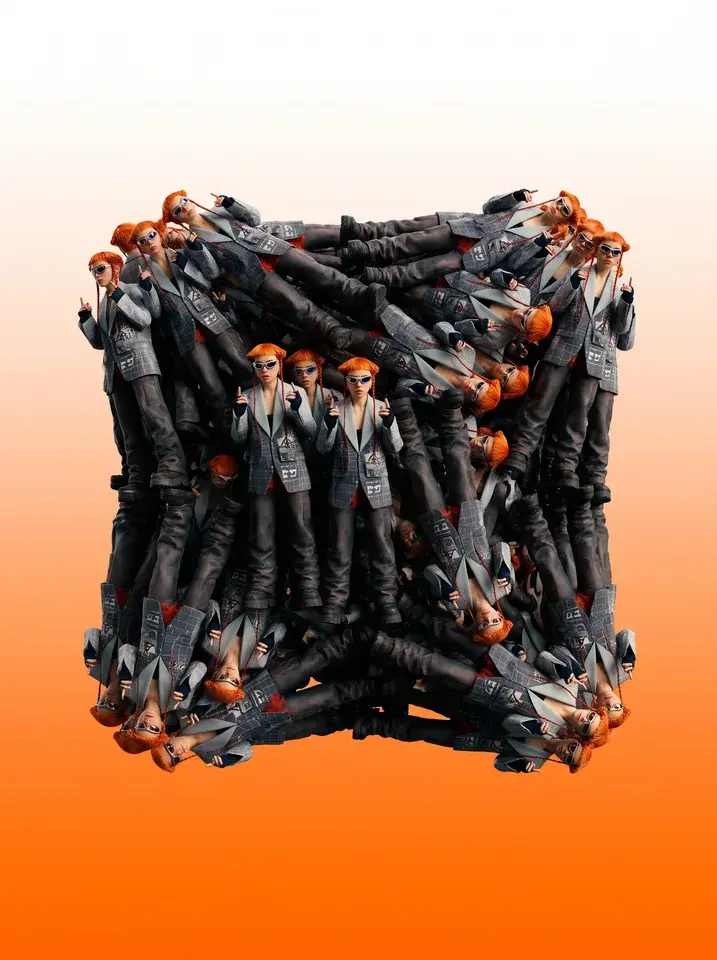
Nano Banana Pro
Copy
Create an exceptionally precise, high-end 3D composition in which the entire shape of the first uploaded image is physically constructed from numerous faithful copies of the subjects shown in the second and subsequent reference images. The first image is the absolute geometric authority: reproduce its exact silhouette, proportions, lettering, curves, spacing, and internal openings. Its solid areas must be entirely replaced by the referenced subjects themselves. The original graphic surface disappears completely, leaving only the objects arranged into its exact recognizable shape. Every visible part of the sculpture consists of these objects, including the central areas, edges, and dimensional thickness. Preserve the complete appearance of each referenced subject with maximum visual fidelity: original facial features, body proportions, clothing, colors, accessories, textures, and distinctive details. Reconstruct missing body parts naturally when a person is shown only partially, creating a coherent full-body version with anatomically accurate limbs and suitable footwear. Use this completed version consistently for every repetition. Duplicate the same faithful subjects at a controlled, relatively consistent scale, with modest size variations for narrow areas. Each copy must remain a separate, complete, beautifully detailed three-dimensional element, retaining its individual identity and natural anatomy. Arrange the objects closely together in a sophisticated, carefully art-directed composition, using varied orientations and controlled spatial layering while preserving clearly readable individual forms. Create visual density through precise placement rather than deformation or compression. Maintain distinct heads, torsos, limbs, and recognizable surface details, with clean separation and subtle contact shadows between neighboring subjects. Keep the original silhouette sharp and accurate, including all genuine open spaces and letter counters, with the background visible directly through them. Every object belongs to the continuous structure of the original shape, creating one unified sculpture with a consistent visual rhythm and refined three-dimensional depth. Use a frontal camera perspective with subtle volumetric layering to preserve the exact original geometry. The sculpture levitates freely in the center of the frame, fully visible, with generous negative space and absolutely no floor or projected shadow. Render with exceptional photorealistic CGI quality, highly resolved geometry, authentic material textures, accurate skin and fabric detail, crisp contours, physically realistic shading, and balanced professional studio lighting that reveals every individual subject clearly. Use a perfectly smooth, seamless two-color digital linear gradient
background transitioning evenly from pure white (#FFFFFF) to the brightest vivid saturated color found on the main subject in the second reference image. Maintain a clean, luminous, uniform transition without darkening, vignetting, lighting spots, grain, texture, or atmospheric effects. The finished image must read immediately as the exact shape of the first reference, constructed exclusively from distinct, recognizable, beautifully rendered copies of the subjects in the remaining references. Premium contemporary CGI, immaculate reference fidelity, precise geometry, sophisticated object arrangement, and refined art direction.

Референс 1

Референс 2

Nano Banana Pro
Copy
Create a premium photorealistic three-dimensional sculpture whose exact overall silhouette is taken from the first uploaded image and whose entire physical structure consists exclusively of complete replicas of the subjects shown in the second and subsequent reference images. Follow a strict two-stage construction process. First, reconstruct each referenced subject as one complete, anatomically and structurally coherent three-dimensional asset before assembling the final composition. When a reference shows only a portrait, face, head, bust, or cropped upper body, extrapolate the unseen anatomy to create a complete head-to-toe person with a naturally proportioned torso, shoulders, arms, hands, waist, hips, legs, and feet. Continue the visible clothing into a coherent complete outfit, including appropriate trousers, lower garments, and footwear matching the original styling, colors, and materials. Preserve the exact recognizable facial features, hairstyle, accessories, visible garments, and distinctive appearance of the reference. For animals and nonhuman subjects, reconstruct the complete recognizable object with its natural full structure and defining features. The resulting complete subject becomes the single indivisible building unit used throughout the sculpture. Every repeated instance must display a coherent full physical body or complete object, with a recognizable head-to-body relationship, intact proportions, and clearly articulated structural features. Only after establishing these complete assets, recreate the first image as a dense assembly of numerous replicas. Treat the first reference purely as the geometric definition of the final silhouette, including its exact outer contours, proportions, orientation, typography, internal openings, and negative spaces. Replace every solid region of that silhouette with tightly arranged complete referenced subjects, filling the entire visible area and three-dimensional thickness through carefully organized physical placement. The original graphic material disappears entirely. Arrange the replicas in an intricate, compact, three-dimensional composition using proportional scaling, varied rotations, naturally interlocking orientations, and controlled overlapping. Maintain a consistent relationship between subject size and silhouette thickness so each repeated figure remains clearly recognizable as a complete individual rather than an isolated face or unidentifiable fragment. Place subjects at varying depths while ensuring visible torso and lower-body structure across the composition. Preserve natural anatomical proportions, individual object boundaries, distinctive textures, and essential features. Smaller complete figures may occupy narrow details, while moderately sized complete figures form the
primary sculptural structure. The assembled objects themselves create the entire outer contour and all visible surfaces of the target shape, with accurately preserved internal openings remaining completely empty and revealing the background through the sculpture. The final image must read simultaneously as the precise original shape and as a dense construction of fully formed individual subjects. Present the complete sculpture levitating weightlessly in empty space, predominantly front-facing with subtle three-dimensional thickness, elegant framing, and generous negative space. Render every subject with exceptional photorealistic geometry, faithful facial detail, realistic anatomy, intricate fabric and material textures, beautiful surface definition, crisp edges, and physically accurate studio lighting. Use a broad directional key light and balanced fill illumination to reveal both the complete bodies and the dimensional depth of the assembly, with subtle contact shadows between individual subjects. Place the sculpture against a perfectly clean, seamless vertical digital gradient transitioning uniformly from pure white (#FFFFFF) at the top to the brightest vivid saturated color found on the main subject in the second uploaded reference at the bottom. Preserve the selected hue's brightness and saturation through a perfectly even, continuous linear color transition. The background remains a pristine, uninterrupted digital color field with no additional colors, darkening, radial lighting, atmospheric effects, texture, grain, vignetting, halos, floor, horizon, or projected shadows. The sculpture floats freely without a pedestal, support, or grounding surface. Exceptional high-end CGI, precise silhouette construction, faithful reference reproduction, complete full-body subject replication, natural anatomy, sophisticated dimensional arrangement, immaculate material quality, clean seamless gradient, and refined contemporary art direction.

Референс 1
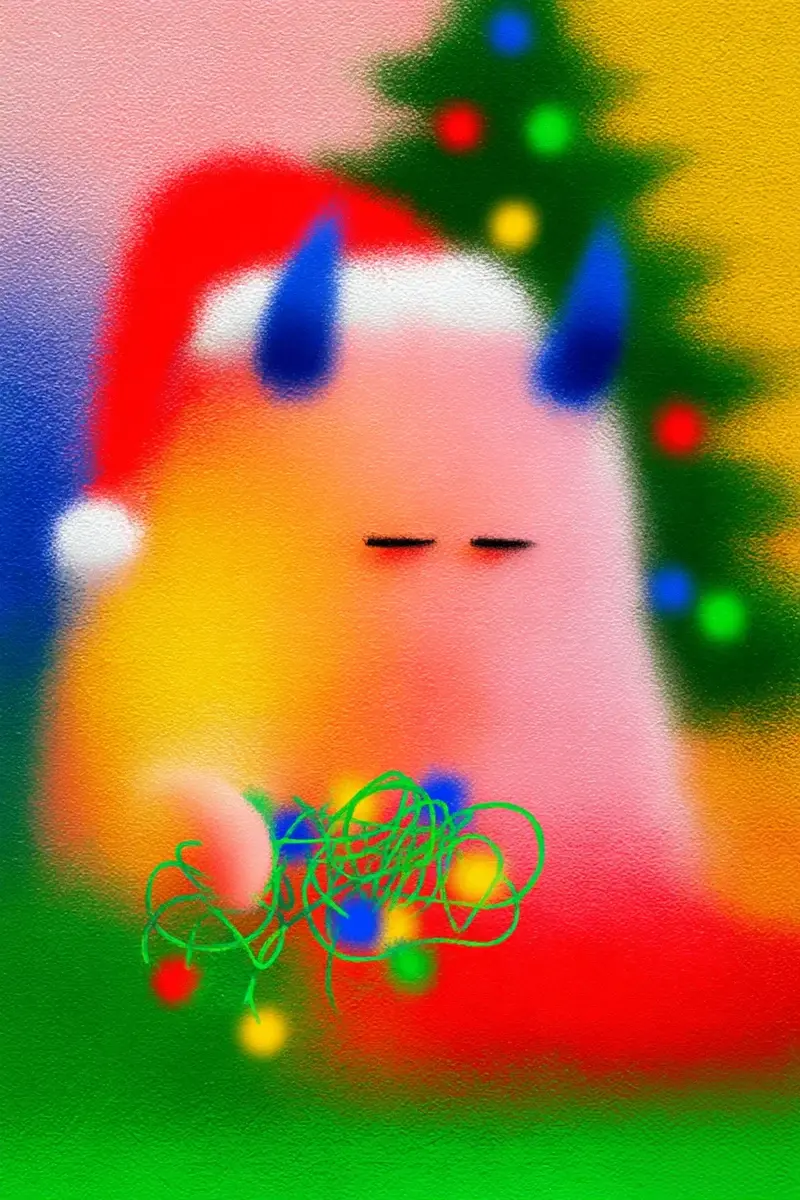
Референс 2
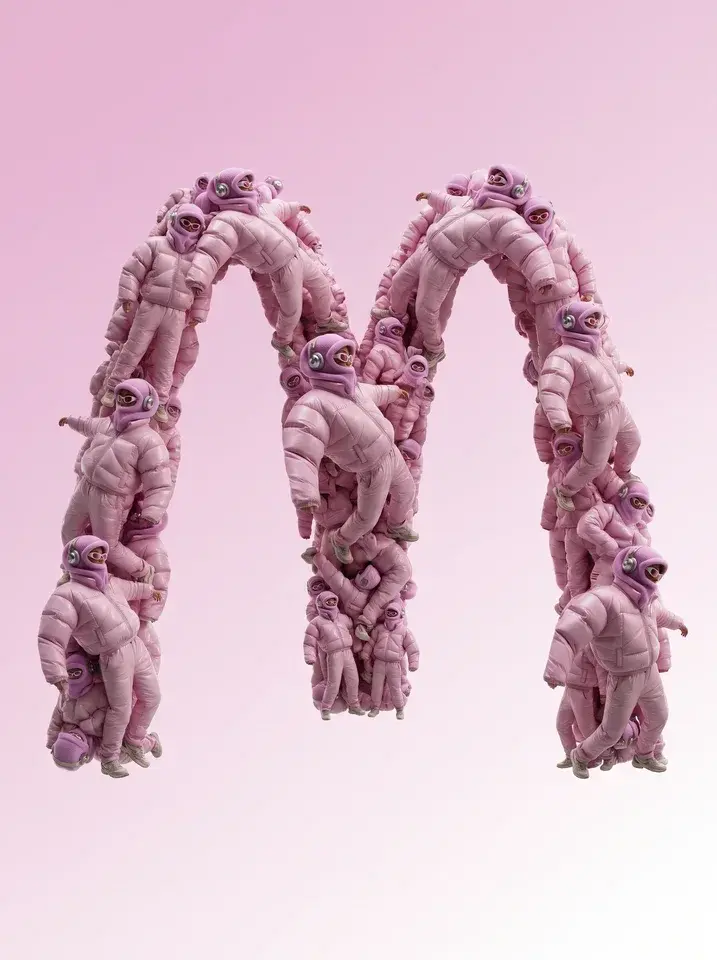
Nano Banana Pro
Copy
Use image 1 exclusively as an exact, immutable silhouette blueprint. Reproduce its original outline, proportions, symmetry, orientation, curves, pointed ends, and negative spaces with maximum precision. Images 2 onward exclusively define the actual objects used to construct this silhouette. First identify each complete primary subject in these images and treat it as a single indivisible 3D asset. Replicate ONLY these exact subjects, preserving their recognizable identity, original design, proportions, anatomy, clothing, colors, distinctive details, and realistic textures. Accessories and clothing belonging to a subject remain attached in their original positions. Every repeated instance must represent the complete subject, with all essential parts intact and anatomically correct. Never extract secondary details, garments, printed motifs, or accessories as separate building elements. Introduce no additional object categories. Assemble numerous intact copies of the referenced subjects into the exact silhouette of image 1, arranging them like carefully fitted three-dimensional pieces. Use intelligent placement, varied rotations, uniform proportional scaling, and controlled depth layering to achieve extremely dense packing while preserving individual object integrity. Smaller complete copies fill narrower sections and contour transitions. Maintain sufficient visibility of each object's defining features, recognizable outline, natural proportions, and fine material details. Avoid crushing, stretching, melting, merging, cutting, or fragmenting individual subjects to fill gaps. The overall form must be entirely constructed from these individual objects throughout its visible depth, with no underlying solid base. Preserve a clean, sharply defined external silhouette and all original negative spaces. Present the assembled form as a substantial freestanding 3D sculpture levitating in empty space. Use a predominantly frontal camera angle aligned with the original silhouette, revealing dimensional thickness through natural overlaps, controlled depth differences, and subtle side visibility without distorting the shape. Render each individual object with exceptionally detailed photorealistic geometry, high-resolution textures, accurate material properties, natural surface microstructure, crisp features, and physically convincing contact shadows. Illuminate the entire construction with broad, balanced studio lighting and gentle directional contrast, ensuring excellent detail visibility across all subjects, including deeper layers. Place the sculpture against a perfectly clean, seamless, digitally smooth two-color linear gradient background. Select two sophisticated, harmonious colors inspired by the dominant palette of the referenced subjects, with sufficient tonal
contrast to separate the sculpture clearly from the background. Transition evenly and continuously between these two colors across the entire frame, maintaining consistent color distribution without localized illumination, radial hotspots, vignetting, cloudy patches, texture, grain, banding, or atmospheric effects. Keep all lighting effects confined to the sculpture itself. Premium photorealistic CGI, meticulous composition, faithful object replication, refined art direction, immaculate material detail, precise recognizable silhouette, elegant levitation, and generous negative space around the entire object.
Референс 1
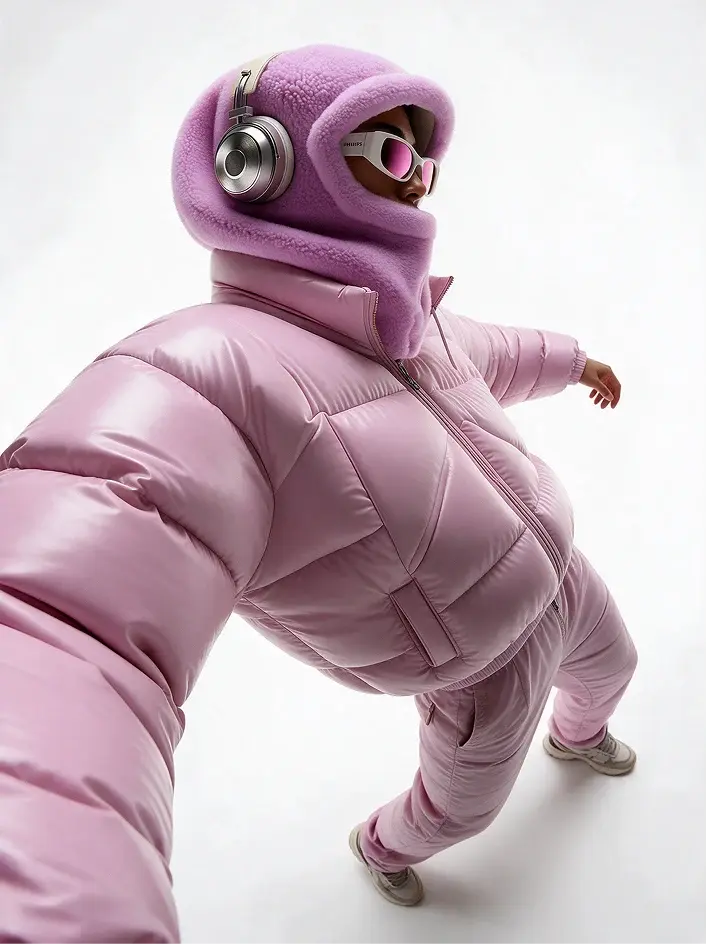
Референс 2

Nano Banana Pro
Copy
Create a premium photorealistic three-dimensional sculpture whose exact overall silhouette is taken from the first uploaded image and whose entire physical structure consists exclusively of complete replicas of the subjects shown in the second and subsequent reference images. Follow a strict two-stage construction process. First, reconstruct each referenced subject as one complete, anatomically and structurally coherent three-dimensional asset before assembling the final composition. When a reference shows only a portrait, face, head, bust, or cropped upper body, extrapolate the unseen anatomy to create a complete head-to-toe person with a naturally proportioned torso, shoulders, arms, hands, waist, hips, legs, and feet. Continue the visible clothing into a coherent complete outfit, including appropriate trousers, lower garments, and footwear matching the original styling, colors, and materials. Preserve the exact recognizable facial features, hairstyle, accessories, visible garments, and distinctive appearance of the reference. For animals and nonhuman subjects, reconstruct the complete recognizable object with its natural full structure and defining features. The resulting complete subject becomes the single indivisible building unit used throughout the sculpture. Every repeated instance must display a coherent full physical body or complete object, with a recognizable head-to-body relationship, intact proportions, and clearly articulated structural features. Only after establishing these complete assets, recreate the first image as a dense assembly of numerous replicas. Treat the first reference purely as the geometric definition of the final silhouette, including its exact outer contours, proportions, orientation, typography, internal openings, and negative spaces. Replace every solid region of that silhouette with tightly arranged complete referenced subjects, filling the entire visible area and three-dimensional thickness through carefully organized physical placement. The original graphic material disappears entirely. Arrange the replicas in an intricate, compact, three-dimensional composition using proportional scaling, varied rotations, naturally interlocking orientations, and controlled overlapping. Maintain a consistent relationship between subject size and silhouette thickness so each repeated figure remains clearly recognizable as a complete individual rather than an isolated face or unidentifiable fragment. Place subjects at varying depths while ensuring visible torso and lower-body structure across the composition. Preserve natural anatomical proportions, individual object boundaries, distinctive textures, and essential features. Smaller complete figures may occupy narrow details, while moderately sized complete figures form the
primary sculptural structure. The assembled objects themselves create the entire outer contour and all visible surfaces of the target shape, with accurately preserved internal openings remaining completely empty and revealing the background through the sculpture. The final image must read simultaneously as the precise original shape and as a dense construction of fully formed individual subjects. Present the complete sculpture levitating weightlessly in empty space, predominantly front-facing with subtle three-dimensional thickness, elegant framing, and generous negative space. Render every subject with exceptional photorealistic geometry, faithful facial detail, realistic anatomy, intricate fabric and material textures, beautiful surface definition, crisp edges, and physically accurate studio lighting. Use a broad directional key light and balanced fill illumination to reveal both the complete bodies and the dimensional depth of the assembly, with subtle contact shadows between individual subjects. Place the sculpture against a perfectly clean, seamless vertical digital gradient transitioning uniformly from pure white (#FFFFFF) at the top to the brightest vivid saturated color found on the main subject in the second uploaded reference at the bottom. Preserve the selected hue's brightness and saturation through a perfectly even, continuous linear color transition. The background remains a pristine, uninterrupted digital color field with no additional colors, darkening, radial lighting, atmospheric effects, texture, grain, vignetting, halos, floor, horizon, or projected shadows. The sculpture floats freely without a pedestal, support, or grounding surface. Exceptional high-end CGI, precise silhouette construction, faithful reference reproduction, complete full-body subject replication, natural anatomy, sophisticated dimensional arrangement, immaculate material quality, clean seamless gradient, and refined contemporary art direction.

Референс 1
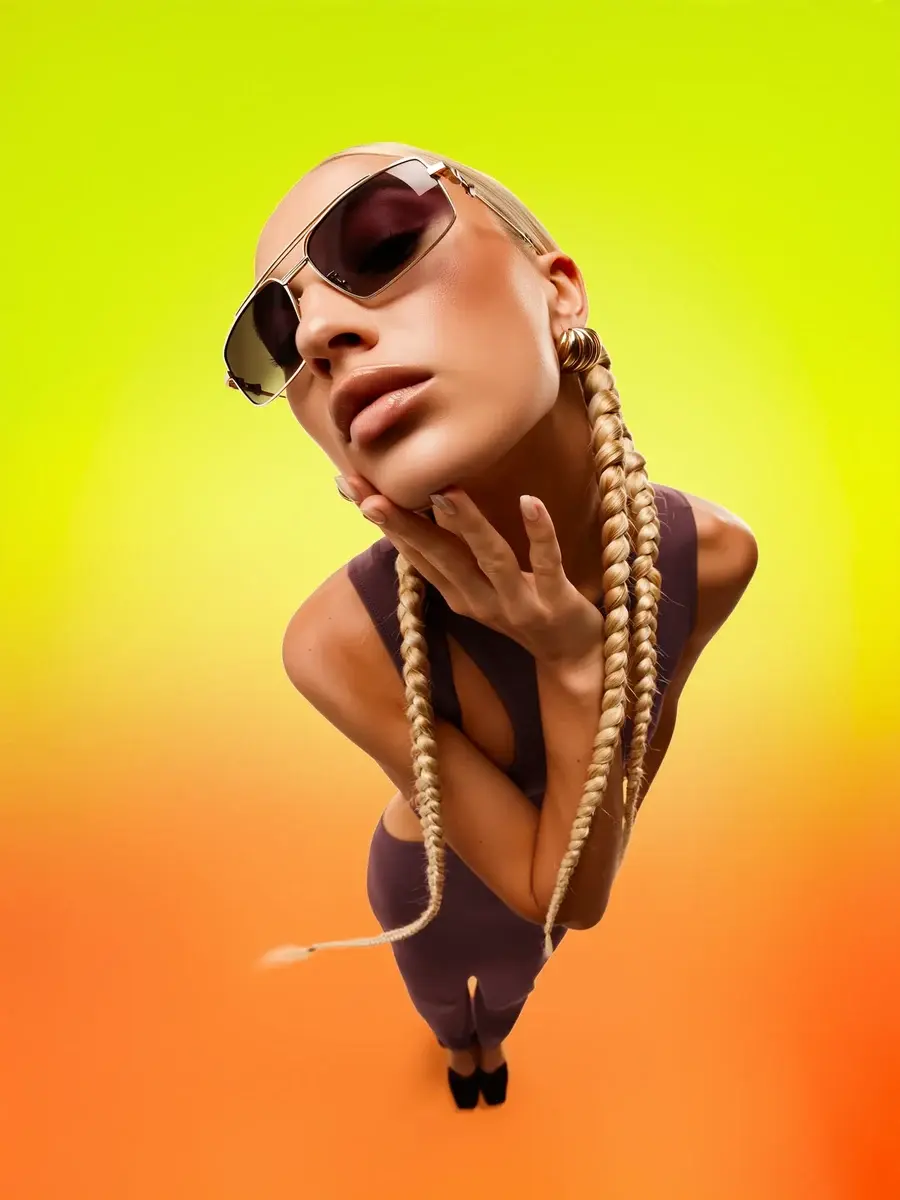
Референс 2
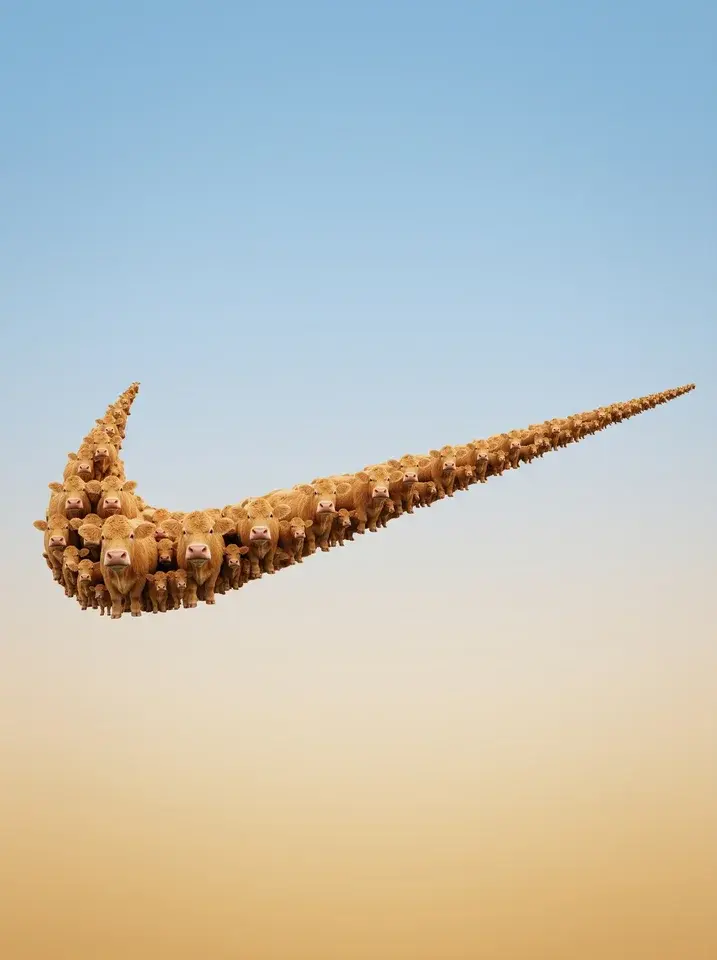
Nano Banana 2.1
Copy
Use image 1 exclusively as an exact, immutable silhouette blueprint. Reproduce its original outline, proportions, symmetry, orientation, curves, pointed ends, and negative spaces with maximum precision. Images 2 onward exclusively define the actual objects used to construct this silhouette. First identify each complete primary subject in these images and treat it as a single indivisible 3D asset. Replicate ONLY these exact subjects, preserving their recognizable identity, original design, proportions, anatomy, clothing, colors, distinctive details, and realistic textures. Accessories and clothing belonging to a subject remain attached in their original positions. Every repeated instance must represent the complete subject, with all essential parts intact and anatomically correct. Never extract secondary details, garments, printed motifs, or accessories as separate building elements. Introduce no additional object categories. Assemble numerous intact copies of the referenced subjects into the exact silhouette of image 1, arranging them like carefully fitted three-dimensional pieces. Use intelligent placement, varied rotations, uniform proportional scaling, and controlled depth layering to achieve extremely dense packing while preserving individual object integrity. Smaller complete copies fill narrower sections and contour transitions. Maintain sufficient visibility of each object's defining features, recognizable outline, natural proportions, and fine material details. Avoid crushing, stretching, melting, merging, cutting, or fragmenting individual subjects to fill gaps. The overall form must be entirely constructed from these individual objects throughout its visible depth, with no underlying solid base. Preserve a clean, sharply defined external silhouette and all original negative spaces. Present the assembled form as a substantial freestanding 3D sculpture levitating in empty space. Use a predominantly frontal camera angle aligned with the original silhouette, revealing dimensional thickness through natural overlaps, controlled depth differences, and subtle side visibility without distorting the shape. Render each individual object with exceptionally detailed photorealistic geometry, high-resolution textures, accurate material properties, natural surface microstructure, crisp features, and physically convincing contact shadows. Illuminate the entire construction with broad, balanced studio lighting and gentle directional contrast, ensuring excellent detail visibility across all subjects, including deeper layers. Place the sculpture against a perfectly clean, seamless, digitally smooth two-color linear gradient background. Select two sophisticated, harmonious colors inspired by the dominant palette of the referenced subjects, with sufficient tonal
contrast to separate the sculpture clearly from the background. Transition evenly and continuously between these two colors across the entire frame, maintaining consistent color distribution without localized illumination, radial hotspots, vignetting, cloudy patches, texture, grain, banding, or atmospheric effects. Keep all lighting effects confined to the sculpture itself. Premium photorealistic CGI, meticulous composition, faithful object replication, refined art direction, immaculate material detail, precise recognizable silhouette, elegant levitation, and generous negative space around the entire object.

Референс 1
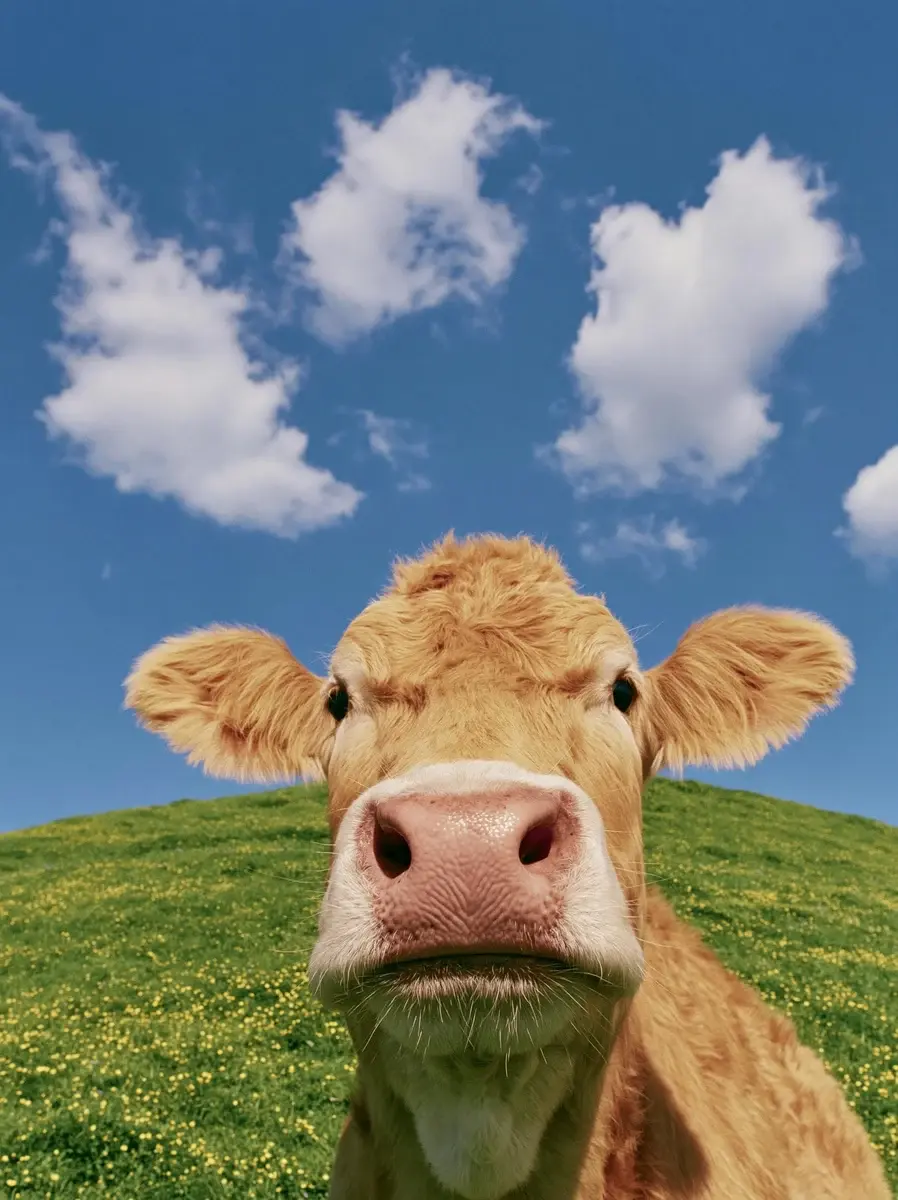
Референс 2
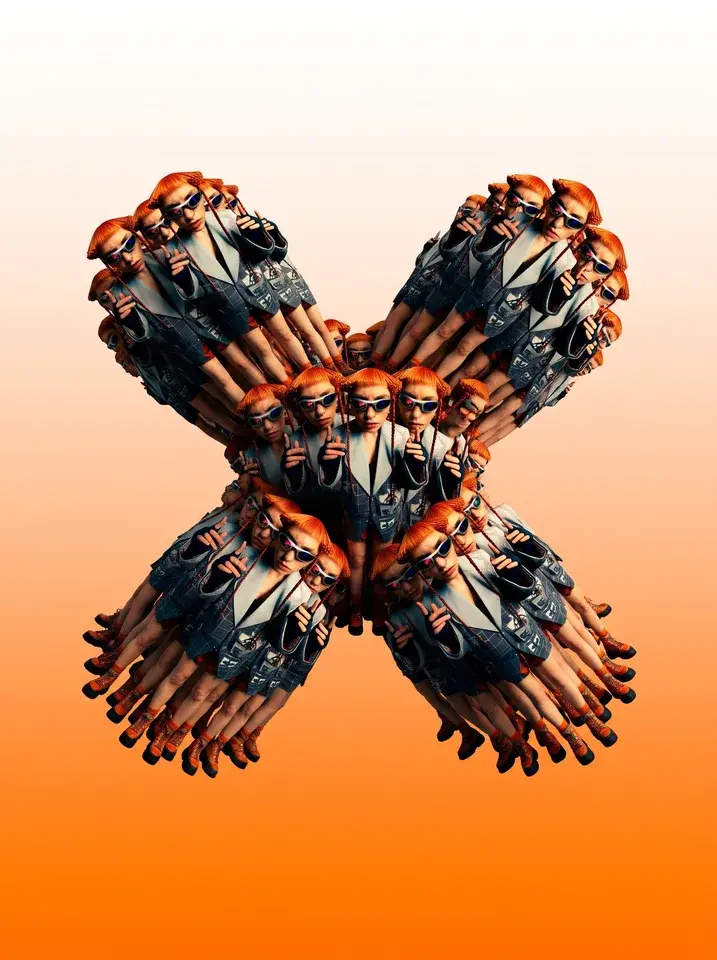
Nano Banana Pro
Copy
Create an exceptionally precise, high-end 3D composition in which the entire shape of the first uploaded image is physically constructed from numerous faithful copies of the subjects shown in the second and subsequent reference images. The first image is the absolute geometric authority: reproduce its exact silhouette, proportions, lettering, curves, spacing, and internal openings. Its solid areas must be entirely replaced by the referenced subjects themselves. The original graphic surface disappears completely, leaving only the objects arranged into its exact recognizable shape. Every visible part of the sculpture consists of these objects, including the central areas, edges, and dimensional thickness. Preserve the complete appearance of each referenced subject with maximum visual fidelity: original facial features, body proportions, clothing, colors, accessories, textures, and distinctive details. Reconstruct missing body parts naturally when a person is shown only partially, creating a coherent full-body version with anatomically accurate limbs and suitable footwear. Use this completed version consistently for every repetition. Duplicate the same faithful subjects at a controlled, relatively consistent scale, with modest size variations for narrow areas. Each copy must remain a separate, complete, beautifully detailed three-dimensional element, retaining its individual identity and natural anatomy. Arrange the objects closely together in a sophisticated, carefully art-directed composition, using varied orientations and controlled spatial layering while preserving clearly readable individual forms. Create visual density through precise placement rather than deformation or compression. Maintain distinct heads, torsos, limbs, and recognizable surface details, with clean separation and subtle contact shadows between neighboring subjects. Keep the original silhouette sharp and accurate, including all genuine open spaces and letter counters, with the background visible directly through them. Every object belongs to the continuous structure of the original shape, creating one unified sculpture with a consistent visual rhythm and refined three-dimensional depth. Use a frontal camera perspective with subtle volumetric layering to preserve the exact original geometry. The sculpture levitates freely in the center of the frame, fully visible, with generous negative space and absolutely no floor or projected shadow. Render with exceptional photorealistic CGI quality, highly resolved geometry, authentic material textures, accurate skin and fabric detail, crisp contours, physically realistic shading, and balanced professional studio lighting that reveals every individual subject clearly. Use a perfectly smooth, seamless two-color digital linear gradient
background transitioning evenly from pure white (#FFFFFF) to the brightest vivid saturated color found on the main subject in the second reference image. Maintain a clean, luminous, uniform transition without darkening, vignetting, lighting spots, grain, texture, or atmospheric effects. The finished image must read immediately as the exact shape of the first reference, constructed exclusively from distinct, recognizable, beautifully rendered copies of the subjects in the remaining references. Premium contemporary CGI, immaculate reference fidelity, precise geometry, sophisticated object arrangement, and refined art direction.
Референс 1
Референс 2
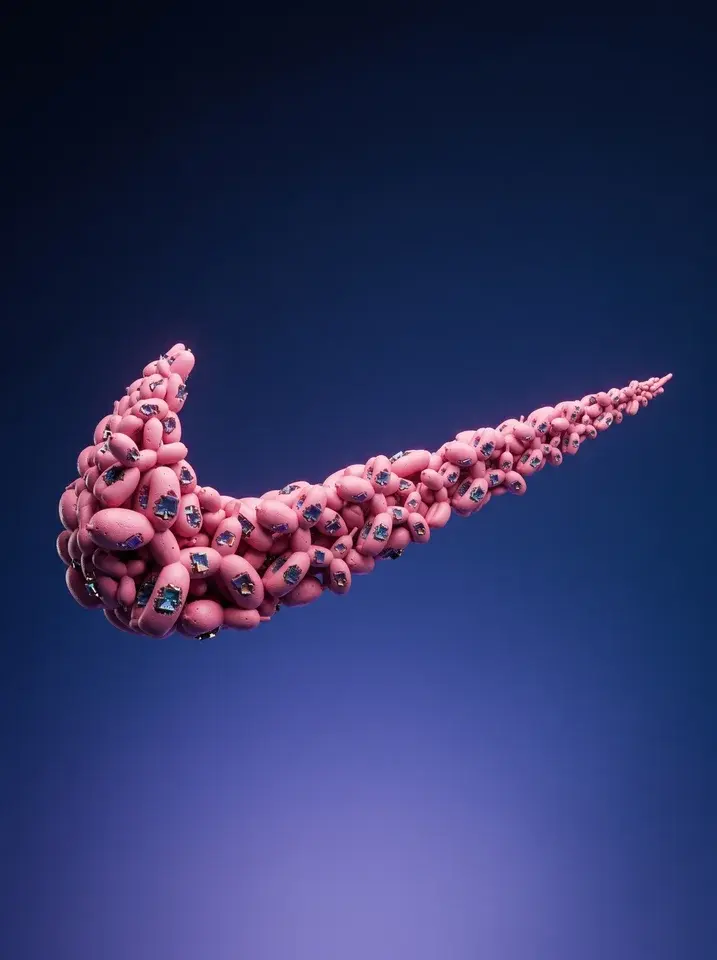
Nano Banana 2.1
Copy
Use the first uploaded image strictly as the exact shape, silhouette, and structural blueprint. Use the second and all subsequent uploaded images exclusively as the precise visual references for the objects that must physically construct this shape. Recreate the exact outer contour, proportions, orientation, curves, angles, and internal negative spaces of the first reference with exceptional accuracy. Construct the entire three-dimensional volume exclusively from the specific objects depicted in the remaining references. These exact objects are the sole building material of the composition. Preserve their original design, recognizable geometry, proportions, colors, surface characteristics, distinctive details, and material identity with extremely high fidelity. Every individual object must remain clearly recognizable, visually distinguishable, and beautifully rendered, even within the densest areas of the arrangement. Repeat and intelligently distribute the referenced objects in varying sizes and orientations, maintaining their natural proportions and structural integrity. Arrange them into an exceptionally dense, tightly interlocked sculptural assembly, filling the entire silhouette and its full three-dimensional thickness from edge to edge. Smaller complete objects should occupy spaces between larger ones, creating an intricate, compact construction with virtually zero visible gaps. Establish a sophisticated spatial hierarchy with carefully controlled overlaps, allowing individual silhouettes, characteristic features, and important surface details to remain visible. Each element must retain its own physical volume and clearly defined boundaries, with subtle contact shadows and fine separation between adjacent objects. The objects form the actual substance and complete internal structure of the shape, rather than a decorative layer over an underlying solid form. Maintain a clean, precise overall silhouette entirely defined by the assembled objects, including accurate curves, sharp transitions, narrow sections, and internal cutouts. The completed structure must appear as a substantial, fully volumetric three-dimensional sculpture levitating weightlessly in open space, with its depth and thickness clearly visible. Compose the image from a carefully selected camera angle that preserves the recognizable silhouette while revealing its sculptural construction. Render every object with exceptional photorealistic material quality, physically accurate shaders, highly detailed surface textures, authentic roughness, translucency, reflectivity, subsurface scattering, and microscopic imperfections wherever appropriate to the referenced materials. Preserve fine fibers, pores, grain, natural irregularities, embossed details, delicate edges, and characteristic
material structures. Use sophisticated multi-directional studio illumination with a beautifully controlled dominant key light, subtle complementary fill light, realistic ambient occlusion, luminous highlights, and rich but carefully balanced contact shadows. Ensure that objects throughout the composition receive sufficient illumination to reveal their individual shapes, natural colors, and intricate textures, including elements recessed deeper within the structure. Create dimensional contrast and beautiful light-to-shadow transitions without sacrificing material clarity or individual object readability. Place the floating sculpture against a seamless, deep, luxurious gradient background with smooth atmospheric color transitions and rich tonal depth. Derive the background palette intelligently from the actual colors of the referenced objects, choosing harmonious complementary or analogous hues that enhance material richness while providing strong visual separation from the sculpture. Maintain an elegant, sophisticated color balance with a subtly luminous central gradient and darker, saturated peripheral tones. Premium contemporary art direction, hyperreal high-end CGI, extraordinary micro-detail, immaculate rendering quality, refined cinematic studio lighting, crisp focus across the entire sculpture, precise geometry, realistic spatial depth, and a polished editorial aesthetic. The complete levitating shape is fully visible within the frame, surrounded by generous negative space, with every referenced object rendered as a distinct, recognizable, beautifully textured physical element.
Референс 1
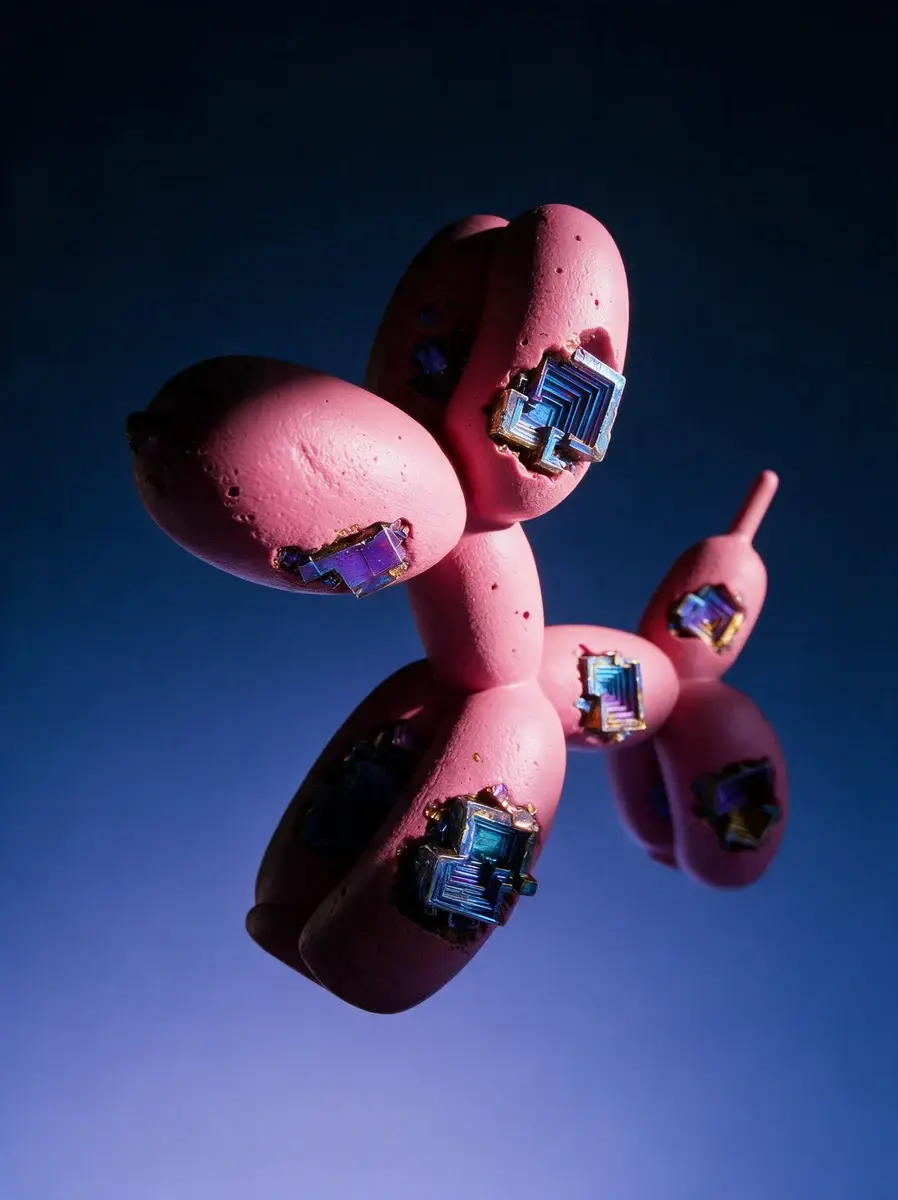
Референс 2
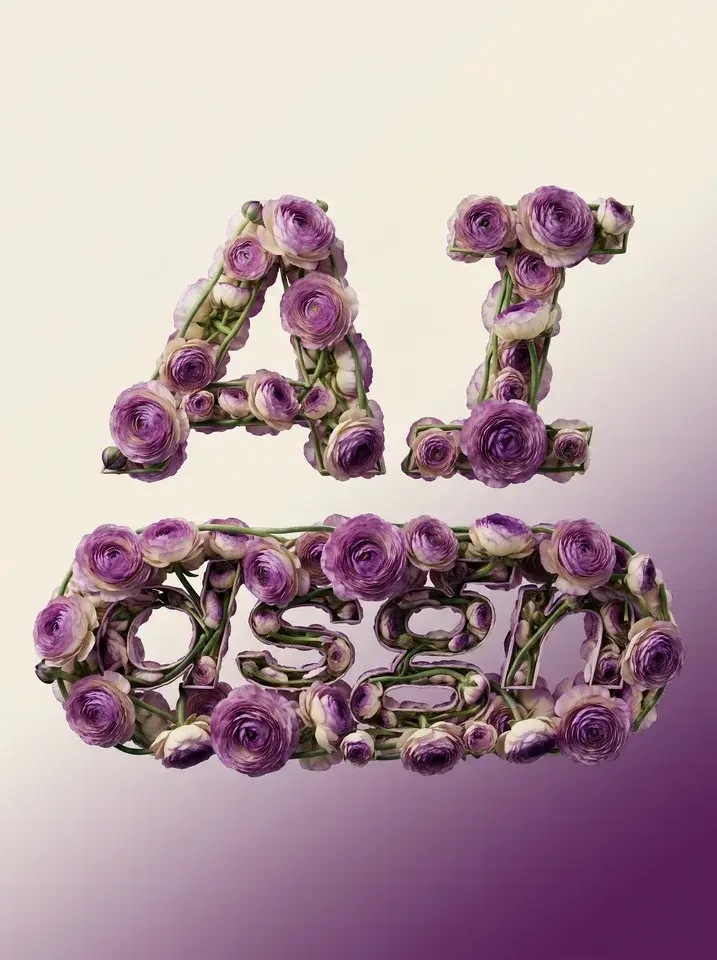
Nano Banana Pro
Copy
Use image 1 exclusively as an exact, immutable silhouette blueprint. Reproduce its original outline, proportions, symmetry, orientation, curves, pointed ends, and negative spaces with maximum precision. Images 2 onward exclusively define the actual objects used to construct this silhouette. First identify each complete primary subject in these images and treat it as a single indivisible 3D asset. Replicate ONLY these exact subjects, preserving their recognizable identity, original design, proportions, anatomy, clothing, colors, distinctive details, and realistic textures. Accessories and clothing belonging to a subject remain attached in their original positions. Every repeated instance must represent the complete subject, with all essential parts intact and anatomically correct. Never extract secondary details, garments, printed motifs, or accessories as separate building elements. Introduce no additional object categories. Assemble numerous intact copies of the referenced subjects into the exact silhouette of image 1, arranging them like carefully fitted three-dimensional pieces. Use intelligent placement, varied rotations, uniform proportional scaling, and controlled depth layering to achieve extremely dense packing while preserving individual object integrity. Smaller complete copies fill narrower sections and contour transitions. Maintain sufficient visibility of each object's defining features, recognizable outline, natural proportions, and fine material details. Avoid crushing, stretching, melting, merging, cutting, or fragmenting individual subjects to fill gaps. The overall form must be entirely constructed from these individual objects throughout its visible depth, with no underlying solid base. Preserve a clean, sharply defined external silhouette and all original negative spaces. Present the assembled form as a substantial freestanding 3D sculpture levitating in empty space. Use a predominantly frontal camera angle aligned with the original silhouette, revealing dimensional thickness through natural overlaps, controlled depth differences, and subtle side visibility without distorting the shape. Render each individual object with exceptionally detailed photorealistic geometry, high-resolution textures, accurate material properties, natural surface microstructure, crisp features, and physically convincing contact shadows. Illuminate the entire construction with broad, balanced studio lighting and gentle directional contrast, ensuring excellent detail visibility across all subjects, including deeper layers. Place the sculpture against a perfectly clean, seamless, digitally smooth two-color linear gradient background. Select two sophisticated, harmonious colors inspired by the dominant palette of the referenced subjects, with sufficient tonal
contrast to separate the sculpture clearly from the background. Transition evenly and continuously between these two colors across the entire frame, maintaining consistent color distribution without localized illumination, radial hotspots, vignetting, cloudy patches, texture, grain, banding, or atmospheric effects. Keep all lighting effects confined to the sculpture itself. Premium photorealistic CGI, meticulous composition, faithful object replication, refined art direction, immaculate material detail, precise recognizable silhouette, elegant levitation, and generous negative space around the entire object.

Референс 1
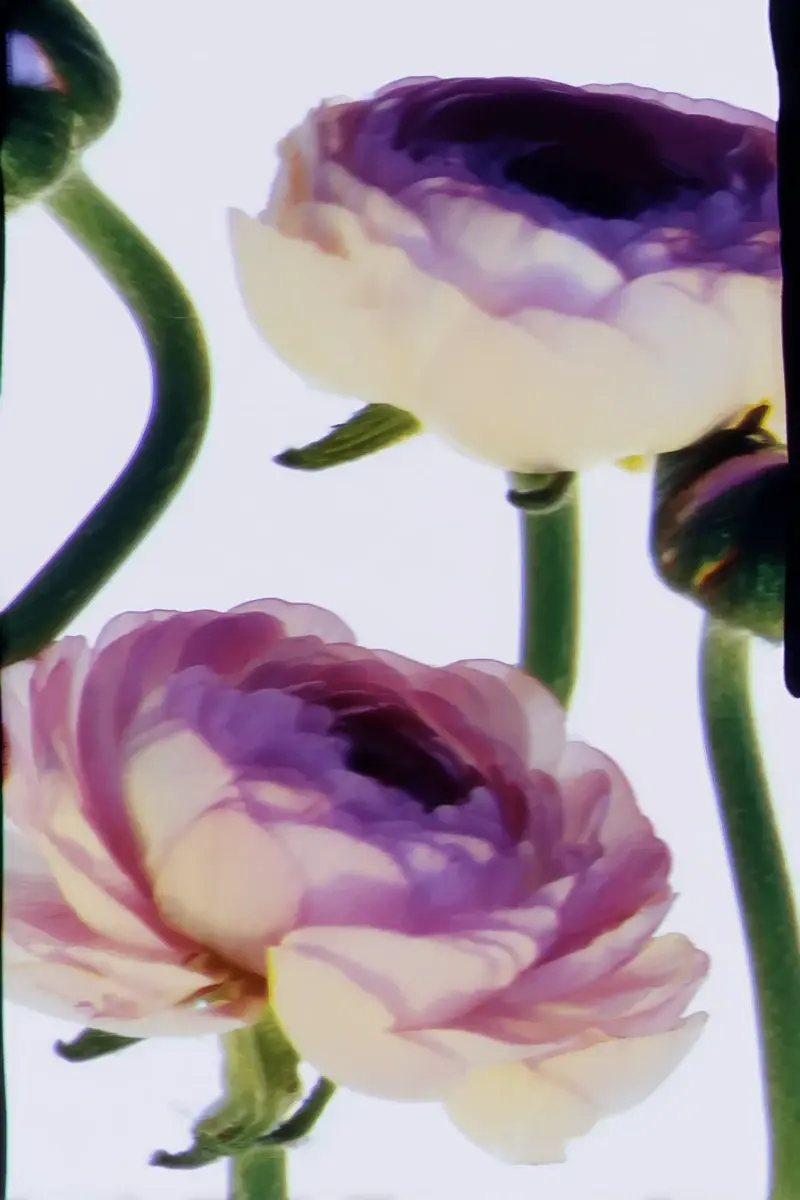
Референс 2

Nano Banana Pro
Copy
Use the first uploaded image strictly as the exact silhouette blueprint and shape map. Reproduce its outline, proportions, symmetry, spacing, geometry, curves, internal cutouts, and overall graphic structure with very high precision, so the final result clearly and immediately matches the original shape. Use the second and all subsequent uploaded images strictly as the only object references for constructing this shape. First identify the complete main subject in each of these images and treat each subject as one whole indivisible object. Replicate only these complete subjects, preserving their recognizable identity, anatomy, proportions, design, colors, materials, clothing, and defining details. Do not extract parts, garments, accessories, printed motifs, or secondary elements as separate objects, and do not introduce any new object categories. Build the entire silhouette from many relatively small complete copies of these referenced objects. Use a large number of copies so the contour can be shaped accurately. Scale each object proportionally only, and arrange them with controlled rotation, intelligent placement, and subtle depth layering, while preserving their full integrity and recognizability. Never stretch, squash, crop, fragment, bend, melt, or merge the objects. Do not cut off limbs, heads, or other essential parts. Each object must remain intact, clearly readable, and fully recognizable. Arrange the objects into a dense three-dimensional assembly that precisely follows the target silhouette. Prioritize silhouette accuracy and clean outer edges. Objects near the perimeter must stay within the silhouette boundary and define a controlled, sharp contour without awkward protrusions. Preserve all negative spaces and internal cutouts from the original shape. The result should read first as one precise large-scale symbol and second as a detailed construction made entirely of many small recognizable objects. Show the assembled form as a beautiful freestanding 3D object levitating elegantly in empty space, with subtle visible thickness and a predominantly frontal camera angle with only slight perspective, so the original silhouette remains максимально clear. The object must appear suspended in midair with no floor, no pedestal, no support, no surface, and no cast shadow on the ground. Keep the levitation clean and weightless. Render the image as a premium high-end CGI studio visualization with crisp geometry, refined lighting, realistic contact shadows only within the object itself, and highly detailed textures. Every object must be sharply resolved and easy to recognize. Place the levitating object against a perfectly clean, seamless, high-contrast gradient studio background. The background must be a smooth digital gradient only, with rich saturated
color, elegant tonal depth, and a strong but tasteful contrast against the object. Use two harmonious but clearly separated colors that complement the referenced objects and create a visually striking backdrop. The gradient transition must be perfectly smooth, seamless, and free of banding, noise, texture, clouds, scenery, atmosphere, hotspots, vignette, or irregular patches. Keep the background polished, minimal, and visually powerful, while ensuring the floating object remains the central focus.
Референс 1

Референс 2
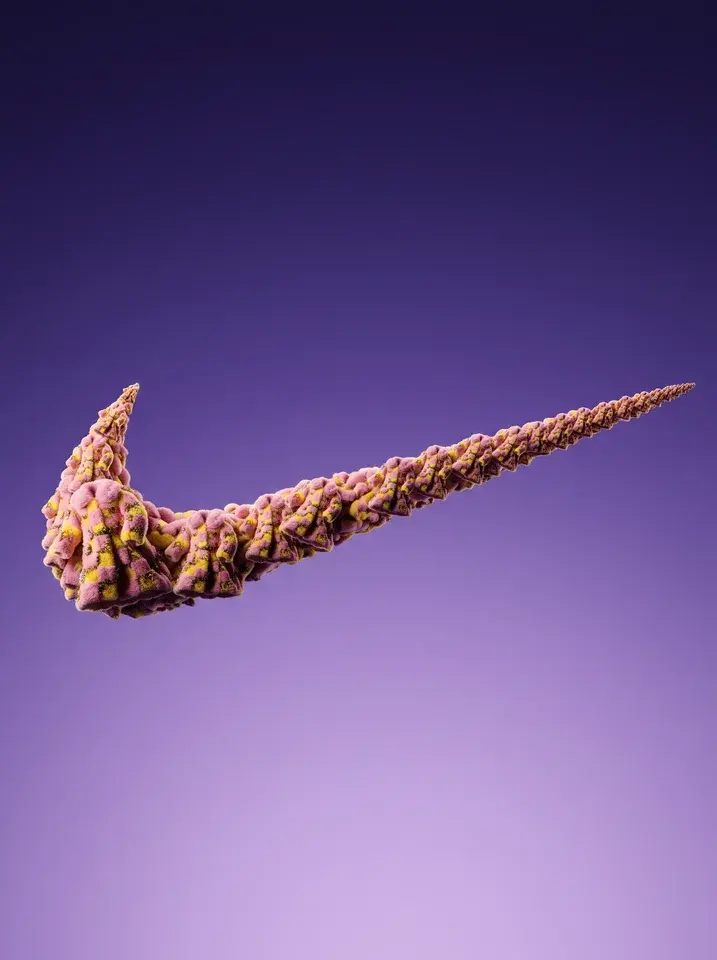
Nano Banana 2.1
Copy
Use image 1 exclusively as an exact, immutable silhouette blueprint. Reproduce its original outline, proportions, symmetry, orientation, curves, pointed ends, and negative spaces with maximum precision. Images 2 onward exclusively define the actual objects used to construct this silhouette. First identify each complete primary subject in these images and treat it as a single indivisible 3D asset. Replicate ONLY these exact subjects, preserving their recognizable identity, original design, proportions, anatomy, clothing, colors, distinctive details, and realistic textures. Accessories and clothing belonging to a subject remain attached in their original positions. Every repeated instance must represent the complete subject, with all essential parts intact and anatomically correct. Never extract secondary details, garments, printed motifs, or accessories as separate building elements. Introduce no additional object categories. Assemble numerous intact copies of the referenced subjects into the exact silhouette of image 1, arranging them like carefully fitted three-dimensional pieces. Use intelligent placement, varied rotations, uniform proportional scaling, and controlled depth layering to achieve extremely dense packing while preserving individual object integrity. Smaller complete copies fill narrower sections and contour transitions. Maintain sufficient visibility of each object's defining features, recognizable outline, natural proportions, and fine material details. Avoid crushing, stretching, melting, merging, cutting, or fragmenting individual subjects to fill gaps. The overall form must be entirely constructed from these individual objects throughout its visible depth, with no underlying solid base. Preserve a clean, sharply defined external silhouette and all original negative spaces. Present the assembled form as a substantial freestanding 3D sculpture levitating in empty space. Use a predominantly frontal camera angle aligned with the original silhouette, revealing dimensional thickness through natural overlaps, controlled depth differences, and subtle side visibility without distorting the shape. Render each individual object with exceptionally detailed photorealistic geometry, high-resolution textures, accurate material properties, natural surface microstructure, crisp features, and physically convincing contact shadows. Illuminate the entire construction with broad, balanced studio lighting and gentle directional contrast, ensuring excellent detail visibility across all subjects, including deeper layers. Place the sculpture against a perfectly clean, seamless, digitally smooth two-color linear gradient background. Select two sophisticated, harmonious colors inspired by the dominant palette of the referenced subjects, with sufficient tonal
contrast to separate the sculpture clearly from the background. Transition evenly and continuously between these two colors across the entire frame, maintaining consistent color distribution without localized illumination, radial hotspots, vignetting, cloudy patches, texture, grain, banding, or atmospheric effects. Keep all lighting effects confined to the sculpture itself. Premium photorealistic CGI, meticulous composition, faithful object replication, refined art direction, immaculate material detail, precise recognizable silhouette, elegant levitation, and generous negative space around the entire object.
Референс 1
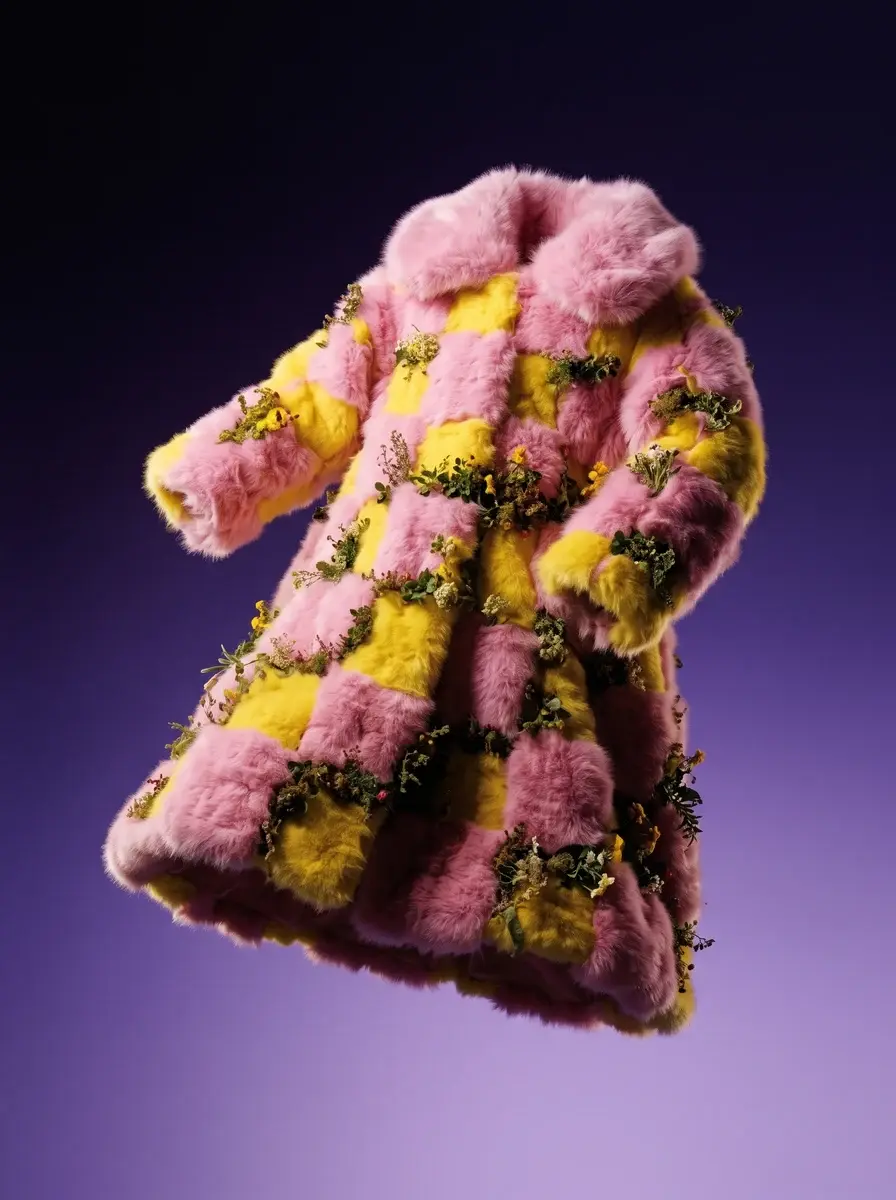
Референс 2
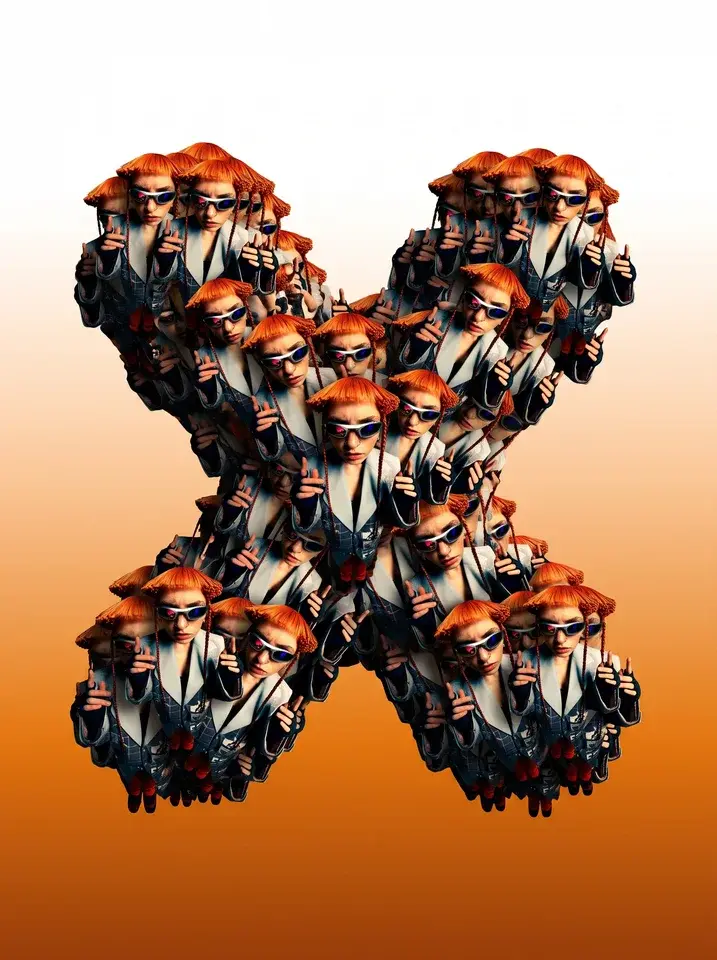
Nano Banana Pro
Copy
Use IMAGE 1 as the absolute geometric master for the final composition. Reproduce its exact silhouette, proportions, orientation, contour, stroke thickness, curves, pointed ends, spacing, and internal openings with maximum precision. Use IMAGE 2 and all subsequent images as strict visual sources for the physical subjects that will entirely constitute this shape. The finished sculpture must consist exclusively of numerous faithful replicas of these exact subjects, densely arranged throughout every solid area of the original silhouette. The shape is created solely by the collective volume and placement of the subjects themselves, with the entire interior filled from front to back. The original graphic has no physical existence in the final image: every visible part is a recognizable referenced subject. Preserve the exact identity, facial structure, hairstyle, skin tone, body proportions, outfit, garment construction, colors, accessories, footwear, textures, and original visual style of each reference. All repeated instances represent the same identifiable subject, with consistent facial identity and identical clothing across different poses. When a reference is cropped, complete the missing body with anatomically accurate proportions and a natural continuation of the original outfit, preserving all visible details. Arrange complete individual subjects in varied natural poses and orientations to follow the target geometry, using predominantly consistent scales with smaller intact replicas for narrow areas. Create dense, carefully organized layers through close positioning and natural overlaps while retaining independent anatomy, complete limbs, correct joints, distinct bodies, and recognizable faces. Each figure remains a separate physical individual with realistic proportions, fully preserved clothing, and precise high-resolution material textures. Maintain clean outer contours and completely open internal negative spaces, including every gap between separate elements. The combined arrangement must match IMAGE 1 immediately at first glance. Present the construction as a substantial three-dimensional sculpture floating freely in space, viewed directly from the front with dimensional thickness revealed by layered objects and directional lighting. Illuminate with a defined upper-side key light producing realistic cast shadows from foreground objects onto the subjects behind them, rich contact shadows, detailed recessed areas, and balanced fill preserving facial and material clarity. Render people as lifelike photographic subjects when the reference is photographic, preserving natural skin, hair, textile structure, and authentic imperfections; retain the exact original rendering style for illustrated or CGI references. Set the sculpture against a perfectly
uniform vertical digital gradient from pure white (#FFFFFF) at the top to the single dominant vivid saturated color of the main subject in IMAGE 2 at the bottom. Use a clean, seamless, continuous two-color transition with uniform color across each horizontal level. The complete sculpture levitates with generous surrounding space, no floor, horizon, support, or projected shadow. Premium editorial art direction, uncompromising subject fidelity, geometrically faithful silhouette, distinct intact subjects, varied expressive poses, crisp microtextures, realistic inter-object shadows, and exceptionally clean high-resolution rendering.
Референс 1
Референс 2

Nano Banana 2.1
Copy
Use image 1 exclusively as an exact, immutable silhouette blueprint. Reproduce its original outline, proportions, symmetry, orientation, curves, pointed ends, and negative spaces with maximum precision. Images 2 onward exclusively define the actual objects used to construct this silhouette. First identify each complete primary subject in these images and treat it as a single indivisible 3D asset. Replicate ONLY these exact subjects, preserving their recognizable identity, original design, proportions, anatomy, clothing, colors, distinctive details, and realistic textures. Accessories and clothing belonging to a subject remain attached in their original positions. Every repeated instance must represent the complete subject, with all essential parts intact and anatomically correct. Never extract secondary details, garments, printed motifs, or accessories as separate building elements. Introduce no additional object categories. Assemble numerous intact copies of the referenced subjects into the exact silhouette of image 1, arranging them like carefully fitted three-dimensional pieces. Use intelligent placement, varied rotations, uniform proportional scaling, and controlled depth layering to achieve extremely dense packing while preserving individual object integrity. Smaller complete copies fill narrower sections and contour transitions. Maintain sufficient visibility of each object's defining features, recognizable outline, natural proportions, and fine material details. Avoid crushing, stretching, melting, merging, cutting, or fragmenting individual subjects to fill gaps. The overall form must be entirely constructed from these individual objects throughout its visible depth, with no underlying solid base. Preserve a clean, sharply defined external silhouette and all original negative spaces. Present the assembled form as a substantial freestanding 3D sculpture levitating in empty space. Use a predominantly frontal camera angle aligned with the original silhouette, revealing dimensional thickness through natural overlaps, controlled depth differences, and subtle side visibility without distorting the shape. Render each individual object with exceptionally detailed photorealistic geometry, high-resolution textures, accurate material properties, natural surface microstructure, crisp features, and physically convincing contact shadows. Illuminate the entire construction with broad, balanced studio lighting and gentle directional contrast, ensuring excellent detail visibility across all subjects, including deeper layers. Place the sculpture against a perfectly clean, seamless, digitally smooth two-color linear gradient background. Select two sophisticated, harmonious colors inspired by the dominant palette of the referenced subjects, with sufficient tonal
contrast to separate the sculpture clearly from the background. Transition evenly and continuously between these two colors across the entire frame, maintaining consistent color distribution without localized illumination, radial hotspots, vignetting, cloudy patches, texture, grain, banding, or atmospheric effects. Keep all lighting effects confined to the sculpture itself. Premium photorealistic CGI, meticulous composition, faithful object replication, refined art direction, immaculate material detail, precise recognizable silhouette, elegant levitation, and generous negative space around the entire object.

Референс 1
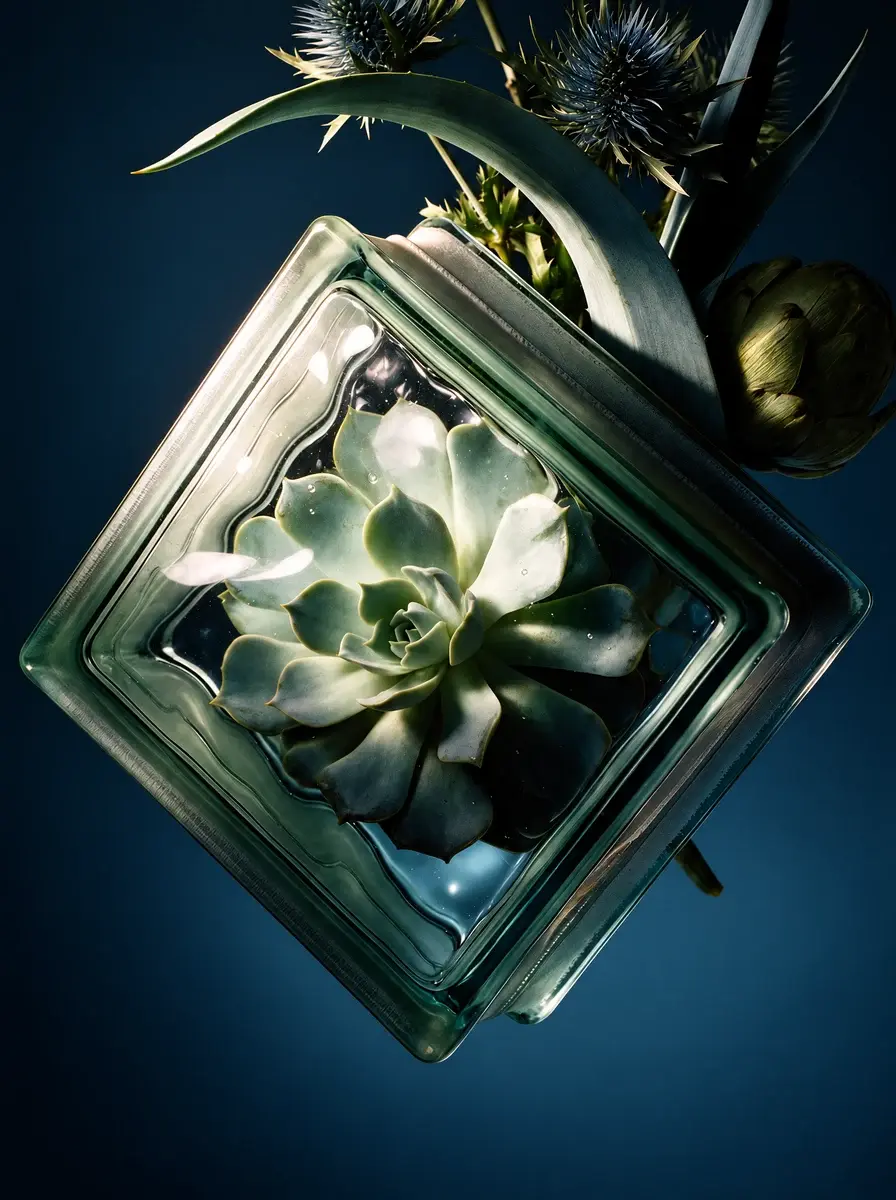
Референс 2
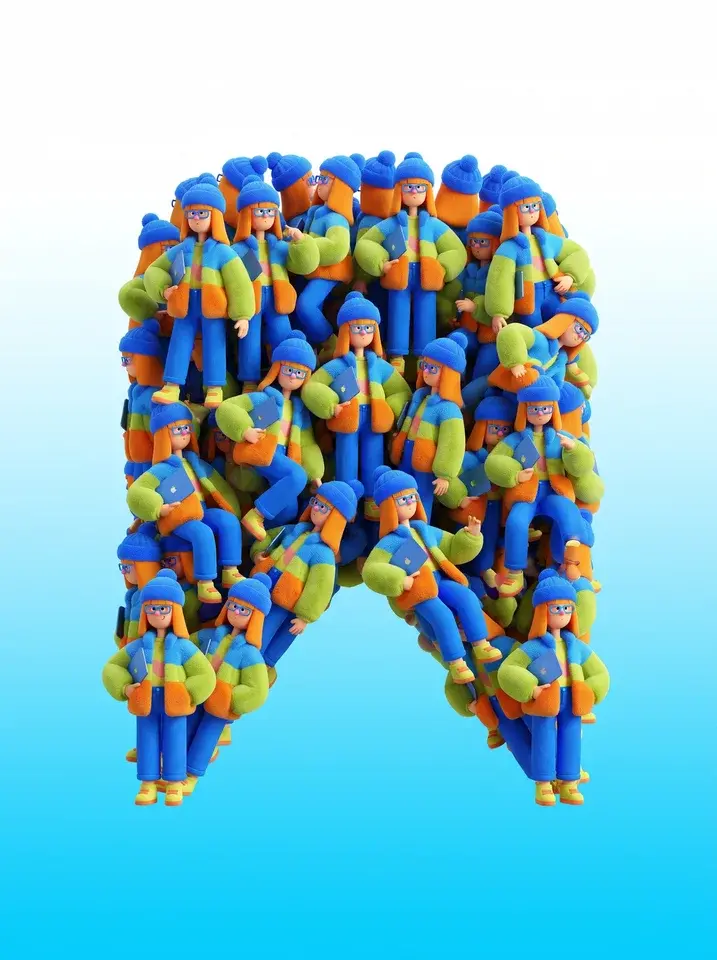
Nano Banana Pro
Copy
Create a premium photorealistic three-dimensional assemblage whose exact overall silhouette matches IMAGE 1, constructed exclusively from numerous separate, complete, faithfully reproduced copies of the subjects in IMAGE 2 and all subsequent references. IMAGE 1 defines only the precise geometry, proportions, curves, typography, spacing, stroke thickness, and internal openings. The shape emerges entirely from the physical arrangement of these objects, which form every solid region across its full width, height, and depth. The original graphic is completely absent as a physical surface, backing, shell, or filler. Every visible part of the sculpture consists exclusively of the referenced subjects. Preserve each subject's recognizable identity, anatomy, proportions, clothing, accessories, original colors, intricate textures, and material properties with maximum fidelity. For partially visible subjects, reconstruct complete coherent objects or full-body characters, naturally continuing their original outfit and styling. Every repeated instance remains a distinct, structurally intact object with correct geometry and anatomy, including complete limbs and footwear where applicable. Create a sophisticated arrangement of varied natural poses, rotations, and controlled proportional scales, allowing subjects to stand, sit, lean, recline, bend, or curl while preserving their anatomy, clothing, and individual recognizable features. Arrange them closely in multiple spatial layers with carefully controlled overlaps and convincing physical contact, maintaining separate bodies, correct limb connections, and realistic object boundaries. Achieve dense packing through intelligent positioning rather than deformation, fusion, or compression. Use smaller complete replicas where necessary for narrow contours, while keeping most subjects sufficiently large for clear individual readability. Preserve the exact outer silhouette and all internal openings of IMAGE 1, with genuine empty spaces revealing the background directly through the construction. Maintain consistent object density throughout the central regions and exterior edges, ensuring the entire shape is physically constructed from the referenced objects rather than merely outlined or decorated. Give the sculpture pronounced dimensional depth through sophisticated directional studio lighting and physically accurate inter-object shadow casting. Use a strong, broad directional key light positioned above and to one side, producing beautifully defined highlights on the foreground objects and distinct cast shadows falling naturally across the surfaces of neighboring objects positioned behind them. Every foreground element should cast spatially consistent shadows onto the underlying and recessed elements according to their
actual relative positions. Create rich contact shadows at points of physical interaction, deeper ambient occlusion inside tightly packed areas, and visible light-to-shadow transitions that reveal the layered arrangement. Maintain realistic shadow softness appropriate to the light source, with defined shadow edges near contact points and progressively softer shadows across more distant surfaces. Preserve readable textures, accurate colors, and recognizable details within the shadowed areas through controlled complementary fill illumination. Establish a clear hierarchy of illuminated foreground subjects, partially shadowed middle layers, and deeper recessed objects, creating dimensional separation without turning the interior into an indistinguishable dark mass. Allow the combined highlights, cast shadows, and subtle occlusion to emphasize the recognizable geometry of the overall silhouette. Preserve high-quality skin, fabric, hair, and material textures, natural roughness, fine details, sharp individual geometry, and realistic surface response. The result should resemble an expertly lit physical installation photographed in a professional studio, with exceptional material fidelity rather than a plastic or artificial appearance. Present the complete sculpture levitating freely in empty space, predominantly front-facing with subtle visible thickness, fully centered and surrounded by generous negative space. Place it against a perfectly smooth, seamless vertical digital gradient transitioning from pure white (#FFFFFF) at the top to the brightest dominant saturated color belonging to the main subject in IMAGE 2 at the bottom. Use a single uniform linear transition with clean, consistent color distribution, free of texture, uneven patches, atmospheric effects, halos, vignetting, and additional colors. Keep the background independent of the sculpture's lighting. All cast shadows occur exclusively between objects within the sculpture, never on the background or an imaginary floor. The sculpture floats without any visible support, pedestal, ground plane, horizon, or projected shadow. Exceptional high-end photorealistic CGI, exact silhouette reconstruction, separate anatomically correct objects, faithful reference materials, expressive natural posing, pronounced inter-object shadows, refined volumetric depth, and sophisticated contemporary art direction.

Референс 1

Референс 2
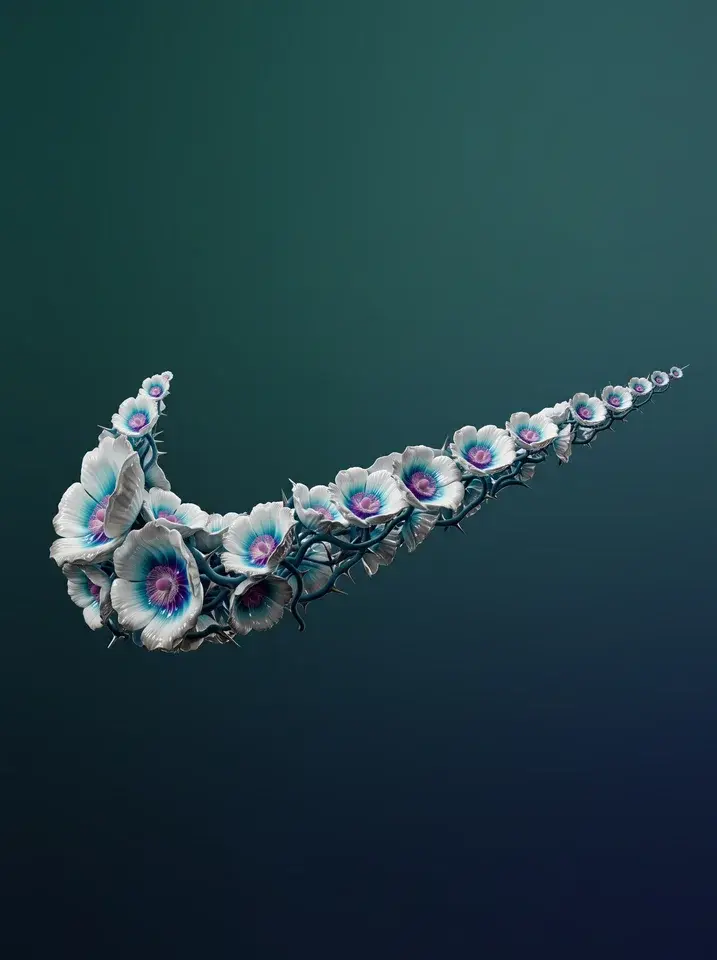
Nano Banana 2.1
Copy
Use image 1 exclusively as an exact, immutable silhouette blueprint. Reproduce its original outline, proportions, symmetry, orientation, curves, pointed ends, and negative spaces with maximum precision. Images 2 onward exclusively define the actual objects used to construct this silhouette. First identify each complete primary subject in these images and treat it as a single indivisible 3D asset. Replicate ONLY these exact subjects, preserving their recognizable identity, original design, proportions, anatomy, clothing, colors, distinctive details, and realistic textures. Accessories and clothing belonging to a subject remain attached in their original positions. Every repeated instance must represent the complete subject, with all essential parts intact and anatomically correct. Never extract secondary details, garments, printed motifs, or accessories as separate building elements. Introduce no additional object categories. Assemble numerous intact copies of the referenced subjects into the exact silhouette of image 1, arranging them like carefully fitted three-dimensional pieces. Use intelligent placement, varied rotations, uniform proportional scaling, and controlled depth layering to achieve extremely dense packing while preserving individual object integrity. Smaller complete copies fill narrower sections and contour transitions. Maintain sufficient visibility of each object's defining features, recognizable outline, natural proportions, and fine material details. Avoid crushing, stretching, melting, merging, cutting, or fragmenting individual subjects to fill gaps. The overall form must be entirely constructed from these individual objects throughout its visible depth, with no underlying solid base. Preserve a clean, sharply defined external silhouette and all original negative spaces. Present the assembled form as a substantial freestanding 3D sculpture levitating in empty space. Use a predominantly frontal camera angle aligned with the original silhouette, revealing dimensional thickness through natural overlaps, controlled depth differences, and subtle side visibility without distorting the shape. Render each individual object with exceptionally detailed photorealistic geometry, high-resolution textures, accurate material properties, natural surface microstructure, crisp features, and physically convincing contact shadows. Illuminate the entire construction with broad, balanced studio lighting and gentle directional contrast, ensuring excellent detail visibility across all subjects, including deeper layers. Place the sculpture against a perfectly clean, seamless, digitally smooth two-color linear gradient background. Select two sophisticated, harmonious colors inspired by the dominant palette of the referenced subjects, with sufficient tonal
contrast to separate the sculpture clearly from the background. Transition evenly and continuously between these two colors across the entire frame, maintaining consistent color distribution without localized illumination, radial hotspots, vignetting, cloudy patches, texture, grain, banding, or atmospheric effects. Keep all lighting effects confined to the sculpture itself. Premium photorealistic CGI, meticulous composition, faithful object replication, refined art direction, immaculate material detail, precise recognizable silhouette, elegant levitation, and generous negative space around the entire object.
Референс 1
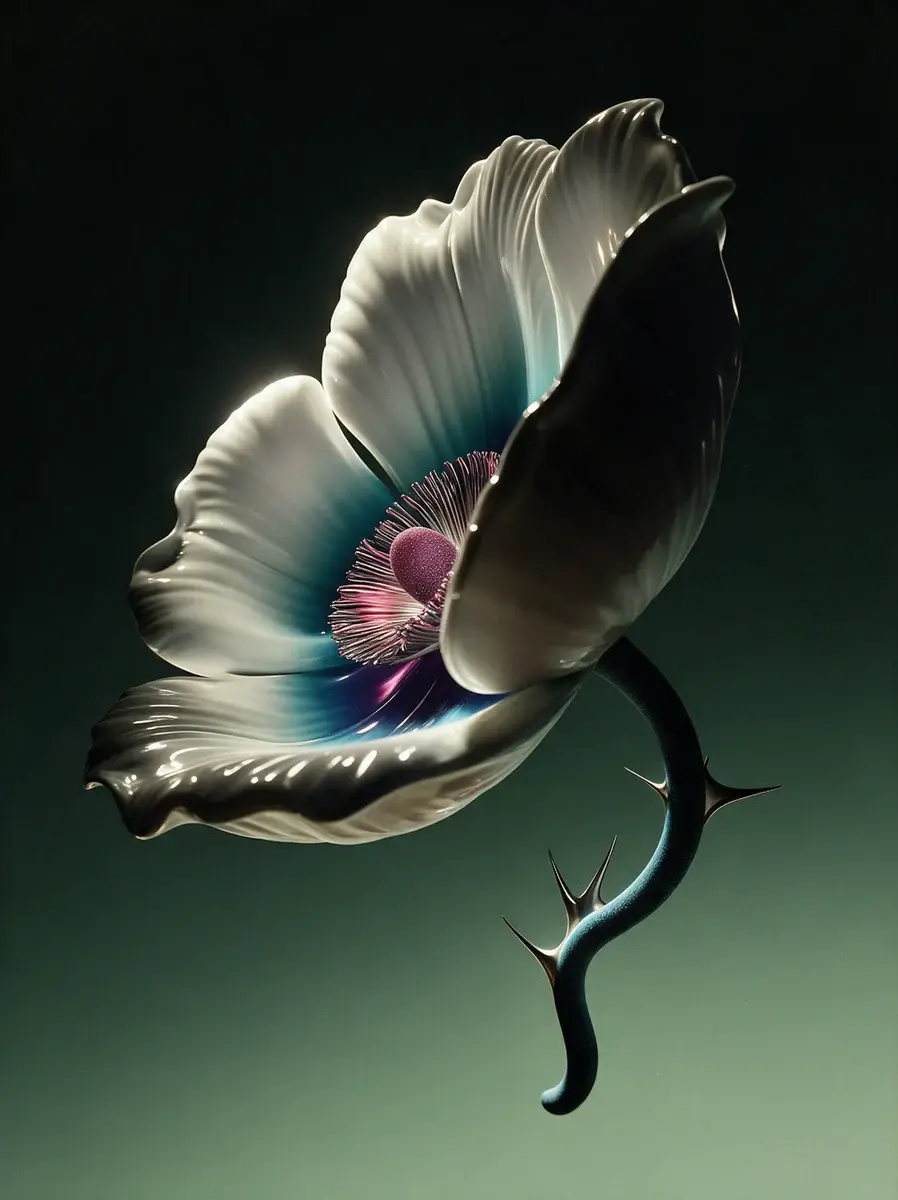
Референс 2
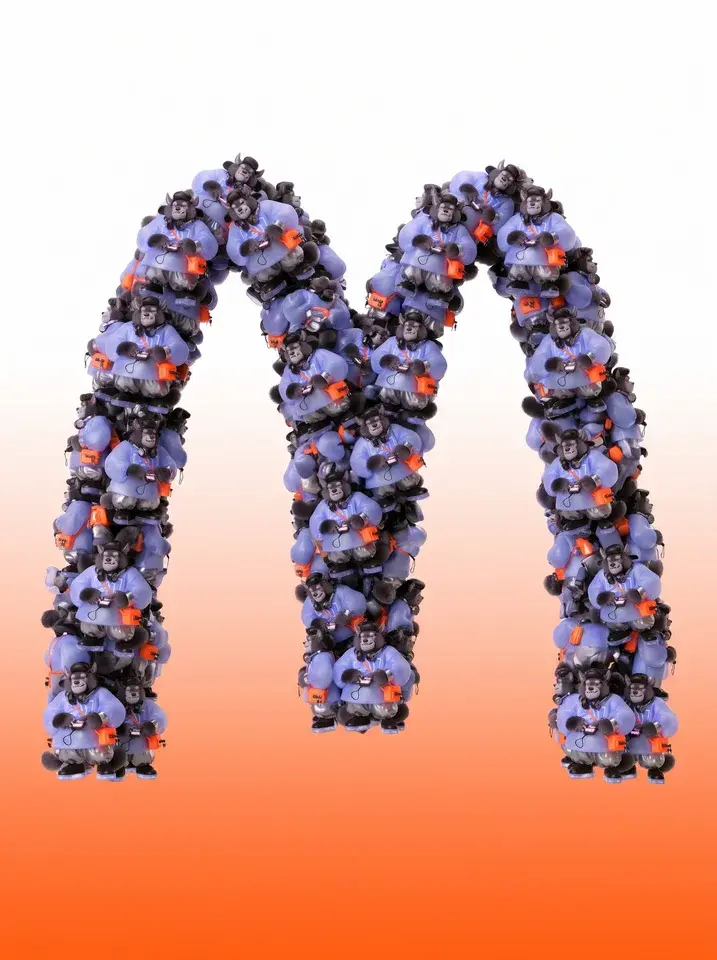
Nano Banana Pro
Copy
Create a high-end photorealistic 3D sculpture that exactly reproduces the complete shape of the first uploaded image, constructed entirely from tightly arranged copies of the subjects in the second and subsequent reference images. The first image is a geometry-only guide: preserve its precise silhouette, proportions, layout, letterforms, spacing, and all open negative spaces. Replace every solid visible area of that shape with a dense arrangement of the actual referenced subjects. Only the subjects from the additional reference images may appear as physical building elements. Preserve each subject's complete recognizable appearance, natural proportions, defining features, colors, clothing, accessories, and detailed surface textures. Reproduce each subject as an intact miniature three-dimensional replica, uniformly scaled and positioned at different natural orientations. Arrange these replicas in a compact, visually balanced, organic three-dimensional structure that fills the entire width and thickness of every part of the target shape, including its central areas and outer edges. Allow natural overlaps while keeping the individual subjects clearly identifiable and their essential parts intact. Vary scale within a controlled range, using smaller complete replicas for narrow sections and intricate details. The subjects themselves form every visible surface and boundary of the final sculpture. The original solid graphic is completely replaced by these objects, with its color and surface entirely absent. Preserve every internal opening as a genuine empty space through which the background is clearly visible. Maintain a precise, unmistakable outer silhouette and clean, accurately shaped negative spaces. Present the completed sculpture floating weightlessly in open space, viewed almost directly from the front with subtle visible dimensional thickness. Keep the full composition centered and surrounded by generous empty space. Render with crisp, faithful geometry, exceptional individual subject detail, realistic material textures, refined directional studio lighting, balanced fill illumination, and subtle contact shadows between neighboring objects. Use a perfectly smooth, clean, vertical digital gradient background transitioning uniformly from pure white (#FFFFFF) at the top to the brightest saturated color found on the main subject in the second reference at the bottom. Maintain the exact vivid hue of that color, with a continuous, even transition and no additional colors, lighting effects, textures, hotspots, vignetting, or uneven patches. The sculpture remains suspended in empty space without a floor, support, horizon, or projected shadow. Premium CGI, precise silhouette reconstruction, complete recognizable objects, carefully controlled density,
sophisticated material rendering, and immaculate contemporary art direction.
Референс 1
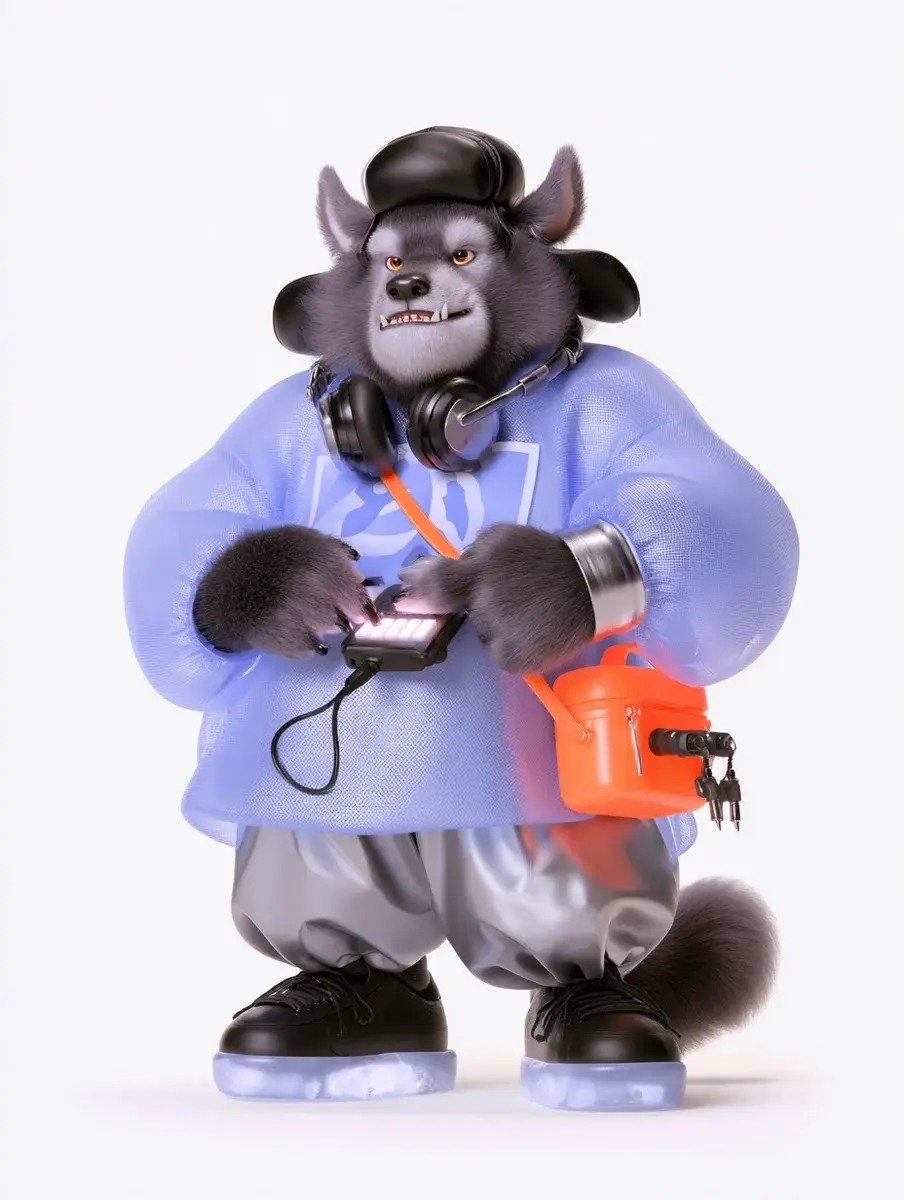
Референс 2
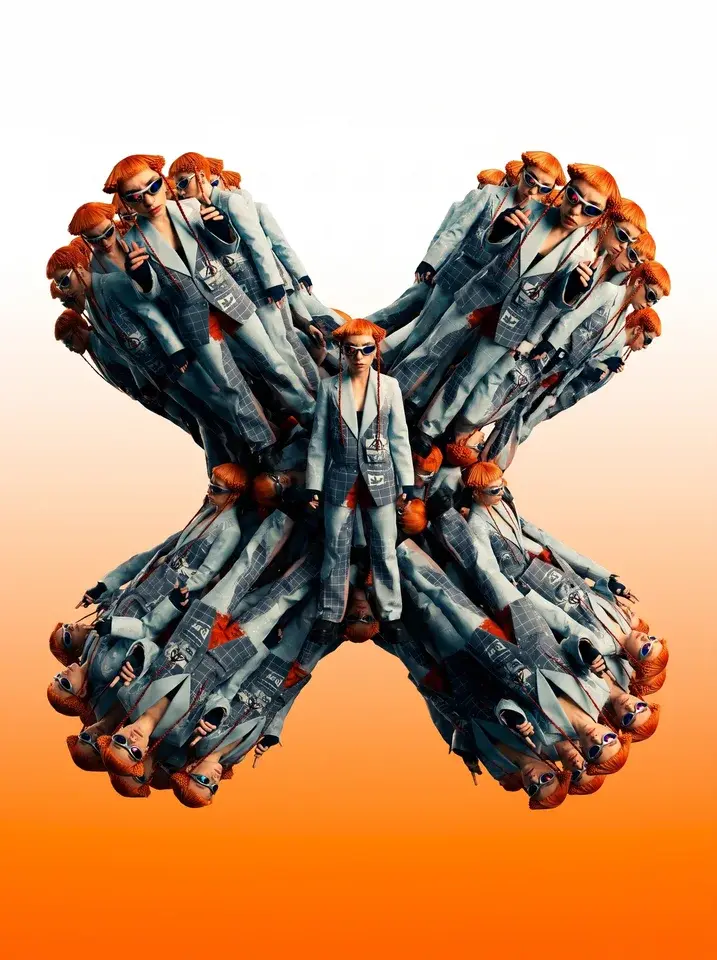
Nano Banana Pro
Copy
Create a premium photorealistic three-dimensional sculpture whose exact overall silhouette is taken from the first uploaded image and whose entire physical structure consists exclusively of complete replicas of the subjects shown in the second and subsequent reference images. Follow a strict two-stage construction process. First, reconstruct each referenced subject as one complete, anatomically and structurally coherent three-dimensional asset before assembling the final composition. When a reference shows only a portrait, face, head, bust, or cropped upper body, extrapolate the unseen anatomy to create a complete head-to-toe person with a naturally proportioned torso, shoulders, arms, hands, waist, hips, legs, and feet. Continue the visible clothing into a coherent complete outfit, including appropriate trousers, lower garments, and footwear matching the original styling, colors, and materials. Preserve the exact recognizable facial features, hairstyle, accessories, visible garments, and distinctive appearance of the reference. For animals and nonhuman subjects, reconstruct the complete recognizable object with its natural full structure and defining features. The resulting complete subject becomes the single indivisible building unit used throughout the sculpture. Every repeated instance must display a coherent full physical body or complete object, with a recognizable head-to-body relationship, intact proportions, and clearly articulated structural features. Only after establishing these complete assets, recreate the first image as a dense assembly of numerous replicas. Treat the first reference purely as the geometric definition of the final silhouette, including its exact outer contours, proportions, orientation, typography, internal openings, and negative spaces. Replace every solid region of that silhouette with tightly arranged complete referenced subjects, filling the entire visible area and three-dimensional thickness through carefully organized physical placement. The original graphic material disappears entirely. Arrange the replicas in an intricate, compact, three-dimensional composition using proportional scaling, varied rotations, naturally interlocking orientations, and controlled overlapping. Maintain a consistent relationship between subject size and silhouette thickness so each repeated figure remains clearly recognizable as a complete individual rather than an isolated face or unidentifiable fragment. Place subjects at varying depths while ensuring visible torso and lower-body structure across the composition. Preserve natural anatomical proportions, individual object boundaries, distinctive textures, and essential features. Smaller complete figures may occupy narrow details, while moderately sized complete figures form the
primary sculptural structure. The assembled objects themselves create the entire outer contour and all visible surfaces of the target shape, with accurately preserved internal openings remaining completely empty and revealing the background through the sculpture. The final image must read simultaneously as the precise original shape and as a dense construction of fully formed individual subjects. Present the complete sculpture levitating weightlessly in empty space, predominantly front-facing with subtle three-dimensional thickness, elegant framing, and generous negative space. Render every subject with exceptional photorealistic geometry, faithful facial detail, realistic anatomy, intricate fabric and material textures, beautiful surface definition, crisp edges, and physically accurate studio lighting. Use a broad directional key light and balanced fill illumination to reveal both the complete bodies and the dimensional depth of the assembly, with subtle contact shadows between individual subjects. Place the sculpture against a perfectly clean, seamless vertical digital gradient transitioning uniformly from pure white (#FFFFFF) at the top to the brightest vivid saturated color found on the main subject in the second uploaded reference at the bottom. Preserve the selected hue's brightness and saturation through a perfectly even, continuous linear color transition. The background remains a pristine, uninterrupted digital color field with no additional colors, darkening, radial lighting, atmospheric effects, texture, grain, vignetting, halos, floor, horizon, or projected shadows. The sculpture floats freely without a pedestal, support, or grounding surface. Exceptional high-end CGI, precise silhouette construction, faithful reference reproduction, complete full-body subject replication, natural anatomy, sophisticated dimensional arrangement, immaculate material quality, clean seamless gradient, and refined contemporary art direction.
Референс 1
Референс 2
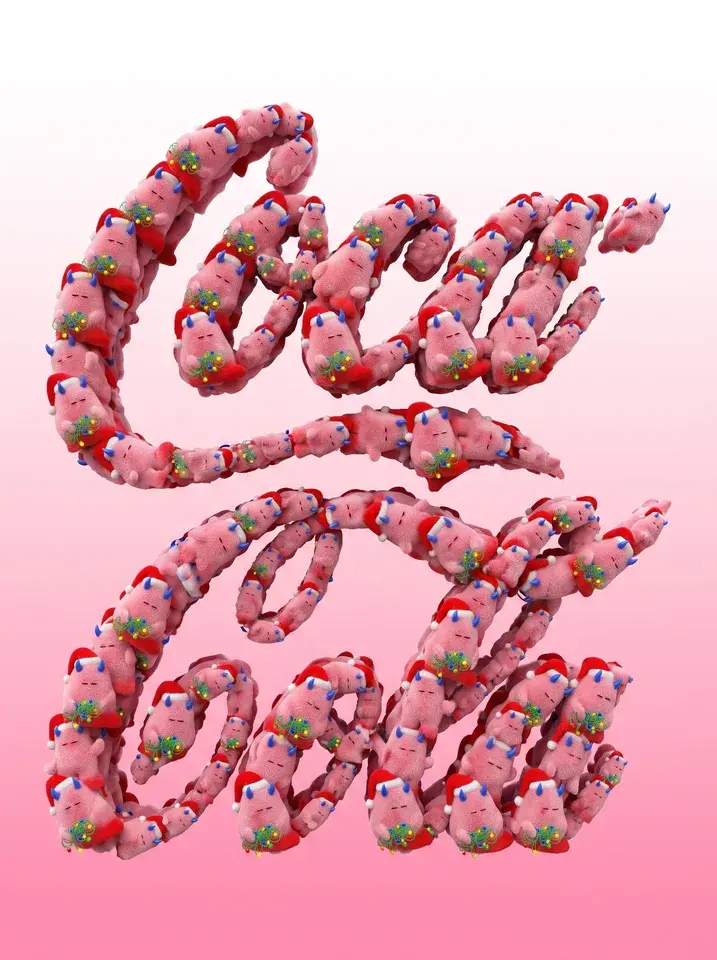
Nano Banana Pro
Copy
Create a premium high-end photorealistic 3D assemblage sculpture in which the exact shape from IMAGE 1 is built entirely and exclusively from repeated copies of the subject in IMAGE 2 and any additional object reference images. IMAGE 1 defines only the target geometry: its exact silhouette, proportions, curves, typography, spacing, stroke thickness, and all internal openings. IMAGE 1 must never appear as a visible surface, outline, shell, ghost, translucent guide, base, backing, filler, underlayer, or smooth solid form. The final image must contain no visible trace of the original flat graphic. The shape exists only because the repeated objects collectively form it. If all repeated objects were removed, nothing of the shape would remain. Use IMAGE 2 as a strict fidelity reference for the subject that fills the shape. Preserve the subject’s recognizable identity, full design, proportions, colors, clothing, materials, textures, and distinctive details with maximum accuracy. If the subject is partially visible, reconstruct it into a complete coherent full object or full-body figure while preserving the same styling, outfit, materials, and visual identity. Every repeated unit must remain a complete, intact, high-quality version of that subject. Do not simplify, blur, stylize, plasticize, melt, fragment, crop, stretch, or distort the subject. Do not reduce the subject to an abstract blob or a low-detail miniature. Maintain crisp recognizable features, high texture fidelity, realistic material definition, and clear object readability. Construct the entire filled shape of IMAGE 1 from these repeated objects alone. Every solid region of the target shape must be densely built from the objects themselves across the full width, full height, and visible thickness of the form. The center of the shape must be just as physically constructed as the edges. Do not place objects merely around the contour. Do not place the objects on top of a flat logo. Do not embed a smooth logo beneath the objects. Do not leave a visible solid surface between objects. The objects themselves must create the whole structure, including all visible front surfaces, side edges, and dimensional depth. Preserve all genuine internal negative spaces, holes, counters, and gaps from IMAGE 1 as fully open empty spaces with the background visible directly through them. Keep the outer contour extremely accurate and immediately recognizable. Use a predominantly frontal camera angle with subtle three-dimensional thickness so the original shape remains clear and legible. Arrange the objects intelligently and densely, using mostly medium-sized high-fidelity copies and smaller complete copies only where necessary for narrow details and thin strokes. Keep the number of tiny objects limited so individual
subjects remain readable and detailed. Allow natural overlaps, varied orientations, and pose variation where appropriate, but keep every subject intact, recognizable, and well separated from neighboring objects. Preserve visual clarity over extreme packing. Render the objects with exceptional quality and crisp detail. Use realistic materials, sharp geometry, clear textures, refined lighting, and high subject fidelity. Avoid plastic toy-like rendering, muddy detail, blur, mushy edges, or low-resolution appearance. The sculpture should feel premium, elegant, dimensional, and art-directed, while the repeated subject remains beautifully readable. Place the sculpture against a perfectly clean seamless digital gradient background. The gradient must use only two colors: pure white (#FFFFFF) as one endpoint and one single dominant bright accent color from the main subject in IMAGE 2 as the second endpoint. Choose the accent color from the largest or most visually dominant bright area of the main subject, not from tiny decorative details, reflections, or small accessories. Create a smooth, even, mathematically clean gradient transition with no extra colors, no muddy mixing, no texture, no grain, no haze, no glowing spots, no dirty patches, no color contamination, no atmospheric effects, no vignette, and no environmental scenery. Keep the gradient simple, clean, modern, and visually polished. The background must remain independent from the sculpture lighting. No floor, no pedestal, no support, no horizon, and no cast shadow. The final image must read immediately as the exact shape from IMAGE 1 and, on closer inspection, as a dense sculptural construction made entirely from sharp, recognizable, high-quality copies of the subject from IMAGE 2. No visible base shape, no translucent logo, no smooth filler, no low-detail object repetition, and no dirty gradient.
Референс 1
Референс 2
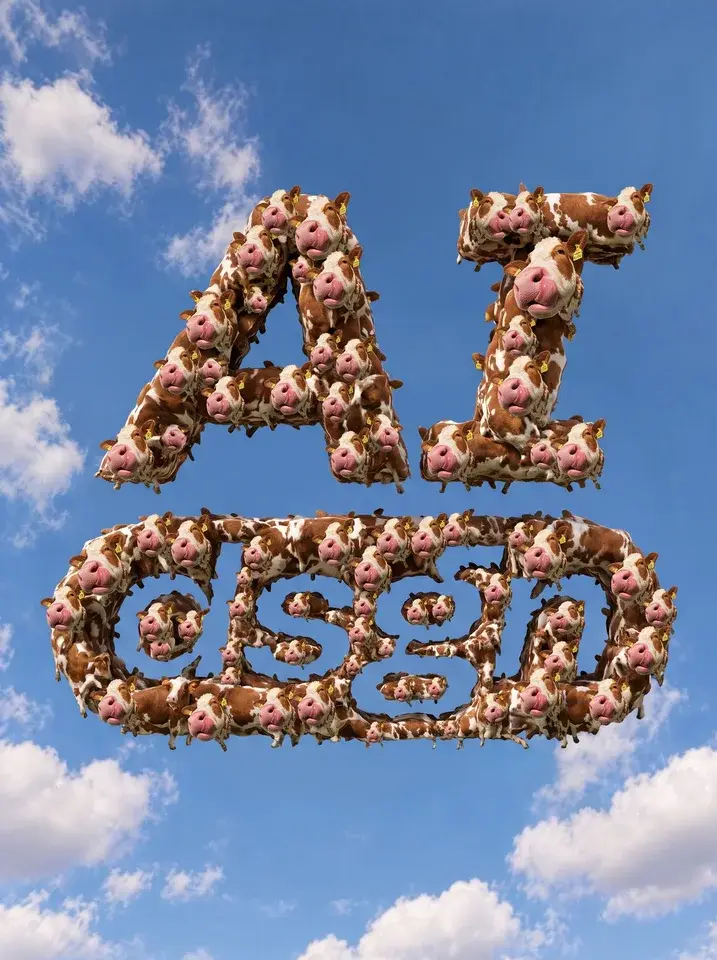
Nano Banana Pro
Copy
Use image 1 exclusively as an exact, immutable silhouette blueprint. Reproduce its original outline, proportions, symmetry, orientation, curves, pointed ends, and negative spaces with maximum precision. Images 2 onward exclusively define the actual objects used to construct this silhouette. First identify each complete primary subject in these images and treat it as a single indivisible 3D asset. Replicate ONLY these exact subjects, preserving their recognizable identity, original design, proportions, anatomy, clothing, colors, distinctive details, and realistic textures. Accessories and clothing belonging to a subject remain attached in their original positions. Every repeated instance must represent the complete subject, with all essential parts intact and anatomically correct. Never extract secondary details, garments, printed motifs, or accessories as separate building elements. Introduce no additional object categories. Assemble numerous intact copies of the referenced subjects into the exact silhouette of image 1, arranging them like carefully fitted three-dimensional pieces. Use intelligent placement, varied rotations, uniform proportional scaling, and controlled depth layering to achieve extremely dense packing while preserving individual object integrity. Smaller complete copies fill narrower sections and contour transitions. Maintain sufficient visibility of each object's defining features, recognizable outline, natural proportions, and fine material details. Avoid crushing, stretching, melting, merging, cutting, or fragmenting individual subjects to fill gaps. The overall form must be entirely constructed from these individual objects throughout its visible depth, with no underlying solid base. Preserve a clean, sharply defined external silhouette and all original negative spaces. Present the assembled form as a substantial freestanding 3D sculpture levitating in empty space. Use a predominantly frontal camera angle aligned with the original silhouette, revealing dimensional thickness through natural overlaps, controlled depth differences, and subtle side visibility without distorting the shape. Render each individual object with exceptionally detailed photorealistic geometry, high-resolution textures, accurate material properties, natural surface microstructure, crisp features, and physically convincing contact shadows. Illuminate the entire construction with broad, balanced studio lighting and gentle directional contrast, ensuring excellent detail visibility across all subjects, including deeper layers. Place the sculpture against a perfectly clean, seamless, digitally smooth two-color linear gradient background. Select two sophisticated, harmonious colors inspired by the dominant palette of the referenced subjects, with sufficient tonal
contrast to separate the sculpture clearly from the background. Transition evenly and continuously between these two colors across the entire frame, maintaining consistent color distribution without localized illumination, radial hotspots, vignetting, cloudy patches, texture, grain, banding, or atmospheric effects. Keep all lighting effects confined to the sculpture itself. Premium photorealistic CGI, meticulous composition, faithful object replication, refined art direction, immaculate material detail, precise recognizable silhouette, elegant levitation, and generous negative space around the entire object. Возьми фон со второй фотки яркое небо с облаками
Референс 1
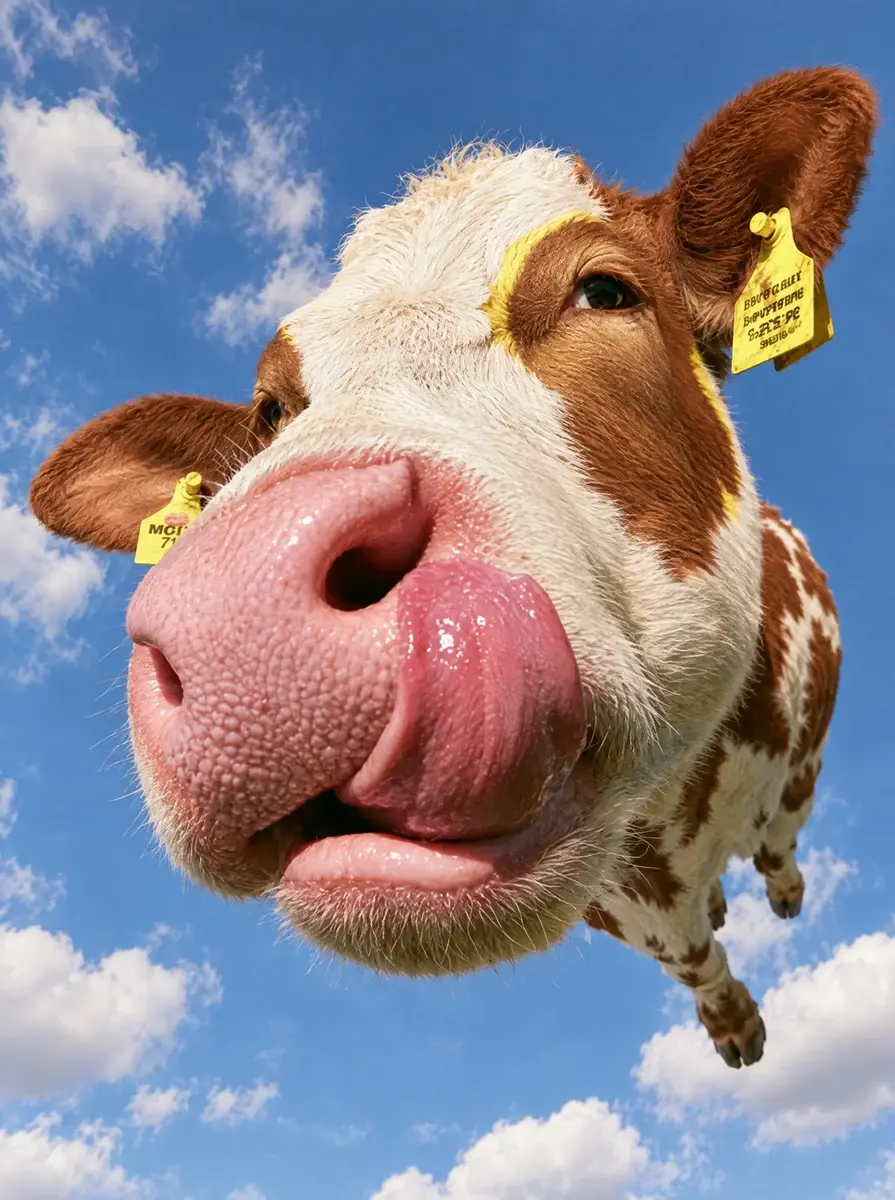
Референс 2

Nano Banana Pro
Copy
Use image 1 exclusively as an exact, immutable silhouette blueprint. Reproduce its original outline, proportions, symmetry, orientation, curves, pointed ends, and negative spaces with maximum precision. Images 2 onward exclusively define the actual objects used to construct this silhouette. First identify each complete primary subject in these images and treat it as a single indivisible 3D asset. Replicate ONLY these exact subjects, preserving their recognizable identity, original design, proportions, anatomy, clothing, colors, distinctive details, and realistic textures. Accessories and clothing belonging to a subject remain attached in their original positions. Every repeated instance must represent the complete subject, with all essential parts intact and anatomically correct. Never extract secondary details, garments, printed motifs, or accessories as separate building elements. Introduce no additional object categories. Assemble numerous intact copies of the referenced subjects into the exact silhouette of image 1, arranging them like carefully fitted three-dimensional pieces. Use intelligent placement, varied rotations, uniform proportional scaling, and controlled depth layering to achieve extremely dense packing while preserving individual object integrity. Smaller complete copies fill narrower sections and contour transitions. Maintain sufficient visibility of each object's defining features, recognizable outline, natural proportions, and fine material details. Avoid crushing, stretching, melting, merging, cutting, or fragmenting individual subjects to fill gaps. The overall form must be entirely constructed from these individual objects throughout its visible depth, with no underlying solid base. Preserve a clean, sharply defined external silhouette and all original negative spaces. Present the assembled form as a substantial freestanding 3D sculpture levitating in empty space. Use a predominantly frontal camera angle aligned with the original silhouette, revealing dimensional thickness through natural overlaps, controlled depth differences, and subtle side visibility without distorting the shape. Render each individual object with exceptionally detailed photorealistic geometry, high-resolution textures, accurate material properties, natural surface microstructure, crisp features, and physically convincing contact shadows. Illuminate the entire construction with broad, balanced studio lighting and gentle directional contrast, ensuring excellent detail visibility across all subjects, including deeper layers. Place the sculpture against a perfectly clean, seamless, digitally smooth two-color linear gradient background. Select two sophisticated, harmonious colors inspired by the dominant palette of the referenced subjects, with sufficient tonal
contrast to separate the sculpture clearly from the background. Transition evenly and continuously between these two colors across the entire frame, maintaining consistent color distribution without localized illumination, radial hotspots, vignetting, cloudy patches, texture, grain, banding, or atmospheric effects. Keep all lighting effects confined to the sculpture itself. Premium photorealistic CGI, meticulous composition, faithful object replication, refined art direction, immaculate material detail, precise recognizable silhouette, elegant levitation, and generous negative space around the entire object.
Референс 1
Референс 2
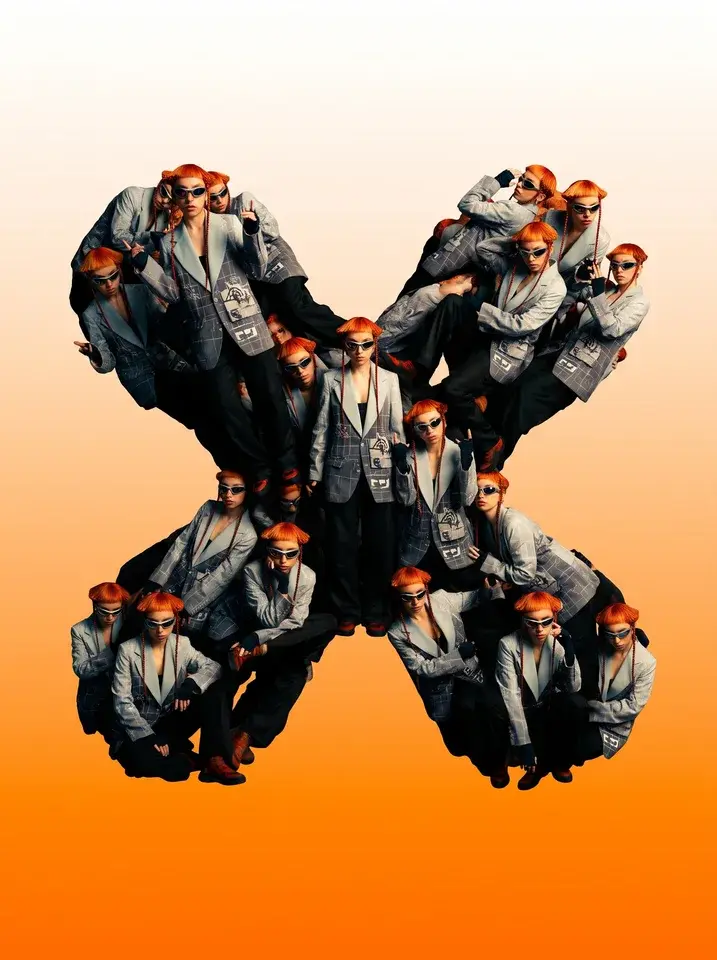
Nano Banana Pro
Copy
Create a visually striking, exceptionally detailed three-dimensional assemblage that precisely reproduces the complete silhouette of the first uploaded image, constructed entirely from the subjects shown in the second and all subsequent reference images. The first image defines the exact overall geometry, proportions, orientation, contours, typography, spacing, and internal openings. Every solid region of this shape must physically consist of the referenced subjects themselves, densely arranged throughout its full width, height, and visible depth. The original graphic material is entirely replaced by these subjects, leaving no solid lettering, backing, separate surface, or underlying structure. The sculpture exists exclusively through the collective arrangement of its individual subjects. Preserve the recognizable silhouette of the first reference with exceptional accuracy, including its most intricate contours and every genuine negative space. Treat the second and subsequent references as strict visual identity and material references. Faithfully reproduce the exact appearance of each primary subject, preserving facial identity, hairstyle, body characteristics, clothing design, garment construction, colors, accessories, proportions, and distinctive details. Maintain the original photographic realism and visual character of the references. If a person is shown only partially, naturally reconstruct the missing body into a complete anatomically coherent figure with appropriate lower clothing and footwear matching the visible outfit. The resulting complete character must remain visually consistent throughout every repetition. Reproduce authentic human skin with natural pores, fine wrinkles, subtle tonal variation, realistic subsurface scattering, and genuine facial detail. Preserve individual hair strands, realistic fabric weave, stitching, seams, folds, natural garment tension, authentic material roughness, and precise accessory geometry. Maintain lifelike human proportions, genuine photographic textures, and naturally imperfect physical surfaces. Build the entire shape from numerous complete, recognizable instances of these same subjects, each adopting a different natural, anatomically convincing pose. Create rich pose diversity through standing, sitting, crouching, reclining, leaning, curling, stretching, bending, and dynamic body positioning appropriate to the subject. Vary arm positions, leg positions, torso rotation, head direction, and overall body orientation while preserving the original identity, outfit, and recognizable appearance. Use these natural pose variations to fit subjects intelligently into different sections of the silhouette, allowing bent and extended body positions to follow curves, narrow strokes, corners, and internal details.
Arrange the subjects densely in a carefully balanced sculptural composition with controlled overlaps and realistic contact between neighboring figures. Create compact visual density through thoughtful posing and spatial organization rather than physical deformation, stretching, or merging. Preserve complete anatomy, recognizable individual bodies, natural joints, intact limbs, and clear separation between neighboring subjects. Maintain a harmonious hierarchy of predominantly similar-sized figures with subtle proportional scale variations where necessary. Every subject remains a real, lifelike individual rather than a miniature plastic figurine, stylized doll, rubber sculpture, or artificial toy. The outer boundary of the assembled subjects must accurately reproduce the exact silhouette of the first reference. Every solid region, including central areas, edges, and the full sculptural thickness, must be densely constructed from the referenced subjects. Preserve all internal openings and negative spaces as genuine unobstructed gaps extending through the composition, revealing the background directly behind them. The sculpture should be immediately recognizable as the original shape from a distance, while revealing numerous distinct, highly detailed individuals in expressive natural poses when viewed closely. Suspend the entire assembled sculpture weightlessly in empty space, with convincing volumetric depth and subtle visible thickness. Use a predominantly frontal camera perspective to maintain precise silhouette recognition, allowing natural three-dimensional layering within the composition. Keep the entire sculpture fully visible and elegantly centered with generous breathing room around it. Illuminate the subjects using sophisticated professional photographic studio lighting, with a controlled directional key light, balanced fill illumination, natural dimensional highlights, and refined contact shadows between neighboring figures. Preserve the photographic realism, authentic skin texture, fabric detail, accurate color, and material definition of every subject across the entire composition. Place the levitating sculpture against a perfectly clean, seamless digital linear gradient background transitioning vertically from pure white (#FFFFFF) at the top to the brightest vivid saturated color found on the primary subject in the second reference at the bottom. The gradient must be a mathematically smooth, uniform two-color transition, maintaining pure luminous white and a clean vivid saturated endpoint with no additional colors, atmospheric effects, darkening, light spots, texture, grain, halos, vignetting, or irregular patches. The background remains completely independent of the sculpture's lighting. The sculpture floats freely without a floor,
pedestal, support, horizon, or projected shadow. Premium photorealistic art direction, exceptional reference fidelity, authentic human appearance, natural anatomy, expressive pose diversity, intricate material textures, clean sculptural construction, precise silhouette preservation, refined dimensional lighting, and extraordinary visual clarity.
Референс 1
Референс 2